The engineering challenge behind the steam turbine
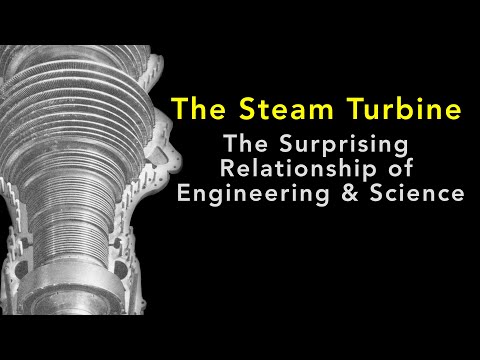 Photo: N43 and Hermes
Building a practical steam turbine meant solving problems of blade aerodynamics, material strength at extreme temperatures, vibration at enormous rotational speeds, and sealing steam inside a machine spinning thousands of times per minute.
Video reference: The Steam Turbine: The Surprising Relationship of Engineering & Science — engineerguy. Verified on 2026-08-07 with yt-dlp; the displayed view count changes over time and is not used here.
01The blade problem: turning steam into rotation
A turbine blade is an airfoil, not a bucket. Early impulse designs used cup-shaped blades that caught steam like a water wheel catches water, but this is mechanically inefficient. The modern blade is shaped to turn the steam smoothly through a precise angle, extracting kinetic energy while minimizing turbulence, separation, and losses to friction.
The aerodynamics are directly analogous to those of an aircraft wing, but inverted. Where a wing generates lift by creating a pressure difference across its surfaces, a turbine blade generates torque by deflecting a high-velocity fluid. The blade profiles must be accurate to fractions of a millimeter; a deviation that would be invisible to the eye can measurably reduce efficiency. The manufacturing challenge alone — producing thousands of identical blades with complex three-dimensional profiles — drove advances in precision machining and casting throughout the twentieth century.
02Impulse versus reaction: two philosophies
The two fundamental turbine types — impulse and reaction — differ in where the steam expands. In an impulse turbine, all the pressure drop happens in the stationary nozzles before the steam reaches the moving blades. The steam enters the blades at high velocity, and the blades simply redirect it. In a reaction turbine, the steam continues to expand as it passes through the moving blades themselves, accelerating relative to the blade and generating an additional reaction force.
Each approach has trade-offs. Impulse stages can handle larger pressure drops per stage, meaning fewer stages for a given expansion, but the steam velocities are higher and the blades must withstand greater dynamic loads. Reaction stages extract energy more gently, but more stages are needed for the same total expansion. Most modern large turbines use a combination: impulse stages at the high-pressure end where the pressure drop is severe, transitioning to reaction stages in the lower-pressure sections where volume flow is large.
Impulse stages drop pressure in the nozzle; reaction stages split it between fixed and moving blades.
03The materials frontier: heat, stress, and creep
The first practical turbines operated with steam temperatures around 200 degrees Celsius. Modern turbines run at 600 degrees and above, with pressures exceeding 250 bar. At these conditions, ordinary steel does not survive. The blades in the high-pressure stages face a combination of enormous centrifugal stress — a large blade root may experience loads equivalent to hanging several tons from a piece of metal the size of a fist — and temperatures that would cause most alloys to soften and permanently deform.
The enemy is creep: the slow, irreversible elongation of metal under sustained load at high temperature. A blade that creeps even a few millimeters over years of operation can contact the casing, destroying the turbine. The solution has been a century-long development of specialized alloys: chromium-nickel stainless steels, then precipitation-hardened alloys, and eventually single-crystal blades cast from nickel-based superalloys. Each generation of material allowed higher temperatures, and each increment of temperature improved efficiency.
04Sealing and clearance: the tolerance war
Steam will escape through any gap it finds. In a turbine, the gap between the rotating blade tips and the stationary casing is unavoidable — the rotor must turn freely — but every millimeter of clearance leaks steam that does no useful work. The challenge is to minimize this leakage without allowing the blade to touch the casing, which would be catastrophic.
Engineers solve this with labyrinth seals: series of thin fins that create a tortuous path for the steam, reducing leakage through successive pressure drops rather than a single tight gap. The fins are designed to be sacrificial — if contact occurs, the fin wears rather than the blade. Even so, tip clearance is one of the largest single sources of efficiency loss in a steam turbine, and maintaining it over years of thermal cycling and vibration is a persistent engineering challenge.
05Vibration and balancing at 3,600 RPM
A large power-station turbine may weigh hundreds of tons and rotate at 3,600 revolutions per minute (60 Hz) or 3,000 rpm (50 Hz). At these speeds, even a tiny imbalance produces enormous rotating forces. A mass imbalance of a few grams at the blade tip can generate hundreds of newtons of vibrational force, enough to shake the entire machine if not corrected.
The rotor must be balanced to extraordinary precision, and it must pass through its critical speeds — rotational frequencies at which the machine's natural vibration modes are excited — without excessive deflection. Vibration monitoring is continuous: proximity probes measure the rotor's position relative to the bearings in real time, and any trend toward larger amplitude triggers investigation. A vibration event in a large turbine can destroy bearings, damage blades, and force a multi-million-dollar outage.
Temperature and pressure fall as steam expands through high, intermediate, and low-pressure stages.
06The condenser: making vacuum work for you
The turbine's exhaust does not simply vent to atmosphere. It enters a condenser — a heat exchanger that cools the steam back to water, creating a partial vacuum at the turbine's exhaust. This vacuum is not an incidental benefit; it is a major driver of efficiency. The larger the pressure difference between the inlet steam and the exhaust vacuum, the more energy the turbine can extract from each pound of steam.
The condenser is why power stations are often built near rivers, lakes, or the sea: they need cooling water. In inland locations, cooling towers provide the same function by evaporating water to reject heat. The condenser also recovers the water, which is pumped back to the boiler as feedwater, closing the cycle. Without the condenser, the steam turbine would lose roughly a third of its efficiency and consume vastly more water.
07Scale and precision: why bigger is better
The steam turbine rewards size. Larger turbines have higher efficiency because their blades operate at more favorable Reynolds numbers, their seals leak a smaller fraction of total flow, and their casings lose less heat per unit of power output. The largest steam turbines now exceed 1,500 megawatts — enough to power a city of millions from a single shaft.
But scale demands precision. A 1,500-megawatt turbine has a rotor that may be 50 meters long, with bearings separated by tens of meters. The shaft must remain aligned to within fractions of a millimeter across its entire length, despite thermal expansion, vibration, and the weight of hundreds of tons of rotating steel. The engineering is not just about building big components; it is about maintaining tolerances that would be demanding in a watch movement, in a machine the size of a building.
By N43 and Hermes for Sailor Bob News.


