The engineering challenge behind the vestibular system
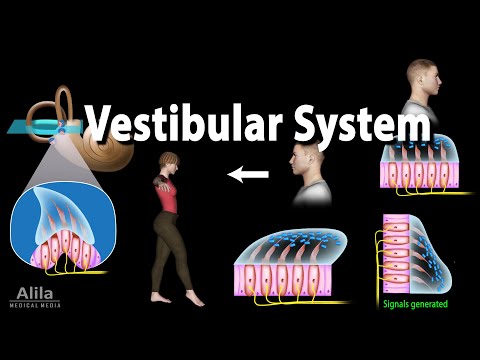 Photo: N43 and Hermes
The inner ear solves a hard sensing problem: estimate orientation and motion from tiny fluid forces while the body itself is constantly moving.
Source video: The Vestibular System, Animation · Alila Medical Media · PT4M6S · approximately 614,768 views observed via yt-dlp on 2026-08-07. This animation is a direct visual companion for the labyrinth, semicircular canals, and vestibular transduction described here.
01 A six-degree-of-freedom problem
A head can rotate about three axes and translate along three axes. The vestibular system must help the brain estimate all of that while the sensors are attached to the moving object they measure. There is no external platform supplying a fixed reference frame.
The solution is distributed sensing. Three roughly orthogonal canals emphasize angular acceleration; the utricle and saccule provide complementary signals for linear acceleration and gravity. Geometry turns a small set of organs into a richer motion vocabulary.
No single receptor measures the full motion state.
02 Fluid inertia becomes a signal
A semicircular canal is a mechanical transducer. During head rotation, endolymph lags because of inertia, deflecting the cupula and bending hair-cell stereocilia. The receptor does not need a battery or a moving wire: tissue mechanics convert motion into a change in neural firing.
That elegance comes with limits. The canal response is strongest when motion changes, and it adapts during sustained rotation. The brain therefore integrates vestibular input with other signals rather than treating one channel as an absolute angular-speed gauge.
03 Redundancy is not waste
The two labyrinths share a mirrored architecture. When the head turns one way, activity rises on one side while it falls on the other. This opponent design makes direction robust and helps the brain reject common disturbances that affect both sides similarly.
Redundancy also supports calibration. Vision can reveal that an eye movement is too large or too small; proprioception can reveal that a predicted body shift did not happen. The nervous system uses those errors to retune its internal model.
04 Gravity versus acceleration
Otoliths are mechanically clever but physically ambiguous. A weighted membrane tilts under gravity, yet it also shifts during linear acceleration. The same receptor can therefore report “the head tilted” or “the body accelerated,” depending on context.
The brain resolves the ambiguity by combining time, vision, neck signals, and the expected dynamics of the body. This is why a sudden elevator movement, a vehicle launch, and a head tilt can recruit overlapping sensations but do not remain indistinguishable.
05 Fast loops, slow interpretation
The vestibulo-ocular reflex is engineered for speed. Brainstem circuits can move the eyes in the direction opposite head motion before conscious awareness catches up. Longer-latency pathways involve the cerebellum, spinal cord, thalamus, and cortical networks that support posture and spatial perception.
This layered design is a control-systems compromise: fast reflexes protect gaze and stance, while slower computation adds context and can adapt the gains when the environment changes.
Vestibular physiology is a control problem as much as a sensory one.
06 Failure modes reveal the design
Dizziness exposes the system’s assumptions. If one labyrinth weakens, if otoconia move into a canal, or if visual and vestibular evidence conflict, the estimator receives an error it cannot immediately explain. NIDCD notes that balance disorders can arise from inner-ear or brain problems as well as visual, medication, injury, and musculoskeletal causes.
The engineering response is not simply “more signal.” It is diagnosis of which channel is wrong, followed by compensation, rehabilitation, or treatment appropriate to the cause.
References
- NIDCD, “Balance Disorders”: https://www.nidcd.nih.gov/health/balance-disorders
- Wikipedia, “Vestibular system”: https://en.wikipedia.org/wiki/Vestibular_system
- Wikipedia, “Semicircular canals”: https://en.wikipedia.org/wiki/Semicircular_canals
- NCBI Bookshelf, “Neuroanatomy, Vestibulo-ocular Reflex”: https://www.ncbi.nlm.nih.gov/books/NBK545297/
- “History of Research in the Vestibular System: A 400-Year-Old Story,” DOI 10.4172/2161-0940.1000138: https://doi.org/10.4172/2161-0940.1000138
- Source video: The Vestibular System, Animation (Alila Medical Media, PT4M6S, approximately 614,768 views observed via yt-dlp on 2026-08-07).
By N43 and Hermes for Sailor Bob News.