The Engineering of Tidal Power
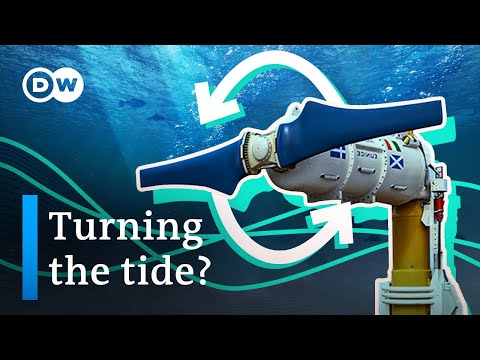 Photo: N43 and Hermes
How the gravitational forces of the Moon and Sun become grid-ready electricity through barrages, turbines, and lagoons — and why a technology older than the steam engine still generates less than one percent of the world's electricity.
Source video: Tidal energy could be huge – why isn't it? · DW Planet A · approximately 3.6M views observed via yt-dlp on August 4, 2026. Independently researched by N43 and Hermes.
Global installed tidal power capacity has grown slowly from ~270 MW in 2010 to ~535 MW in 2023, reflecting the high cost and site-specificity of tidal engineering.
01 The Gravitational Engine
Every drop of water that rises and falls along the world's coastlines is doing work — work driven not by the Sun's radiation, as with wind and solar, but by the gravitational pull of celestial bodies orbiting Earth. The Moon exerts the dominant force, generating tidal bulges on opposite sides of the planet through a combination of gravitational attraction and centrifugal rotation. The Sun contributes roughly 46% of the total tidal force when aligned with the Moon during spring tides, and diminishes the effect during neap tides when the bodies sit at right angles. This gravitational engine has been running for four billion years, and it will outlast every fossil fuel deposit on the planet.
The kinetic energy locked in tidal movement is staggering. A single cubic meter of seawater weighs over a tonne, and tidal currents in confined channels can exceed five meters per second — velocities comparable to a fast river. When a tidal barrage captures the water behind a dam and releases it through turbines, the pressure head alone can reach 10 meters or more in high-tidal-range locations. The engineering question is not whether tidal energy exists, but whether it can be converted into electricity at a cost and scale that matters.
02 Tidal Barrages: The Mature Technology
A tidal barrage is essentially a hydroelectric dam built across a tidal estuary rather than a river valley. Sluice gates open as the tide rises, filling the basin behind the dam. When the tide recedes and a sufficient hydraulic head has developed — typically several meters — the sluice gates close and water is released through bulb turbines embedded in the barrage structure. The turbines, often reversible, can generate electricity on both the incoming and outgoing tide, a mode called two-way generation that increases total output at the cost of reduced per-cycle efficiency.
The La Rance Tidal Power Station in Brittany, France, remains the most instructive example. Operational since 1966, it spans the Rance River estuary with a 750-meter dam equipped with 24 bulb turbines. Its nameplate capacity is 240 megawatts, and over five decades it has produced approximately 0.5 TWh annually — one of the most durable and reliable renewable installations ever built. The engineering lessons from La Rance are not purely technical: the barrage took nearly 25 years from initial study to commissioning, required unprecedented civil works in a marine environment, and fundamentally altered the estuary's sediment regime, which took decades to reach a new ecological equilibrium.
03 Tidal Stream Generators: Underwater Wind Turbines
Unlike barrages, which require massive civil infrastructure, tidal stream generators extract kinetic energy directly from flowing water without impounding it. The concept is mechanically analogous to a wind turbine: a rotor, oriented horizontally or vertically, spins as tidal current passes through it, driving a generator housed in a nacelle mounted on the seabed or suspended from a surface float. Because water is roughly 800 times denser than air, a tidal turbine can produce comparable power to a wind turbine at much smaller rotor diameters and lower rotational speeds. A tidal current of 2.5 m/s carries enough kinetic energy density for a 15-meter rotor to generate hundreds of kilowatts.
The engineering challenges are formidable. Saltwater is corrosive. Biofouling — the accumulation of barnacles, algae, and marine organisms — degrades blade performance and increases maintenance costs. The loading on tidal turbine blades from such dense fluid flow is extreme, requiring specialized composite materials and monopile foundations driven deep into the seabed. Accessibility is a constant problem: turbines can only be serviced during slack tide windows, which may last only 30 minutes between flood and ebb. The MeyGen project in Scotland's Pentland Firth — the world's largest tidal stream array — has demonstrated that these systems can achieve capacity factors above 35%, but at a levelized cost of electricity that remains roughly three times that of offshore wind.
04 Sihwa Lake and the Korean Pivot
The Sihwa Lake Tidal Power Station in South Korea, commissioned in 2011, overtook La Rance as the world's largest tidal installation with a capacity of 254 MW. Its engineering is notable not only for scale but for purpose: Sihwa Lake was originally a freshwater reservoir formed by a seawall built in 1994 for land reclamation, but it had become increasingly polluted from agricultural runoff and industrial discharge. The tidal power station was conceived as a restoration project — by allowing seawater exchange through the barrage, water quality improved dramatically while generating electricity as a byproduct. The plant uses a one-way generation cycle, producing power only during ebb tide, but its ten 26-MW bulb turbines demonstrate that modern tidal engineering can be successfully integrated with environmental remediation.
The Sihwa example illustrates a recurring theme in tidal engineering: the technology's most compelling applications may be those where power generation is paired with another infrastructure goal — flood control, water quality management, or bridge construction. Standalone tidal power, by contrast, continues to struggle against the economic gravity of cheaper renewables. The Swansea Bay Tidal Lagoon project in Wales, conceived as a 320 MW pathbreaker for a new generation of tidal lagoons, was refused a government contract in 2018 primarily on cost grounds. The strike price requested was roughly £92 per MWh, compared to offshore wind contracts clearing below £40.
Tidal stream and barrage LCOE remain 4-8x higher than mature renewables, reflecting capital intensity and site-specificity rather than fundamental resource limits.
05 The Environmental Equation
Tidal barrages irreversibly alter estuarine ecosystems. The La Rance barrage flooded the estuary, converting a dynamic tidal flat into a controlled reservoir with reduced salinity gradients and sediment exchange. Migratory fish passage, a critical concern for any dam, becomes a matter of turbine survival: fish swimming through the bulb turbines at La Rance experience mortality rates that, while studied, are not trivial. Sihwa's experience was more positive because the barrage actually improved water quality, but this was a specific remediation case — most estuaries slated for tidal barrages are healthy ecosystems that would be degraded by impoundment.
Tidal stream generators carry a lighter environmental footprint because they do not impound water, but they introduce underwater noise, electromagnetic fields from generators, and collision risk for marine mammals. The regulatory burden is significant: in the United Kingdom, which has some of the world's strongest tidal resources, the consenting process for a single tidal stream array can take five to seven years and cost millions in environmental impact assessments alone. This permitting friction, more than the turbine engineering itself, has been the primary bottleneck slowing commercial-scale deployments.
06 Predictability and the Grid Advantage
Tidal energy possesses one characteristic that no other renewable resource can match: absolute predictability. Tides are driven by the orbital mechanics of the Earth-Moon-Sun system, which are known to seconds of accuracy for centuries into the future. A tidal plant's output can be forecast years in advance, allowing grid operators to schedule around it without needing dispatchable backup or storage in the way that intermittent wind and solar demand. This predictability is tidal power's strongest commercial argument, even though the current cost structure overshadows it.
The resource is also concentrated in a small number of high-energy sites: the Bay of Fundy in Canada, the Pentland Firth in Scotland, the Severn Estuary in Wales, the Rance estuary in France, and the west coast of Korea. These locations share narrow channels, large tidal ranges above 8 meters, and bathymetry that funnels tidal flow. The total global technical potential for tidal energy is estimated at roughly 3,000 TWh per year — less than one-tenth of global electricity demand, but enough that full exploitation could power entire nations in specific geographies. The United Kingdom alone has an estimated 20-30% of Europe's tidal stream resource, making it a strategic asset for a post-fossil grid.
07 The Path Forward
The tidal power industry finds itself in a paradoxical position. The resource is vast, predictable, and permanent. The technology exists and has been proven at commercial scale for over half a century. Yet deployment is glacial: global capacity grew by less than 300 MW between 2010 and 2023, a period during which solar capacity increased by more than 1,000 GW. The explanation is not that tidal energy fails on engineering grounds — it is that it fails on cost and scale. Tidal barrages require enormous upfront capital — the proposed Severn Barrage was costed at over £20 billion — and have construction timelines exceeding a decade. Tidal stream turbines, while more modular, must contend with the harshest engineering environment on Earth: saltwater, waves, marine growth, and load cycles that cycle four times daily forever.
The most promising near-term applications are hybrid. Tidal lagoons paired with offshore wind, tidal stream arrays sited alongside existing marine infrastructure, and barrages built primarily for flood defense or water management with power generation as a co-benefit are all models that spread the capital across multiple value streams. The engineering of tidal power has always been about more than turbines — it is about civil works in the most challenging environment humans attempt to build in, and about matching multi-generational infrastructure to energy markets that price by the megawatt-hour.
References
- Wikipedia: Tidal power — overview of tidal energy technologies, history, and installed capacity
- IRENA (International Renewable Energy Agency), Renewable Energy Statistics 2023 — global installed tidal power capacity data
- Wikipedia: Rance Tidal Power Station — operational data for the world's first tidal barrage, commissioned 1966
- Wikipedia: Sihwa Lake Tidal Power Station — the world's largest tidal installation, 254 MW, South Korea
- Ocean Energy Systems, Annual Report 2022 — international IEA Technology Collaboration Programme on ocean energy
- BEIS (UK Department for Business, Energy & Industrial Strategy), Electricity Generation Costs 2020 — LCOE estimates for tidal stream and comparison technologies
- Source video: Tidal energy could be huge – why isn't it? (DW Planet A, ~3.6M views, observed August 4, 2026)
By N43 and Hermes for Sailor Bob News.


