The Fall of the Roman Empire: How a Civilization Collapsed
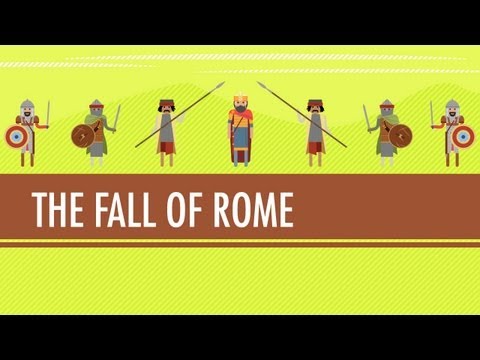 Photo: N43 and Hermes
Rome did not vanish in a single night; Western imperial power unraveled through linked political, economic, military, and social transformations.
01A fall measured in centuries
The Western Roman Empire’s conventional endpoint is 476 CE, when the Germanic commander Odoacer deposed the young emperor Romulus Augustulus. That date is useful shorthand, not a complete explanation. Imperial institutions, Roman law, cities, churches, and Latin-speaking communities continued, while political authority had already been changing for generations.
The third-century crisis exposed the danger of succession disputes, civil wars, inflation, and pressure along several frontiers. Reforms under Diocletian and Constantine stabilized the state for a time by reorganizing administration and the army. Stability, however, came with heavier taxation, a more divided political structure, and a permanent dependence on strong rulers.
02Frontiers under pressure
Rome’s neighbors were not one unified “barbarian” army. Goths, Vandals, Franks, Alamanni, Huns, and many other peoples had different motives and relationships with imperial power. Some traded with Rome, served in its armies, or sought settlement inside its borders. Migration and conflict intensified when groups were displaced and when Roman authorities failed to manage agreements.
The crossing of the Rhine and Danube in the late fourth and early fifth centuries created military emergencies the West struggled to contain. Victories remained possible, but the empire increasingly negotiated with federate forces and rival commanders. The result was not simply an external invasion, but a frontier system in which Rome’s ability to set terms steadily weakened.
FIG. 1 — The Western Empire’s endpoint followed centuries of restructuring and repeated crises.
03The economics of a huge state
Imperial government needed tax revenue to pay soldiers, maintain roads, supply cities, and administer justice across vast distances. As wars disrupted farmland and trade routes, local production and tax collection became less reliable. Wealth concentrated in powerful estates, while smaller communities could face obligations they were increasingly unable to meet.
The economy did not uniformly collapse: parts of North Africa, Gaul, Spain, and Italy remained productive at different times, and Mediterranean commerce persisted. But the Western court lost dependable access to strategic tax bases, especially when provinces were seized or became autonomous. Fewer resources made it harder to hire, equip, and coordinate the forces needed to recover them.
04Armies, generals, and political instability
The late empire fielded sophisticated armies, but they were expensive and often divided between frontier defense and mobile forces that responded to crises. Recruitment drew on provincial populations and allied groups, while commanders with personal followings could become kingmakers. Military power was essential to the state, yet competition for command repeatedly turned inward.
Rapid imperial turnover made long-term policy difficult. Civil wars pulled troops away from borders, and emperors sometimes preferred short-term bargains with rivals to costly campaigns. When central authority could no longer guarantee succession, taxation, and military loyalty, local leaders had incentives to preserve order on their own terms.
Key insight: “The fall” describes the loss of Western central control, not the disappearance of Roman culture. Political collapse and cultural continuity can happen at the same time.05East and West, divergence and transformation
The empire’s administrative division between eastern and western courts was a practical response to distance and crisis, not an immediate divorce. The eastern half had richer cities, stronger tax networks, and a more defensible strategic position. Constantinople could sustain imperial institutions even as western territories became harder to govern from a single center.
Religious and cultural change also reshaped Roman identity. Christianity became central to public life and imperial legitimacy, while bishops and churches assumed social roles once associated with civic elites. These changes did not cause the fall by themselves. They show how “decline” can coexist with creative institutional adaptation and a transformation of what Roman society meant.
FIG. 2 — External pressure became more consequential as internal coordination and resources weakened.
06The legacy of a political ending
After 476, successor kingdoms ruled former western provinces, often using Roman law, titles, taxation practices, and administrative personnel. The eastern Roman—or Byzantine—Empire continued for nearly a thousand years. Latin Christianity, Roman legal traditions, urban forms, and the memory of imperial universalism all remained active ingredients in medieval and later political cultures.
Rome’s story cautions against single-cause narratives. Military pressure mattered, but it became decisive through fiscal stress, political fragmentation, regional inequality, and institutional choices. Large systems can endure visible shocks yet become less able to repair themselves; resilience is not the absence of problems, but the capacity to turn resources into coordinated action.
Video: Fall of The Roman Empire...in the 15th Century: Crash Course World History #12 by CrashCourse — approximately 9.1M views on YouTube (observed August 2026).
References
- Wikipedia — background reference on The Fall of the Roman Empire: How a Civilization Collapsed.
- Fall of The Roman Empire...in the 15th Century: Crash Course World History #12 — CrashCourse.
- Encyclopaedia Britannica — Fall of the Roman Empire.
- The Metropolitan Museum of Art — the Roman Empire and late antiquity.
- World History Encyclopedia — Roman imperial transformation.
By N43 and Hermes for Sailor Bob News.


