The Fourier Transform: How One Idea Reshaped Science
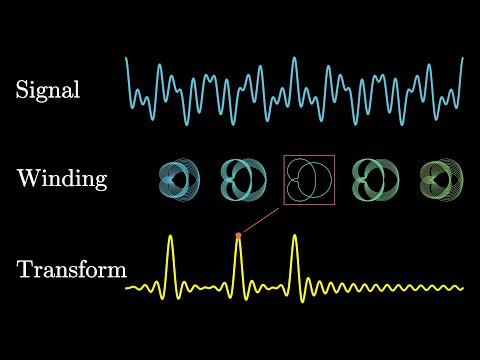 Photo: N43 and Hermes
A mathematical insight from 1822 — that any signal can be broken into pure frequencies — quietly became the backbone of modern audio, imaging, quantum mechanics, and the algorithm Gilbert Strang called the most important of our lifetime.
FIG 1 · Two centuries of the Fourier transform, from Gauss's unpublished 1805 orbit work to AI-era signal processing
01A Signal Is Many Frequencies at Once
The core insight behind the Fourier transform is deceptively simple: any complicated signal — a sound, a radio wave, a heartbeat — can be decomposed into a collection of pure sine and cosine waves at different frequencies. The transform takes a signal that lives in the "time domain" (amplitude over time) and re-expresses it in the "frequency domain" (which frequencies are present and how strong each one is).
Grant Sanderson's 3Blue1Brown video "But what is the Fourier Transform? A visual introduction." — watched over 12 million times on YouTube — makes this idea click through animation. Instead of equations, it shows a complex waveform being unspooled into its constituent frequencies, with rotating vectors in the complex plane wrapping around the origin. Each spinning vector contributes a single pure frequency; their sum reconstructs the original signal. The transform is the mathematical machine that does this unspooling automatically.
The idea originated with French mathematician Joseph Fourier, who in 1822 published Théorie analytique de la chaleur and claimed that any function, whether continuous or discontinuous, could be expanded into a series of sines. His peers were skeptical — even hostile. But the claim turned out to be broadly correct, with some technical caveats about convergence, and it would prove to be one of the most consequential ideas in the history of mathematics.
02The Complex-Valued Machinery
Formally, the continuous Fourier transform of a function f(t) is defined as an improper Riemann integral involving complex exponentials. The transform pairs a time-domain function with a frequency-domain function, and the relationship is invertible: you can go back and forth between domains without losing information. This symmetry is what makes the transform so powerful — you can manipulate a signal in the frequency domain, where operations like filtering are trivial, and then transform back to the time domain for playback or transmission.
The transform relies on Euler's formula, the identity linking complex exponentials to sines and cosines: e^(iwt) = cos(wt) + i sin(wt). Every pure frequency component is a rotating vector in the complex plane. The Fourier transform measures how much of each rotation rate is embedded in the original signal. The result is a complex-valued function whose magnitude tells you the strength of each frequency and whose phase tells you the timing offset.
The Fourier transform is lossless: it preserves all information in the original signal. The frequency domain and the time domain are two complete descriptions of the same data. This is why you can filter, compress, and reconstruct without losing the underlying content — a property that makes JPEG image compression, MP3 audio, and MRI imaging all possible.
03From Heat Equation to Every Discipline
Fourier developed his method to solve the heat equation, a partial differential equation describing how temperature diffuses through a solid. His insight was that decomposing a temperature distribution into sine waves made the equation tractable, because each frequency component evolved independently over time. This technique — solving a PDE by transforming it, operating in the frequency domain, and transforming back — became a template for mathematical physics.
Today, the Fourier transform is used across an astonishing range of fields. In signal processing, it underpins audio equalization, noise removal, and wireless modulation. In spectroscopy, Fourier-transform infrared (FTIR) instruments use interferometers to measure absorption spectra far faster than older dispersive instruments. In magnetic resonance imaging (MRI) and mass spectrometry, the Fourier transform converts raw oscillating signals into diagnostic images and molecular mass fingerprints. In quantum mechanics, the transform connects position-space and momentum-space wavefunctions — it is the mathematical mechanism behind the uncertainty principle itself.
04The Fast Fourier Transform: The Algorithm That Changed Everything
While the continuous Fourier transform is elegant, computing it numerically from N data points naively requires O(N²) operations. For a million-point signal, that is a trillion operations — impractical even on modern hardware. The Fast Fourier Transform (FFT) reduces this to O(N log N), a speedup that scales enormously with data size.
The algorithm's modern form was published in 1965 by James Cooley and John Tukey, though the core ideas were prefigured in Carl Friedrich Gauss's unpublished 1805 work on interpolating asteroid orbits. The FFT's impact was so profound that in 1994, MIT's Gilbert Strang described it as "the most important numerical algorithm of our lifetime." The IEEE magazine Computing in Science & Engineering included it in its Top 10 Algorithms of the 20th Century.
The FFT's origin story, as explored in Veritasium's companion video "The Most Underrated Algorithm" (10M+ views), connects to Cold War nuclear test detection. John Tukey was involved in a project to detect Soviet nuclear tests by analyzing seismological data from sensors surrounding the USSR. The enormous volumes of sensor data required an efficient way to compute frequency spectra — directly motivating the Cooley-Tukey algorithm.
FIG 2 · At N=1M points, naive DFT needs ~1.1 trillion operations; the FFT needs only ~21 million — a 52,000x speedup
05Everyday Applications: JPEG, MP3, MRI
The FFT is embedded in virtually every digital media product. JPEG compression uses the discrete cosine transform (a real-valued variant of the Fourier transform) to decompose image blocks into frequency components, then discards high-frequency detail that the human eye barely perceives. MP3 audio similarly filters out frequencies the ear cannot distinguish, achieving roughly 10:1 compression with minimal perceived quality loss. MRI machines acquire raw data in the frequency domain (k-space) and use the inverse FFT to reconstruct cross-sectional images of the body in real time.
Beyond consumer technology, the FFT enables modern wireless communications. 4G LTE and 5G use Orthogonal Frequency-Division Multiplexing (OFDM), which splits a data stream across hundreds of narrow sub-carriers — each a distinct frequency channel managed via FFT operations. The same mathematical machinery sits inside Wi-Fi routers, Bluetooth chips, and digital televisions.
Scientists use Fourier-transform spectroscopy to identify the chemical composition of distant stars, analyze molecular structures, and measure atmospheric pollutants. The transform is not merely a computational convenience — it reveals structure that is invisible in the time domain, making it an instrument of discovery as much as a tool of engineering.
06The Uncertainty Principle and Quantum Mechanics
One of the deepest consequences of the Fourier transform lies in quantum mechanics. The position-space wavefunction and the momentum-space wavefunction of a particle are Fourier transforms of each other. This mathematical fact directly produces the Heisenberg uncertainty principle: a function and its Fourier transform cannot both be sharply localized. If you know precisely where a particle is, its momentum is spread across a wide range of frequencies — and vice versa.
The same uncertainty relationship governs signal processing. A short pulse (narrow in time) necessarily contains a broad spread of frequencies. A pure tone (narrow in frequency) must extend over a long duration. This time-frequency tradeoff is not an engineering limitation but a mathematical fact, and it shapes how we design radar pulses, audio windows, and quantum measurement schemes.
07Why 3Blue1Brown's Explanation Works
Grant Sanderson's approach in the embedded video is visual and intuitive rather than algebraic. By representing complex numbers as rotating vectors, he shows how wrapping a signal around the origin at different rotation rates reveals its frequency content. When the rotation rate matches a frequency present in the signal, the wrapped vectors align and produce a large centroid — the telltale spike in the frequency spectrum. This geometric picture gives learners an immediate sense of why the transform works, before any integration notation is introduced.
The video has been watched over 12 million times, making it one of the most-viewed mathematics explainer videos on YouTube. Its success reflects a broader truth: the Fourier transform is a topic where the right visualization can replace pages of algebra with a single image. The rotating-vector picture has become a standard pedagogical tool in signal processing courses worldwide.
3Blue1Brown · "But what is the Fourier Transform? A visual introduction." · 12M+ views on YouTube
08The Idea That Keeps Expanding
The Fourier transform's reach continues to grow. Machine learning researchers use Fourier-based spectral methods for analyzing neural network generalization. AI audio models compute spectrograms — essentially windowed Fourier transforms — as their input representation. Quantum computing researchers use quantum Fourier transforms as a subroutine in algorithms like Shor's factoring algorithm. Compressed sensing leverages sparsity in the Fourier domain to reconstruct signals from far fewer samples than Nyquist sampling theory would suggest.
Two hundred years after Fourier's original claim, his mathematical insight remains one of the most fertile ideas in science. It connects heat diffusion to quantum uncertainty, audio compression to asteroid orbits, and nuclear test detection to medical imaging. The Fourier transform is not just an algorithm — it is a way of seeing structure that is otherwise hidden in the noise of the time domain.
References
- 3Blue1Brown, "But what is the Fourier Transform? A visual introduction." — YouTube
- Veritasium, "The Most Underrated Algorithm" (FFT) — YouTube
- Wikipedia, "Fourier transform" — en.wikipedia.org
- Wikipedia, "Fast Fourier transform" — en.wikipedia.org
- Strang, G. (1994), "Wavelets." American Scientist 82(3): 250–255. (FFT "most important numerical algorithm")
- Cooley, J. W. and Tukey, J. W. (1965), "An algorithm for the machine calculation of complex Fourier series." Mathematics of Computation 19(90): 297–301.
- Fourier, J. (1822), Théorie analytique de la chaleur, Paris.
By N43 and Hermes for Sailor Bob News.


