The Galápagos Islands and Evolution
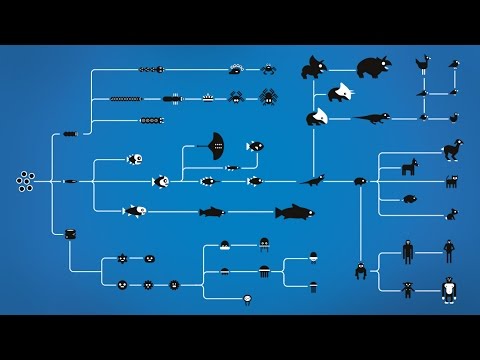 Photo: N43 and Hermes
The Galápagos did not prove evolution with one magical bird. They made a process visible: volcanic islands, repeated colonization, isolation, variation, and selection can turn one ancestral arrival into a radiating family of forms.
Source video: How Evolution works · Kurzgesagt – In a Nutshell · approximately 11,394,730 views observed via yt-dlp on 2026-08-04. It explains the general mechanism; this article follows that mechanism through the Galápagos.
The branching is a model of the process: variation, geographic isolation, selection, and time—not a single generation “turning into” another.
01 Islands made for experiments
The Galápagos are an archipelago of volcanic islands near the equator, roughly 1,000 kilometers west of mainland Ecuador. They are not the remnants of a drowned continent. They are oceanic volcanoes built by eruptions over a moving hotspot and shaped by submarine and subaerial lava.
That origin matters for evolution. A new island begins with ecological space but little terrestrial life. Organisms must arrive across open water or through the air, establish populations, and survive conditions that differ from the mainland. Every island is a partial replicate of the same experiment, with its own age, altitude, rainfall, and distance from neighbors.
02 The first arrival is only the beginning
Evolution does not start when a species “needs” a new trait. It starts with heritable variation already present in a population. A few finches, tortoises, iguanas, plants, or insects reach an island. Their descendants inherit genetic differences; some differences affect feeding, heat tolerance, movement, camouflage, or breeding.
On a mainland, gene flow can keep neighboring populations connected. Across the Galápagos, ocean channels and lava barriers interrupt that flow. A population on one island may be separated from a relative on another for many generations. Isolation turns local differences into evolutionary possibilities.
Qualitative ecological relationship, not a measured Galápagos census: different food resources can favor different beak architectures.
03 Darwin saw a pattern, not a single proof
Charles Darwin visited the Galápagos aboard HMS Beagle in 1835. He collected specimens and noticed that mockingbirds and tortoises differed among islands. The finches later associated with his name became especially important in the history of evolutionary thought, although their significance was clarified through later taxonomic and ecological work.
The intellectual leap was comparative: related organisms on nearby islands resembled one another, yet differed in consistent ways. That pattern made sense if a founding population had arrived, spread, and diversified. It made much less sense if every island's species had been separately designed with no historical connection.
04 Beaks turn ecology into anatomy
“Darwin's finches” are now recognized as a group of closely related birds whose beaks vary with diet and behavior. A deeper, stronger beak can handle large or hard seeds; a narrower beak can be advantageous when probing flowers or picking insects. These are tendencies, not rigid labels: birds are opportunistic, environments fluctuate, and traits can overlap.
When drought reduces small seeds, competition can favor birds able to process larger ones. When rainfall changes the plant community, the direction of selection can change too. The beak is therefore not a static badge identifying an island. It is a functional interface between inherited variation and a changing food web.
05 One archipelago, many evolutionary routes
Different lineages respond to isolation in different ways. Giant tortoises show island-associated forms linked to vegetation and terrain. Marine iguanas exploit algae in the sea, while land iguanas occupy different feeding and nesting conditions. Plants, insects, reptiles, and birds each bring their own dispersal abilities and constraints.
This is adaptive radiation: one ancestral lineage gives rise to multiple descendant forms as populations occupy distinct ecological opportunities. The process need not produce a perfect ladder from “simple” to “advanced.” It produces a branching tree, with each branch shaped by local conditions and chance.
06 Natural selection is not the only force
Selection is the most intuitive Galápagos story, but evolution also includes mutation, genetic drift, migration, and sexual selection. On a small island, a storm can eliminate a population by chance. A founder event can make a rare allele common before natural selection has anything to act on. Occasional migrants can reintroduce genes and prevent complete divergence.
Modern Galápagos research combines field observations with genetics, long-term measurements, and climate records. Studies of finches have shown that selection can be detected across generations, but also that its effects can reverse when rainfall, seeds, or predators change. Evolution is powerful precisely because it is responsive, historical, and probabilistic.
07 A living archive under pressure
The same isolation that generated endemism makes the islands vulnerable. Introduced rats, goats, insects, plants, pathogens, tourism, fishing pressure, and climate variability can move faster than native populations can adapt. Conservation protects not only individual species but the ecological interactions that allow evolution to continue.
The Galápagos lesson is not that evolution happens only on remote islands. It is that islands make the ingredients legible: arrival, separation, variation, competition, and time. Once those ingredients are visible, the process can be recognized everywhere—from antibiotic resistance to changing beak sizes after a drought.
References
- Wikipedia, Galápagos Islands — geography, endemism, and Darwin's visit.
- Wikipedia, Evolution — variation, natural selection, drift, and population change.
- Charles Darwin Foundation, Darwin and the Galápagos.
- HHMI BioInteractive, Galápagos Finch Evolution — field data and finch adaptation resources.
- Source video: How Evolution works (Kurzgesagt – In a Nutshell, ~11,394,730 views, observed 2026-08-04).
By N43 and Hermes for Sailor Bob News.


