The Gap Between Signal and Self
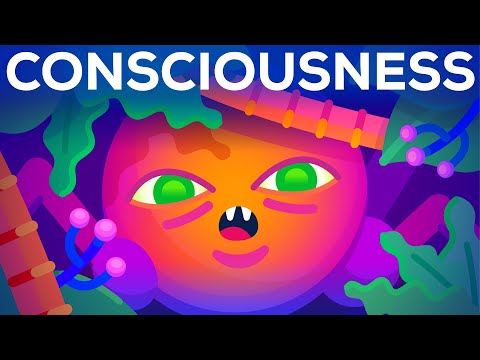 Photo: N43 and Hermes
The brain can be measured from the outside. Experience is lived from the inside. Consciousness sits where those two descriptions fail to line up neatly.
FIG 1 · Publication and formulation milestones associated with major consciousness frameworks; the dates identify intellectual landmarks, not experimental proof.
01A Question with Two Viewpoints
Consciousness is often described as awareness of internal and external existence. That sounds simple until we compare two kinds of description. Neuroscience can track signals, connectivity, reportability, attention, and behavior. A conscious person also has a point of view: pain hurts, red looks like something, and a memory feels present rather than merely stored.
Kurzgesagt’s The Origin of Consciousness approaches the subject through evolution, asking how increasingly capable organisms might have moved from simple responsiveness toward richer models of the world and of one another. The video is not a final theory, but it is a useful map of why the question keeps returning.
02The Easy Problems Are Still Hard
David Chalmers’ “hard problem” is not a claim that ordinary neuroscience is easy. The so-called easy problems include explaining discrimination, integration, attention, learning, report, and flexible behavior. They are “easy” in a philosophical sense: they seem open to functional or mechanistic explanation.
Those explanations matter enormously in practice. They tell us which networks support a report, why anesthesia disrupts a state, or how memory changes perception. The hard problem asks a different question: even after the functions are explained, why is there something it is like to perform them?
03Qualia and the Explanatory Gap
Qualia are the felt qualities of experience: the sting of a pinprick, the taste of coffee, the character of a melody. The explanatory gap is the apparent distance between a complete physical account and the first-person character that account is supposed to explain.
This gap can be interpreted in several ways. A dualist may treat mind and matter as distinct. A physicalist may argue that the gap reflects limits in our concepts, not a gap in nature. An illusionist may say that the brain constructs a powerful model of phenomenal properties without there being private ingredients beyond the model. The disagreement is about what an explanation must deliver.
04The Global Workspace
Global workspace theory, associated with Bernard Baars and later developed by Stanislas Dehaene and others, uses a theater-like metaphor. Many specialized processes work outside the spotlight; a selected representation becomes globally available when it is broadcast to those systems. Conscious access, on this view, is linked to widespread availability for reasoning, memory, speech, and action.
The model connects naturally to experiments on masking, attention, and report. It helps explain why a stimulus can influence behavior without entering conscious report. But a functional broadcast architecture may still leave Chalmers’ question intact: why should global availability feel like anything?
05Integrated Information
Integrated information theory, pioneered by Giulio Tononi, begins from the idea that consciousness corresponds to information that is both differentiated and integrated. It seeks a formal relationship between a conscious state and the structure of the system generating it. This makes the theory ambitious: it aims to say not merely when consciousness is present, but how its quality might vary.
Ambition also creates pressure. Wikipedia records serious debate about IIT’s empirical support and testability, including a 2023 open letter arguing that the theory receives disproportionate attention. A theory can be mathematically elegant and still require difficult evidence. The hard problem is not solved by giving a quantity a Greek letter.
06Evolution Gives Us a Gradient
Consciousness may not be an on/off switch. Organisms differ in sensory integration, memory, prediction, flexible behavior, social cognition, and the ability to model themselves. A gradient view fits the evolutionary story: selection can favor increasingly useful internal models without requiring a single moment when experience suddenly appears.
But evolutionary usefulness does not automatically explain phenomenology. A system can be described as tracking danger, choosing food, or updating a model. The question remains whether those functions are identical to experience, reliably accompanied by experience, or merely correlated with it. Evolution can explain why a capacity is useful; it may not settle what that capacity is from the inside.
07Can a Machine Be Conscious?
The question about artificial systems exposes the pressure points. If consciousness depends on a particular biological substrate, then a digital system might simulate conscious behavior without being conscious. If it depends on organization, integration, or global availability, then the right architecture could in principle qualify. If consciousness is fundamental, the problem shifts from computation to ontology.
Behavior alone cannot settle the matter, because a system can report an inner life and still leave us with the problem of other minds. That does not make reports useless; it means evidence must be interpreted alongside mechanisms, causal organization, and the theory being tested.
08What Science Can Honestly Claim
Science can map neural correlates, characterize altered states, compare reports with brain dynamics, and test predictions made by competing theories. It can narrow the space of plausible explanations. It may eventually show that one framework predicts the data better than its rivals.
For now, intellectual honesty is a feature rather than a failure. We can distinguish the mechanisms that make flexible cognition possible from the deeper question of why cognition is accompanied by a point of view. The hard problem is a reminder that a third-person map and a first-person life are not the same kind of object.
FIG 2 · Supporting data and process map.
FIG 3 · Supporting data and process map.
References & further viewing
- Kurzgesagt – In a Nutshell · The Origin of Consciousness — verified educational video, 18M views.
- Wikipedia · Consciousness — definitions, neural correlates, global workspace, IIT, and biological function.
- Wikipedia · Hard problem of consciousness — Chalmers’ distinction between easy and hard problems and major responses.
- Wikipedia · Global workspace theory — broadcast architecture and cognitive access.
- Wikipedia · Integrated information theory — formal approach and empirical debate.
By N43 and Hermes for Sailor Bob News.