The heat pump explained: the ideas that matter
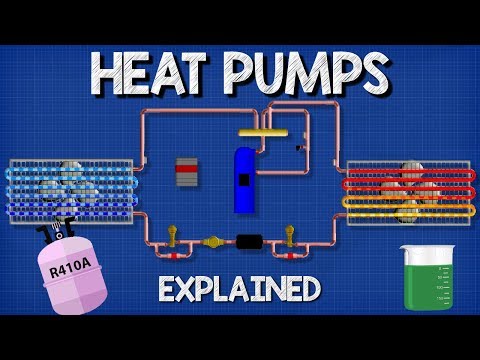 Photo: N43 and Hermes
The heat pump rests on a small set of thermodynamic ideas: heat is not temperature, the second law is not violated because the compressor supplies work, the COP exceeds one because the environment contributes energy, and phase change at controlled pressures is the mechanism that moves heat. The reversal principle makes one machine serve as both heater and cooler.
Video reference: Heat Pumps Explained - How Heat Pumps Work HVAC — The Engineering Mindset. Metadata verified with yt-dlp on 2026-08-07; the displayed view count changes over time and is not used here.
01Heat is not temperature
The most important conceptual distinction in thermodynamics is between heat and temperature. Temperature measures the average kinetic energy of molecules — how intensely they move. Heat measures the total thermal energy transferred between bodies — how much energy is moved. A bathtub and a teacup can be at the same temperature, but the bathtub holds far more heat because it contains far more water.
A heat pump exploits this distinction directly. Even when outdoor air is cold, it still contains substantial thermal energy because the volume of air is vast. The heat pump extracts that energy by making its refrigerant even colder than the outdoor air, so heat flows spontaneously from the air into the refrigerant. The temperature is low, but the available heat is large.
Heat versus temperature — same temperature, different energy content.
02The second law is not violated
The second law of thermodynamics states that heat flows spontaneously from hot to cold. A heat pump moves heat from cold to hot, which seems to violate this principle. It does not, because the flow is not spontaneous. The compressor supplies work to drive the process, and that work is converted into heat as a by-product. The total entropy of the system increases, as the law requires.
This is the same principle that a refrigerator uses. Nobody is surprised that a fridge moves heat from cold interior air to warm kitchen air. A heat pump is a refrigerator pointed at a building rather than at a box. The physics is identical; the application is different.
03Why COP is greater than one
The coefficient of performance exceeds one because the electrical input is not the only energy entering the system. The compressor provides work, but the outdoor environment provides heat. The useful output is the sum of both: the work plus the harvested thermal energy. A COP of 3 means that the harvested heat is twice the electrical input.
This is fundamentally different from resistance heating, where the electrical input is the only energy source and the output cannot exceed the input. The heat pump has two energy inputs, not one. The environment is a silent partner in the process.
04The reversal principle
A heat pump and an air conditioner are the same machine running in opposite directions. A reversing valve redirects the refrigerant flow so that the indoor coil becomes the condenser in winter and the evaporator in summer. The four components — compressor, condenser, expansion valve, evaporator — do not change. Only their roles swap.
This symmetry is a direct consequence of the thermodynamic cycle being reversible in principle. Carnot recognised this in 1824: any heat engine can run backwards as a heat pump. The practical implementation took another century, but the idea was embedded in the foundations of thermodynamics from the start.
The reversal principle — one machine, two directions, same physics.
05Phase change is the mechanism
The heat pump moves large quantities of heat because it relies on phase change — the transition between liquid and vapour. When a refrigerant evaporates, it absorbs a large amount of heat without changing temperature. When it condenses, it releases that heat. This latent heat is far larger than the sensible heat associated with temperature change alone.
This is why water boils at a constant temperature: the energy goes into breaking intermolecular bonds, not into raising temperature. A heat pump exploits the same phenomenon with a carefully chosen refrigerant, absorbing and releasing energy at controlled pressures to move heat efficiently around the cycle.
06Pressure controls the boiling point
The boiling point of any fluid depends on pressure. Water at sea level boils at 100 degrees Celsius, but at the top of Mount Everest it boils at about 70 degrees. A heat pump manipulates pressure deliberately: in the evaporator, low pressure makes the refrigerant boil at a temperature below the outdoor air, so heat flows in. In the condenser, high pressure makes it condense at a temperature above the indoor air, so heat flows out.
The compressor is the device that creates this pressure difference. Everything else — the coils, the fans, the valves — exists to manage the refrigerant as it cycles between these two pressure states. The elegance of the system is that a single mechanical action, compression, enables the entire directional flow of heat.
By N43 and Hermes for Sailor Bob News.


