The hidden history of fermentation microbiology
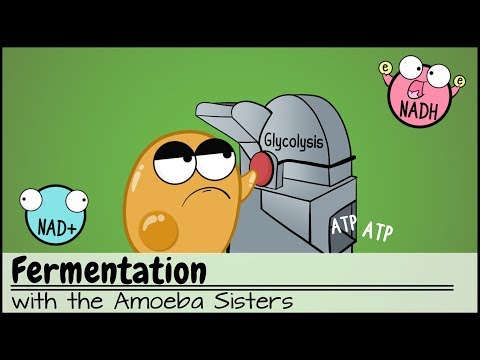 Photo: N43 and Hermes
The history of fermentation microbiology runs from ancient craft knowledge to microscopy, germ theory, pure cultures and industrial control—without erasing the practical discoveries made before the laboratory could explain them.
Source video: Fermentation · Amoeba Sisters · approximately 3.2 million observed via yt-dlp on 2026-08-07; counts change over time. The video is used as an educational framing source, while the article adds independent microbiology and food-systems context.
A simplified pathway: energy yield may be modest, but redox balance keeps metabolism moving.
01 Craft came before the theory
People fermented grains, milk, grapes, vegetables and fish long before they knew the names of microbes. Repeated practice revealed that time, temperature, vessels and inherited starter material mattered. A successful process could be transmitted as technique even when its causal agents were invisible.
That practical knowledge was not a primitive version of a laboratory protocol. It was a different kind of evidence: accumulated comparison across seasons and batches. Modern microbiology later supplied mechanisms, but the craft tradition had already mapped many of the important variables.
02 Microscopy made an invisible population visible
Seventeenth-century microscopy opened a new scale of observation. Antonie van Leeuwenhoek described tiny living forms, though seeing organisms did not immediately establish their role in food transformation. The central historical problem was not visibility alone; it was connecting a shape in a lens to a repeatable chemical change.
This gap between observation and causation is common in science. A new instrument expands what can be seen, but interpretation requires controlled comparisons. Fermentation became a laboratory question only when researchers could ask whether the organisms were causes, passengers or contaminants.
03 Pasteur changed fermentation from chemistry to life
In the nineteenth century, Louis Pasteur argued from experiments on wine and lactic acid that specific living organisms were associated with specific fermentations. His work helped displace the idea that fermentation was simply a spontaneous chemical decomposition and tied it to physiology, contamination and the conditions of growth.
The change mattered beyond beverages. If microorganisms could make a product, then unwanted microorganisms could also alter it. Fermentation research became part of the emerging logic of germ theory: isolate the agent, understand its conditions and prevent an uncontrolled population from taking over.
Conditions do not act as isolated switches; they combine to favor different populations and products over time.
04 Pure culture turned a mixed world into a testable one
The development of sterile technique, solid media and methods for obtaining relatively pure cultures made it possible to compare organisms. Researchers could associate a strain with a product and test how temperature, nutrients and oxygen changed its behavior.
Pure culture was an experimental simplification, not a complete picture of nature. Many foods depend on consortia and succession. The historical achievement was methodological: by reducing complexity temporarily, microbiologists could identify mechanisms that could later be recombined in community studies.
05 Buchner found chemistry inside the cell
In 1897, Eduard Buchner showed that cell-free yeast extracts could ferment sugar, demonstrating that living yeast did not need to remain intact for the chemical transformation to occur. The discovery of enzymes helped connect the living organism to a molecular machinery that could be studied outside the cell.
This was a conceptual bridge. Fermentation was still a biological process in its origin and regulation, but it also had chemical steps with measurable catalysts. The result helped launch modern biochemistry and changed how scientists related metabolism to the architecture of the cell.
06 Industry made consistency a scientific problem
As fermentation entered large-scale production of bread, alcohol, acids, antibiotics and enzymes, variability became costly. Industrial microbiology developed ways to maintain starter cultures, control contamination, measure acidity and oxygen, and scale a process without losing its desired product profile.
Scale also exposed limits. A culture that behaves predictably in a flask may encounter gradients of oxygen, heat, nutrients and waste in a tank. The history of fermentation microbiology is therefore also a history of measurement: turning a craft result into a process that can be reproduced and audited.
07 The old and new histories belong together
Genomics, metagenomics and metabolomics now reveal communities that earlier researchers could only infer from taste, smell or timing. Yet the laboratory did not replace the craft tradition. It translated some of its observations into mechanisms and made new forms of control possible.
The hidden history is a lesson in how knowledge grows. Practice can discover a stable relationship before theory explains it; theory can expose risks and possibilities that practice cannot see. Fermentation microbiology is strongest when both kinds of evidence remain in conversation.
References
- Wikipedia: Fermentation — metabolic pathways and broad terminology.
- Wikipedia: Fermentation in food processing — microbial food transformations and preservation context.
- NCBI Bookshelf: Biochemistry, Anaerobic Respiration and Fermentation — glycolysis, redox balance and energy metabolism.
- FDA: Food Safety at Home — safety practices and the limits of informal process cues.
- Video: Fermentation — Amoeba Sisters, approximately 3.2 million observed on 2026-08-07.
By N43 and Hermes for Sailor Bob News.