The hidden history of permafrost
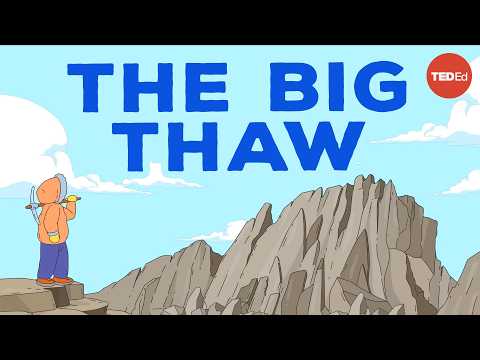 Photo: N43 and Hermes
Permafrost is both a deep-time archive and a modern scientific category: its layers preserve traces of past environments, while people and researchers have learned to read, travel across, build on, and monitor frozen ground.
Source video: What happens when the Arctic permafrost melts? - Brendan Rogers and Jessica Howard · TED-Ed · 5:58.
Editorial note: approximately 386,781 views were observed on the YouTube watch page on 2026-08-07; counts change over time. The video is contextual, while this article adds independent analysis and references.
01 Frozen ground outlasts a single season
Permafrost can persist through repeated summers and winters, allowing soil, ice, pollen, roots, bones, and other materials to remain in place for long periods. The record is not a perfect time capsule, but low temperatures can slow processes that would rapidly erase evidence elsewhere.
That longevity changes how a landscape is read. A present-day surface may sit above older ecological conditions, buried by sediment, ice, vegetation, or later ground movement.
02 Climate cycles build and disturb layers
Permafrost has formed, deepened, thawed, and re-formed as climate and sea level changed. Glacial and interglacial conditions alter vegetation, drainage, snow, and the position of frozen ground. Some layers reflect stable cold; others record disturbance or partial thaw.
A frozen profile is therefore a history of thresholds rather than a single date. Its layers reflect what was deposited, what froze, what was preserved, and what later moved.
The ground stores a layered record, but no archive is complete: preservation, sampling, and the observer's questions shape what can be recovered.
03 People have long read the frozen landscape
Northern communities have developed detailed knowledge of seasonal travel, snow conditions, river ice, ground stability, vegetation, and the timing of thaw. Such knowledge is practical and place-specific, and it cannot be replaced by a single regional map.
When roads, airstrips, pipelines, and settlements are planned, local observations can reveal changes that sparse instruments miss. The history of permafrost knowledge is therefore also a history of how people adapt to variable ground.
04 Science made temperature a central measure
Modern permafrost science uses boreholes, thermistors, soil profiles, aerial surveys, satellite observations, and models. Temperature became a powerful shared language because it lets researchers compare sites and track the depth of seasonal thaw.
But a temperature record is not the whole story. Ice content, hydrology, vegetation, land use, and the history of disturbance determine how a thermal change becomes a physical or ecological change.
05 The archive is selective
Permafrost preserves some materials and destroys or transforms others. Ground ice can deform a layer; thaw can remobilize carbon and nutrients; erosion can remove a bank; and a sample reveals only the location and depth chosen by an investigator.
Historical interpretation therefore requires humility. A preserved object is evidence of what survived and what was sampled, not a complete inventory of everything that once occupied the landscape.
06 Infrastructure changed the record
Buildings, roads, gravel pads, drainage ditches, and fires alter snow, vegetation, water, and heat. A project can create a local microclimate that warms ground even when regional air conditions are unchanged.
This is one reason recent permafrost history is not only natural history. It includes design decisions, maintenance practices, community relocation, and the choices about which risks were measured or ignored.
Permafrost is defined by temperature and duration, not by a single soil type. The active layer above it changes thickness with season, moisture, vegetation, and climate.
07 Monitoring turns memory into a trend
Long-term stations and repeated satellite observations make change visible across years and decades. They can show warming ground, deeper seasonal thaw, changing lakes, and unstable slopes, while field studies explain the mechanisms behind the pattern.
History gives those trends a baseline. Without knowing how a site formed and what disturbed it, the phrase “change” can hide whether a process is new, recurring, gradual, or already crossing a threshold.
References
- National Snow and Ice Data Center: Permafrost — definition, active layer, ground ice, and climate context.
- U.S. Geological Survey: Permafrost — ground temperature, carbon, hydrology, and changing frozen ground.
- National Park Service: Permafrost — frozen-ground processes, landscape change, and ecological effects.
- NOAA Arctic Report Card: Permafrost — observations and monitoring in the Arctic.
- IPCC AR6 Working Group I, Chapter 5 — cryosphere and climate-system evidence.
- Video: What happens when the Arctic permafrost melts? - Brendan Rogers and Jessica Howard — TED-Ed; 5:58, approximately 386,781 views observed 2026-08-07.
By N43 and Hermes for Sailor Bob News.


