The hidden history of the blood-brain barrier
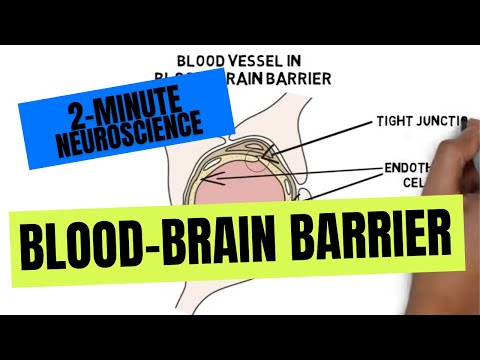 Photo: N43 and Hermes
The barrier’s story is a history of dyes, disputed names, and a gradual shift from a mysterious wall to a dynamic cellular system.
Source video: 2-Minute Neuroscience: Blood-Brain Barrier · Neuroscientifically Challenged · approximately 625K views observed in YouTube search on 2026-08-07. Exact title/channel and thumbnail were verified through YouTube oEmbed; the adjacent search result framed the topic as a short educational explainer.
01 Before the name, an observation
The idea began as an experimental puzzle. In the late nineteenth century, investigators noticed that substances circulating through the body did not colour the brain in the same way they coloured other organs. A negative stain was not yet a mechanism, but it forced a question: was the brain chemically isolated, or was it simply different at receiving and retaining dye?
That uncertainty is worth preserving. Early researchers were not looking through a modern microscope at claudin proteins. They were inferring compartments from what an animal did—or did not—look like after an injection. The history of the barrier is therefore also a history of what counts as evidence.
02 Ehrlich’s dyes and a first interpretation
Paul Ehrlich’s work with aniline dyes helped make the contrast visible. When dyes injected into the circulation coloured many tissues but spared the brain, Ehrlich initially considered the possibility that the brain had less affinity for the stain. The observation was real; the explanation was provisional.
This is a familiar scientific pattern: a result arrives before the vocabulary needed to explain it. The same experiment can support different models depending on whether one imagines selective entry, selective binding, rapid clearance, or a separate compartment.
03 Goldmann reverses the direction
In 1913, Edwin Goldmann injected dye into cerebrospinal fluid and found that the brain became coloured while the rest of the body did not. The paired experiments created a powerful contrast. The direction of injection changed the destination of the dye, implying a barrier or compartmentalization between blood and central nervous tissue.
The experiment did not reveal every component of the modern barrier. It did something more foundational: it made the interface experimentally reciprocal. Blood-to-brain and brain-to-blood movement were no longer assumed to be the same process.
04 A name with a footnote
The label “blood-brain barrier” is often linked to Max Lewandowsky around 1900, yet historians note that the phrase does not appear straightforwardly in the papers usually credited to him. Lina Stern has also been proposed as an originator or early popularizer. The disagreement is not a trivia contest; it shows how scientific credit travels through languages, citations, and later textbooks.
A name can stabilize a field while obscuring the path by which an idea moved. Russian- and French-language work, changing terminology, and retrospective attribution all shaped which researchers became familiar to English-speaking audiences.
05 From membrane to neurovascular unit
For years, the vessel wall itself was treated as the likely barrier because no obvious standalone membrane could be found. Later anatomy and molecular biology shifted the model toward endothelial tight junctions supported by pericytes, basement membrane, astrocytes, and transport machinery.
The conceptual change was large. A static membrane became a living interface whose permeability can be tuned by signalling, inflammation, development, and disease. The barrier’s history is a move from “what is blocking the dye?” to “which cells, proteins, and routes decide?”
06 Why the old experiments still matter
Modern imaging and molecular assays are more precise, but the early dye studies retain a methodological lesson: a tracer is not the same thing as a barrier measurement. A dye may bind proteins, leak during injury, or be cleared at a different rate from a medicine. Historical experiments are useful when their limitations travel with them.
The hidden history is thus not a straight march from ignorance to certainty. It is a record of better questions, better controls, and occasional arguments over language—exactly the social and technical work by which a biological boundary becomes a scientific object.
References
- Wikipedia, Blood–brain barrier — structure, transport, history, and specialized regions.
- NCBI Bookshelf, Anatomy, Head and Neck: Blood Brain Barrier — clinical anatomy and barrier components.
- Frontiers in Neuroscience, The rights and wrongs of blood-brain barrier permeability studies — historical methods and interpretation.
- Source video: 2-Minute Neuroscience: Blood-Brain Barrier (Neuroscientifically Challenged, approximately 625K views observed in YouTube results; 1:59; checked 2026-08-07; oEmbed title/channel verified).
By N43 and Hermes for Sailor Bob News.