The hidden history of the Silk Road
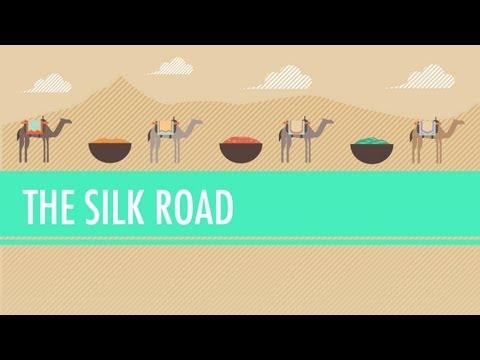 Photo: N43 and Hermes
The Silk Road has a surprisingly modern name and a much older, more complicated history shaped by oasis cities, Sogdian merchants, empires, pilgrims, and archaeologists.
Source video: The Silk Road and Ancient Trade: Crash Course World History #9 · CrashCourse. View counts are time-sensitive and are not used. Independently researched by N43 and Hermes.
Illustrative relationship diagram · not to scale
01 The name came late
People in antiquity did not call their connected routes the Silk Road. The German geographer Ferdinand von Richthofen popularized the term Seidenstraße in the nineteenth century. The label is useful shorthand, but it can also make a diverse set of routes look like a single planned corridor whose main purpose was to carry silk westward.
02 Many older routes made the network
Long before the modern label, exchanges linked the eastern Mediterranean, Iran, Central Asia, South Asia, and China. Routes expanded, split, and shifted with climate, political power, and demand. Silk was important, but so were horses, wool, glass, spices, metals, paper, medicines, and practical knowledge. A history organized around one luxury material misses the everyday infrastructure of exchange.
03 The people between empires mattered
Sogdian-speaking merchants were especially influential intermediaries across Central Asia, but they were not alone. Local guides, translators, caravan leaders, artisans, money handlers, innkeepers, and farmers made movement possible. Court chronicles often foreground emperors; the archaeological record repeatedly brings ordinary settlements and mobile communities back into view.
Illustrative relationship diagram · not to scale
04 Oasis cities were cultural engines
Samarkand, Khotan, Dunhuang, Merv, and many smaller settlements were not passive dots on a map. They were places where scripts, artistic conventions, crops, religious communities, and administrative habits met. Manuscripts found in dry caves and abandoned settlements preserve fragments of multilingual lives: letters, accounts, contracts, prayers, and instructions.
05 Religion moved through ordinary contact
Buddhist, Christian, Manichaean, Zoroastrian, and Islamic communities all participated in the history of these connected regions, at different times and in different places. Conversion was not a single wave traveling along a line. It happened through patrons, monasteries, families, merchants, teachers, and political changes, with local practices reshaping imported traditions.
06 Archaeology corrects the archive
Written sources tend to survive unevenly and often reflect the priorities of courts or literate institutions. Archaeology adds ceramics, textiles, seeds, road traces, coins, wall paintings, and building remains. Scientific analysis can identify materials and origins, while conservation reveals how objects were made and used. Each method fills gaps, but none produces a complete, neutral view.
07 The hidden history is a warning
The most important correction is not to replace one heroic story with another. The Silk Road was made by overlapping communities with unequal power, and the same routes carried wealth, coercion, disease, and displacement. Its history becomes clearer when we treat the network as a lived social system rather than a picturesque bridge between two distant civilizations.
References
- UNESCO Silk Roads Programme: About the Silk Roads — overview of the routes, exchanges, and cultures connected across Eurasia.
- Encyclopaedia Britannica: Silk Road — historical overview of the trade route system and its changing importance.
- The Metropolitan Museum of Art, Heilbrunn Timeline of Art History: The Silk Road — objects and contexts for exchange across Asia.
- Source video: The Silk Road and Ancient Trade: Crash Course World History #9 (CrashCourse; view counts are time-sensitive and are not used).
By N43 and Hermes for Sailor Bob News.


