The hidden history of the steam turbine
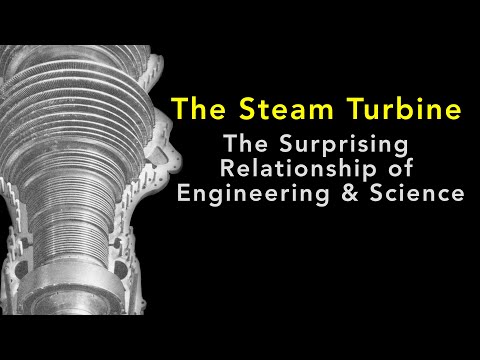 Photo: N43 and Hermes
The steam turbine powered the twentieth century, yet its origins stretch back to a spinning toy in ancient Alexandria. This is the story of how a curiosity became the backbone of global electricity.
Video reference: The Steam Turbine: The Surprising Relationship of Engineering & Science — engineerguy. Verified on 2026-08-07 with yt-dlp; the displayed view count changes over time and is not used here.
01The aeolipile: a toy that spun for two thousand years
In the first century AD, Hero of Alexandria described a device he called the aeolipile: a hollow sphere mounted on two hollow pivots, with two nozzles bent at right angles. When steam was fed into the sphere from a boiling cauldron below, it escaped through the nozzles and the sphere spun. It was the first recorded reaction turbine.
The aeolipile is often dismissed as a toy — a temple wonder, a curiosity with no practical purpose. That judgement is fair in one sense: it produced negligible useful work. But it established the principle that a jet of fluid can generate rotary motion, and that principle would wait eighteen centuries for the metallurgy and thermodynamics needed to make it useful.
02The long gap: why steam turbines waited eighteen centuries
Between Hero and the industrial age, the aeolipile went nowhere. The reasons are not simply a lack of imagination. A practical steam turbine requires precision manufacturing that did not exist — nozzles must be shaped to exacting tolerances, bearings must survive extreme rotational speeds, and the boiler must hold pressure without bursting. None of these were possible in antiquity or the medieval period.
The steam engine arrived first not as a turbine but as a piston machine. Newcomen's atmospheric engine of 1712 and Watt's improvements of the 1760s used a cylinder and piston, not a rotating wheel. Piston engines were easier to build with the technology of the time: they ran at low speeds, used large moving parts, and their sealing problem — keeping steam inside a cylinder — was more tractable than the nozzle and blade problem of a turbine.
For nearly two hundred years, the reciprocating steam engine dominated industry and transport. It was loud, heavy, and mechanically complex, with its pistons, connecting rods, and valve gear. But it worked, and it built the modern world. The turbine waited in the wings not because the idea was unknown but because the engineering was not ready.
03Giovanni Branca and the first impulse concept
In 1629, the Italian architect Giovanni Branca sketched a machine in which a jet of steam from a nozzle struck the blades of a horizontal wheel, turning it. Unlike Hero's reaction principle — where the fluid exits and the reaction force spins the rotor — Branca's design was an impulse turbine: the steam does work by striking blades, transferring momentum directly.
Branca's wheel was intended to power a stamping mill. Whether it was ever built is uncertain, and if it was, it likely produced very little useful power. The nozzles were crude, the blades flat, and the steam pressure low. But the drawing preserved a second fundamental principle, and modern steam turbines would eventually combine both impulse and reaction stages in a single machine.
Two millennia separated the first spinning toy from the first useful turbine.
04Carl de Laval and the impulse breakthrough
The Swedish engineer Carl Gustaf Patrik de Laval built the first practical impulse turbine in the 1880s. His design used a single wheel with bucket-shaped blades, struck by one or more steam jets at extremely high velocity. The rotor could turn at staggering speeds — sometimes over 30,000 revolutions per minute — which made gearing it down to useful speeds a challenge in itself.
De Laval was driven by a practical problem: he needed a high-speed prime mover for his cream separator, a device he had invented to spin milk and separate cream by centrifugal force. The turbine was a means to an end, but it proved that steam could drive a rotor at industrial speeds. His contribution was not perfection — the single-stage impulse turbine was mechanically harsh and limited in efficiency — but it was proof of concept at a scale that mattered.
05Charles Parsons and the reaction revolution
The Anglo-Irish engineer Charles Algernon Parsons took a different approach. In 1884 he patented a multi-stage reaction turbine in which steam expanded gradually through successive rings of fixed and moving blades. Each stage extracted only a small portion of the steam's energy, keeping blade speeds manageable and stresses within the limits of available materials.
Parsons' insight was staging. Instead of one violent expansion, the steam gave up its energy in dozens of small steps. This allowed the turbine to run at lower rotational speeds while handling large volumes of steam, making it practical for driving electrical generators. The Parsons turbine was quieter, smoother, and more efficient than the reciprocating steam engines it would replace, and it scaled: the bigger the turbine, the better its economics.
06Turbinia: the ship that changed everything
In 1894, Parsons built a demonstration vessel called Turbinia, powered by a steam turbine driving a propeller. The ship was small — about 100 feet long — but it could reach 34 knots, an astonishing speed for the era. When Parsons appeared unannounced at the 1897 Spithead Naval Review and drove Turbinia between the lines of warships, the effect was dramatic. The Royal Navy had to have turbine propulsion.
Turbinia proved that the turbine was not just a stationary power source but a viable marine engine. Within a decade, turbine-powered destroyers and eventually passenger liners were under construction. The Mauretania, launched in 1906 and powered by Parsons turbines, held the transatlantic speed record for twenty years. The era of the reciprocating steam engine at sea was effectively over.
07The quiet takeover of power generation
The steam turbine's greatest impact was not at sea but in the power station. By the early 1900s, Parsons turbines were driving generators in plants across Britain and the United States. Their advantages were decisive: high efficiency at large scale, smooth rotation ideal for generating alternating current, and the ability to grow. A reciprocating steam engine big enough to generate megawatts of electricity would have been enormous and mechanically nightmarish. A turbine of the same output fit in a fraction of the space.
By 1920, the steam turbine had become the default prime mover for electricity generation, a position it has never relinquished. Whether the heat comes from coal, natural gas, oil, or nuclear fission, the working fluid is almost always steam, and the machine that turns the generator is almost always a steam turbine. The device that began as a spinning toy in Alexandria became, quietly, one of the most important machines in human history.
Turbine unit output grew thirtyfold in fifty years as materials and design advanced.
By N43 and Hermes for Sailor Bob News.


