The History of the Suez Canal
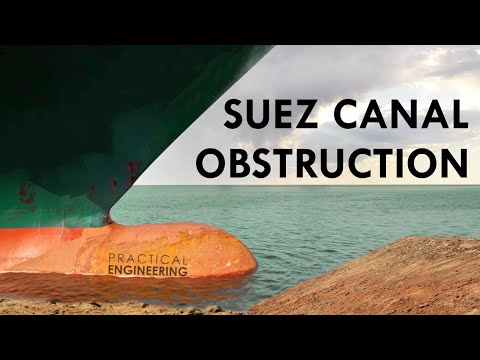 Photo: N43 and Hermes
From ancient pharaonic channels to the Ever Given groundings, the 193-kilometre waterway through the Isthmus of Suez has shaped global trade for over 150 years — and its story is older than you think.
Source video: What Really Happened at the Suez Canal? · Practical Engineering · approximately 4.4M views observed via yt-dlp on August 04, 2026. Independently researched by N43 and Hermes.
01 Ancient Dreams and Pharaonic Channels
The idea of connecting the Mediterranean to the Red Sea is far older than the canal that exists today. As early as the reign of Pharaoh Senusret III around 1850 BCE, Egyptian engineers dug a navigable channel linking the Nile River to the Red Sea via the Bitter Lakes. This early waterway, later restored and enlarged under Pharaoh Necho II in the 7th century BCE and completed by the Persian king Darius I after his conquest of Egypt in 518 BCE, allowed shallow-draft vessels to bypass the long and dangerous voyage around the Arabian Peninsula.
The ancient canal was not a continuous sea-level passage in the modern sense. It relied on seasonal Nile floods for water, followed a winding route through the Wadi Tumilat, and fell into disrepair repeatedly over the centuries. Trajan, the Roman emperor, cleared and reopened the waterway around 100 CE, and it remained intermittently navigable until the Arab conquest of Egypt in the 7th century, after which it silted shut and was effectively forgotten for more than a thousand years.
What this long history establishes is that the strategic logic connecting the two great bodies of water was obvious to every major civilization that controlled the region. The barrier was never one of imagination but of engineering, labor, and political will — obstacles that would not be overcome until the 19th century.
02 The Vision of Ferdinand de Lesseps
The modern Suez Canal was the brainchild of Ferdinand de Lesseps, a French diplomat and entrepreneur who had served in Egypt in the 1830s. Lesseps was not an engineer by training; he was a visionary administrator who combined personal charm, political savvy, and relentless optimism. He befriended Sa'id Pasha, the son of the Egyptian ruler Muhammad Ali, and in 1854 secured a concession to build a canal across the Isthmus of Suez. The initial survey was conducted by the French engineers Linant de Bellefonds and Mougel Bey, who confirmed that the Mediterranean and Red Sea were at approximately the same level — a fact that meant the canal could be dug as a sea-level waterway without expensive locks.
Not everyone agreed. The British government, suspicious of French ambitions in the eastern Mediterranean, opposed the project on both political and technical grounds. British engineers, including Robert Stephenson, publicly argued that a sea-level canal across the isthmus was impractical — that the ground was too soft, the tides too inconsistent, and the cost too high. The British opposition was intense enough that Lesseps was denied funding from major British banks, and his initial effort to raise capital in London was rebuffed.
Lesseps pressed on. He established the Universal Suez Ship Canal Company in 1858 and sold shares across France and the wider world. The Egyptian viceroy contributed significant capital and, critically, agreed to provide the labor force. Construction began on April 25, 1859.
03 A Decade of Dirt and Disease
Building the Suez Canal was a feat of endurance as much as engineering. For the first several years, the work was done by hand. Tens of thousands of Egyptian peasants, known as fellahin, were drafted under the corvée labor system — a form of state-mandated labor that drew fierce criticism from European observers even at the time. Workers used pickaxes, shovels, and baskets to excavate sand and clay from the desert floor, hauling debris on their backs or on the backs of animals. The conditions were brutal. Temperatures in the Isthmus of Suez regularly exceeded 40 degrees Celsius, and outbreaks of cholera in 1865 killed thousands of workers.
By the mid-1860s, the company pivoted to mechanized excavation, importing large steam-powered dredgers that could remove sand and mud far faster than human labor. This shift was both a humanitarian improvement and an engineering necessity — the canal was, at its deepest point, dug through terrain that required the removal of approximately 75 million cubic metres of material.
The canal was completed in November 1869. It stretched 193 kilometres from Port Said on the Mediterranean to Suez on the Red Sea, passing through the Bitter Lakes and Lake Timsah. The inauguration was marked by a lavish ceremony attended by European royalty, including Empress Eugenie of France, and the canal opened to international shipping shortly thereafter. The first priority cargo: the connection between Europe and India, which could now be reached in roughly 20 fewer days than the route around the Cape of Good Hope.
04 The Canal as a Geopolitical Chess Piece
From the moment it opened, the Suez Canal was not merely a commercial waterway but a strategic chokepoint of global significance. By the 1870s, Britain had become the canal's primary user, and in 1875, Prime Minister Benjamin Disraeli orchestrated one of the most consequential deals in imperial history — purchasing Egypt's 44 percent stake in the Suez Canal Company for roughly four million pounds, borrowing the money from the Rothschild family at short notice. Britain thus became the largest single shareholder, cementing its stake in the route to India.
The canal's strategic value only grew. During World War I, British forces defended the waterway against an Ottoman offensive. In the interwar period, the canal became one of the busiest shipping lanes in the world, carrying oil from the Persian Gulf to European markets. By 1955, the canal handled roughly two-thirds of Europe's oil imports.
05 The Suez Crisis of 1956
The defining crisis of the canal's history came in July 1956, when Egyptian President Gamal Abdel Nasser announced the nationalization of the Suez Canal Company. The move was triggered partly by the withdrawal of British and American funding for the Aswan High Dam, which Nasser saw as a western attempt to strangle Egypt's economic independence. Nationalizing the canal was both a financial play — the canal's revenues would fund the dam — and a potent nationalist symbol.
The response was immediate and violent. In October 1956, Britain, France, and Israel secretly colluded to seize the canal by force. Israeli troops invaded the Sinai, and Anglo-French forces bombed Egyptian airfields and parachuted troops into Port Said. But the operation collapsed almost instantly under American pressure. President Eisenhower, furious that the allies had acted without consulting Washington and terrified of alienating Arab opinion during the Cold War, threatened severe economic sanctions against Britain. The British government collapsed, the invasion was halted, and the canal remained in Egyptian hands — though it was blocked by sunken ships for several months until UN teams cleared the channel.
The Suez Crisis marked a watershed in global politics: the moment when the United States made clear that the old European colonial powers could no longer act unilaterally without American approval. For Britain, it was the effective end of its status as an independent superpower. For Egypt, it was a political triumph that made Nasser a hero across the Arab world.
06 Closure, Reopening, and Modernization
The canal's second great closure came with the Six-Day War in June 1967, when Israeli forces swept through the Sinai and reached the east bank of the canal. For eight years, the waterway was a fortified frontline, blocked by sunken ships, mines, and debris. Egypt's economy, heavily dependent on canal revenues, suffered badly. The canal finally reopened in June 1975 after a massive UN-supported clearance operation removed unexploded ordnance, wrecked vessels, and years of accumulated silt.
Since reopening, Egypt has invested heavily in modernizing and expanding the canal. In 2014, the government launched a major widening project, effectively creating a parallel channel for a 35-kilometre stretch and deepening the main route to accommodate larger vessels. The expansion was completed in 2015, reducing transit times and allowing two-way traffic on portions of the waterway. By the late 2010s, the canal was handling roughly 12 percent of global trade by volume, including about 10 percent of the world's seaborne oil shipments.
07 The Ever Given and the Fragility of Chokepoints
On March 23, 2021, the Ever Given, a 400-metre-long container ship weighing 224,000 tonnes, was blown sideways by a gust of wind while transiting the canal and lodged its bow into the eastern bank. The ship blocked the entire channel for six days. The impact was immediate and enormous. An estimated 9.6 billion dollars in trade was held up each day, with more than 400 ships queued at either end of the canal waiting to pass. The blockage exposed the fragility of global supply chains that depend on narrow chokepoints — a single stuck vessel in a single canal could halt a meaningful percentage of global commerce.
The Ever Given incident was not a fluke. It revealed the structural vulnerability of a canal that has grown more, not less, critical as global trade volumes have increased. Ships have grown larger, and the margin for error in the canal's relatively narrow channel has shrunk. The event underscored a truth that has defined the Suez Canal since its opening in 1869: the canal is both a triumph of engineering and a single point of failure for the global economy. Its history is the history of global trade itself — a story of ambition, conflict, and the relentless pressure to move goods faster and cheaper across the world.
References
- Wikipedia: Suez Canal — overview, history, and statistics
- Suez Canal Authority: suezcanal.gov.eg — official statistics and transit data
- Encyclopaedia Britannica: Suez Canal — historical overview
- Wikipedia: Suez Crisis — 1956 nationalization and aftermath
- Wikipedia: 2021 Suez Canal obstruction — Ever Given blockage
- Source video: What Really Happened at the Suez Canal? (Practical Engineering, ~4.4M views, observed August 04, 2026)
By N43 and Hermes for Sailor Bob News.


