The Last Frontier on Earth: What Hides in the Deep Sea
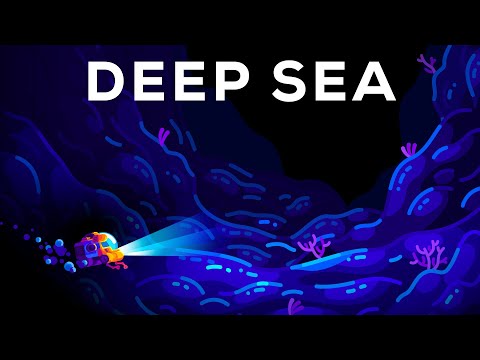 Photo: N43 and Hermes
A field guide to the ocean's depth zones, the creatures that survive crushing pressure, and the handful of humans who have visited the darkest place on Earth.
FIG 1 · The five major ocean depth zones. Light vanishes by 1,000 m; pressure reaches over 1,000 atmospheres in the hadal zone.
01The Planet We Barely Know
The ocean covers roughly 71% of Earth's surface, yet less than a quarter of its seafloor has been mapped to high resolution. We have better topographic maps of Mars and the Moon than of the ocean floor beneath our own boats. The deep sea — broadly defined as everything below 200 meters where sunlight gives out — constitutes the largest habitat on the planet and the least explored.
Kurzgesagt's animated explainer frames this paradox with characteristic clarity: the most solitary place on Earth is not a desert or a mountaintop but the bottom of the Mariana Trench, where the water column above exerts pressure equivalent to dozens of jumbo jets stacked on your back. The video has drawn 25 million views, and the reason is simple — people are captivated by the idea that the largest environment on Earth is also the one we know least about.
02Descent Through the Zones
As you sink from the surface, the ocean does not simply get darker — it transforms in stages. The upper 200 meters, called the epipelagic or sunlight zone, is where photosynthesis powers nearly all marine food webs. Below that lies the mesopelagic, or twilight zone, where only faint blue-green light filters through. By 1,000 meters, the bathypelagic zone begins: total darkness, temperatures near freezing, and pressure exceeding 100 atmospheres.
Deeper still, the abyssopelagic zone (4,000-6,000 m) covers the vast abyssal plains that constitute most of the ocean floor. Finally, the hadal zone — named for Hades — comprises the narrow, V-shaped ocean trenches that plunge below 6,000 meters. The Mariana Trench is the deepest of these, and its lowest point, the Challenger Deep, bottoms out at nearly 11 kilometers. If Mount Everest were placed inside it, its summit would still be more than 2 kilometers underwater.
03Life Without Light
The absence of sunlight means no photosynthesis, so the deep sea cannot support a plant-based food chain. Instead, life depends on two remarkable energy sources. The first is marine snow — a continuous drift of dead plankton, fecal pellets, and organic detritus sinking from the sunlit waters above. It sounds unappetizing, but it sustains entire ecosystems of filter feeders, scavengers, and predators across the abyssal plains.
The second energy source is far stranger. At hydrothermal vents — fissures in the seafloor where magma heats seawater to hundreds of degrees — bacteria perform chemosynthesis, converting sulfur compounds into energy without any sunlight at all. These microbial communities support tube worms, clams, and shrimp in dense oases that were entirely unknown until 1977. The discovery overturned the assumption that all life on Earth ultimately depends on the sun.
04Designing for Crushing Pressure
Pressure increases by roughly one atmosphere for every 10 meters of depth. At the bottom of the Mariana Trench, the pressure exceeds 1,000 atmospheres — over 16,000 pounds per square inch. Organisms that live here have evolved elegant solutions. Many deep-sea fish lack swim bladders, the gas-filled organs that surface fish use for buoyancy, because gas would be compressed to nothing at these depths. Instead, their bodies are mostly water, which is incompressible.
Some species produce trimethylamine oxide (TMAO), a molecule that stabilizes proteins against the distorting effects of pressure. The deeper a fish lives, the higher its TMAO concentration — a biochemical depth gauge written into its cells. Other organisms use flexible cartilage instead of bone, or simply abandon calcium skeletons that would dissolve under the combined assault of pressure and the deep ocean's slight acidity.
FIG 2 · Key milestones in humanity's exploration of the deep ocean, from the HMS Challenger survey to the Five Deeps Expedition.
05The Vehicles That Go There
Getting to the deep sea alive is an engineering problem of the first order. The bathyscaphe Trieste, which carried two men to the bottom of the Challenger Deep in 1960, used a gasoline-filled float for buoyancy (gasoline is lighter than water and incompressible) and iron ballast that could be released for ascent. The descent took nearly five hours; the explorers spent only 20 minutes on the bottom before observing a flatfish and beginning the long rise.
For decades after Trieste, human-occupied submersibles stayed shallower. The Japanese ROV Kaikō reached the Challenger Deep in 1995 but was lost at sea in 2003. James Cameron's DeepSea Challenger made a solo descent in 2012. In 2019, Victor Vescovo's Five Deeps Expedition became the first to reach the deepest point in all five oceans, descending in the submersible DSV Limiting Factor. Between crewed and unmanned missions, the cumulative bottom time at full ocean depth remains measured in hours, not days.
06Bioluminescence: Light Made in the Dark
One of the most poetic facts about the deep sea is that it is not entirely dark. In the twilight and midnight zones, an estimated 76% of organisms produce their own light through bioluminescence — chemical reactions that generate photons without heat. Deep-sea species use this living light for counterillumination (hiding their silhouette against the faint surface glow), for attracting prey with luminous lures, for finding mates with species-specific flash patterns, and for startling predators with sudden bursts.
The result is a world that, to eyes adapted to see it, twinkles like a night sky turned inside out. Kurzgesagt highlights this image memorably: the deep ocean is not merely empty and dark but, to the creatures that live there, lit by millions of living stars.
07What Remains Unexplored — and Why It Matters
The deep sea is not a curiosity; it is a planetary system. It absorbs vast quantities of carbon dioxide, regulates global temperature, and hosts biodiversity we have barely begun to catalog. Hydrothermal vent communities have already yielded enzymes used in PCR testing and pharmaceutical compounds under investigation for cancer treatment. The seafloor contains mineral-rich polymetallic nodules that mining companies are racing to extract, with unknown ecological consequences.
The central tension is simple. The deep ocean is the largest habitat on Earth, it sustains planetary systems we depend on, and we have explored less of it than the surface of Pluto. Every mission that descends finds species new to science. The most solitary place on Earth is also the most unknown — and the most worth knowing.
References & further reading
- Kurzgesagt, "What's Hiding at the Most Solitary Place on Earth? The Deep Sea" (source video; 25M views at research time).
- Wikipedia, "Deep sea" (depth zones, pressure, marine snow, chemosynthesis).
- Wikipedia, "Deep-sea exploration" (milestones, submersibles, instrumentation).
- Wikipedia, "Mariana Trench" (Challenger Deep, depth 10,911 m, research history).
- Wikipedia, "Hydrothermal vent" (chemosynthetic ecosystems, discovery in 1977).
- Wikipedia, "Bioluminescence" (prevalence in deep-sea organisms, ecological functions).
By N43 and Hermes for Sailor Bob News.


