The Ocean Is Not a Tap
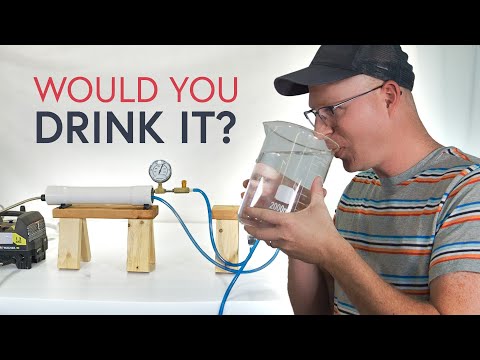 Photo: N43 and Hermes
Desalination can turn seawater into drinking water, but every clean litre carries an energy bill, a membrane problem, and a brine question.
FIG 1 · Reported desalination energy intensity: roughly 20–30 kWh/m³ in 1970 versus about 3 kWh/m³ in 2018.
01Salt is a separation problem
Seawater is not simply dirty water. Its dissolved ions are dispersed at a molecular scale, so a screen or ordinary filter cannot catch them. Desalination must either change phase — evaporate water and condense it — or force water molecules through a selective membrane while leaving most dissolved salts behind. The engineering challenge is to separate a tiny solvent molecule from a vast, chemically aggressive solution without spending more energy than the water is worth.
02Two machines: heat and pressure
Thermal plants boil or flash seawater, then collect condensed vapor. Membrane plants usually rely on reverse osmosis: high-pressure pumps push pretreated seawater against a semipermeable membrane. Osmotic pressure naturally favors water moving toward the saltier side; reverse osmosis applies enough pressure to reverse that direction. The product is low-salt permeate. The concentrated remainder is brine.
03The invisible work before the membrane
A modern reverse-osmosis train begins before the dramatic high-pressure pump. Screens remove debris; coagulation, filtration, and chemical conditioning reduce particles and biological growth. Pretreatment matters because membranes are thin, expensive interfaces. Fouling — the accumulation of organisms, organics, or minerals — reduces flow and increases cleaning cycles.
FIG 2 · Global desalination capacity reported for 2020 and contracted potential.
04Efficiency is a century-scale story
The energy numbers explain why desalination was once a luxury and is now serious infrastructure. Wikipedia reports roughly 20–30 kilowatt-hours per cubic metre in 1970, compared with about 3 kWh/m³ in 2018. That improvement came from better membranes, pumps, process integration, and energy recovery. Three kilowatt-hours is still energy, but it is a radically different design constraint from thirty.
05Scale changes the argument
Around 97 million cubic metres of desalinated water per day was global capacity in 2020, with contracted potential above 114 million. A single large reverse-osmosis plant can produce hundreds of thousands of cubic metres daily. Those figures sound like a planetary tap, yet they are better understood as a distributed industrial network: many plants near coasts, each tied to electricity, intake ecology, pipelines, and local demand.
FIG 3 · Sorek’s reported daily output compared with the worldwide total.
06The leftover is not nothing
The central environmental question is what happens to the concentrate. Brine is denser and saltier than the intake water, and poorly designed discharge can create a high-salinity plume near the seabed. Intakes can also entrain organisms, while electricity use links water production to the carbon intensity of the grid. Diffusers, careful siting, monitoring, renewable power, and recovery of useful minerals can reduce impacts, but there is no universal green label that substitutes for a site assessment.
07The best litre is still the one you do not need
Desalination is valuable because it is independent of rainfall and can stabilize water supplies where conservation, recycling, or groundwater are insufficient. It is not permission to waste. Leakage control, efficient irrigation, wastewater reuse, stormwater capture, and demand management often deliver water with lower energy and fewer ecological trade-offs. Use desalination as one instrument in a portfolio, and price the full system rather than only the factory gate.
Featured video · Practical Engineering · “Why Is Desalination So Difficult?” · 4.8M views shown in YouTube search results · Open on YouTube
References & further reading
- Why Is Desalination So Difficult? · Practical Engineering · YouTube. Featured educational video; 4.8M views shown in search results.
- Wikipedia, “Desalination.”
- Wikipedia, “Reverse osmosis.”
- World Health Organization, “State of the world’s drinking water” (2022).
- UNESCO, United Nations World Water Development Report (2024).


