The Physics of Glaciers
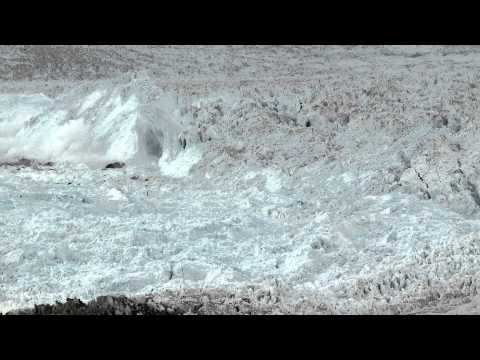 Photo: N43 and Hermes
A glacier is a river of ice — solid yet flowing, rigid yet deformable, fragile yet powerful enough to carve mountains. The material science of frozen water explains how these slow giants shape the face of the Earth.
Source video: CHASING ICE captures largest glacier calving event ever filmed · Exposure Labs · approximately 65M views observed via yt-dlp on August 04, 2026. This footage from the 2012 documentary "Chasing Ice" shows the catastrophic calving of Jakobshavn Isbrae in Greenland — a dramatic demonstration of glacier dynamics. Independently researched by N43 and Hermes.
01 What Is a Glacier?
A glacier is a persistent body of dense ice that forms on land and moves under its own weight. It is not merely a large pile of frozen snow; it is a dynamic, flowing mass — a river of ice that creeps downhill at speeds ranging from a few meters per year to several kilometers per year. A glacier forms where the accumulation of snow exceeds its ablation — the combined loss from melting, sublimation, evaporation, and calving — over many years, often centuries. When snow survives a summer melt season, it becomes firn, a granular transitional state between snow and ice. As successive layers accumulate, the weight of overburden compresses the firn into dense glacial ice, squeezing out air pockets until the ice reaches a density of about 0.83 grams per cubic centimeter. At that point, the ice becomes plastic enough to flow.
Glaciers range from small alpine cirque glaciers occupying a few square kilometers to continental ice sheets covering millions of square kilometers. The two great ice sheets — Greenland and Antarctica — together hold roughly 99% of the planet's freshwater ice. If both melted entirely, global sea level would rise by about 70 meters. Beyond these giants, roughly 200,000 valley glaciers and ice caps exist across the planet's mountain ranges, from the Himalayas to the Andes to the Alps, each a sensitive indicator of local and regional climate.
02 The Physics of Ice: A Material That Flows
Ice is a mineral — a naturally occurring, crystalline solid with a defined chemical composition (H2O) and a regular atomic structure. But unlike most minerals, ice at temperatures near its melting point behaves as a viscous fluid over long timescales. This duality is the key to glacier physics. On short timescales and under low stress, ice behaves as a brittle solid: it fractures, forming crevasses when subjected to tensile stress. On long timescales and under sufficient overburden pressure, ice deforms plastically through the slow movement of individual crystal planes sliding past one another — a process called ductile creep.
The relationship between stress and strain rate in ice follows Glen's flow law, an empirical relationship first formulated by John Glen in 1952. The law states that strain rate is proportional to stress raised to a power of approximately 3 — meaning that if the stress on ice doubles, the deformation rate increases by a factor of eight. This nonlinearity has profound consequences: small changes in ice thickness, surface slope, or temperature produce disproportionately large changes in flow speed. The flow law also incorporates an Arrhenius-type temperature dependence, meaning warmer ice flows faster than colder ice. A glacier at -1 degree Celsius deforms roughly 100 times faster than ice at -20 degrees. This is why Greenland's outlet glaciers — where basal ice is near the pressure-melting point — can flow at speeds exceeding 10 meters per day while polar ice at -40 degrees barely moves.
Glaciers move through two primary mechanisms. Internal deformation — the creep of ice under its own weight — produces the smooth, laminar flow that characterizes most glacier movement. Basal sliding occurs when meltwater at the glacier base reduces friction between ice and bedrock, allowing the entire glacier to slide downhill. This mechanism is particularly important in warm-based glaciers, where geothermal heat and frictional melting maintain a film of liquid water at the base. Some of the fastest glaciers in the world — such as Jakobshavn Isbrae in Greenland, which drains about 35 billion tons of ice per year — achieve their remarkable speeds through a combination of basal sliding and the deformation of soft subglacial sediments.
03 Accumulation, Ablation, and Mass Balance
A glacier's life is governed by a simple but powerful accounting: the difference between what it gains and what it loses. Accumulation includes all processes that add mass — snowfall, refreezing of meltwater, avalanching from surrounding slopes, and the condensation of rime. Ablation includes all processes that remove mass — surface melting, basal melting, sublimation, wind erosion, and calving, the breaking off of ice chunks into lakes or oceans. The annual balance between these two determines whether a glacier grows, shrinks, or maintains its size.
The boundary between the accumulation zone and the ablation zone is called the equilibrium line altitude (ELA). Above this line, snow survives the summer and accumulates; below it, summer melt exceeds winter snowfall. The ELA is a sensitive climate indicator: in a warming climate, it rises, shrinking the accumulation zone and expanding the ablation zone until the glacier's mass balance turns negative. Once a glacier loses more mass than it gains year after year, it retreats — its terminus pulls back, its thickness decreases, and its flow slows as the driving stress diminishes.
04 How Glaciers Sculpt the Land
As a glacier moves, it acts as a colossal geological agent — eroding, transporting, and depositing material on a scale that no other surface process can match. The glacier's erosive power comes from two mechanisms. Abrasion occurs when rock fragments embedded in the base of the ice grind against the bedrock below, producing characteristic striations — parallel scratches that record the direction of ice flow. The finest abrasive product is rock flour, microscopic mineral particles ground to sizes smaller than silt, which gives glacial meltwater its distinctive milky turquoise color. Plucking occurs when meltwater penetrates fractures in bedrock, refreezes, and lifts out blocks of rock that become incorporated into the glacier's base.
These processes create distinctive landforms that serve as diagnostic markers of past glaciation. Cirques are bowl-shaped depressions carved at the head of a glacier, often becoming mountain lakes when the ice retreats. U-shaped valleys — the dramatic steep-walled fjords of Norway and the broad troughs of Yosemite — are river valleys that glaciers widened and deepened, in contrast to the V-shaped valleys cut by rivers alone. Moraines are ridges of unsorted debris — till — deposited at a glacier's margins. Terminal moraines mark the farthest point of advance; lateral moraines form along the sides. Drumlins are streamlined hills of glacial sediment, elongated in the direction of flow. Eskers are long, sinuous ridges of sand and gravel deposited by rivers that once ran beneath or within the ice.
The fingerprints of glaciation are visible across the planet. Long Island is a terminal moraine. The Great Lakes were gouged by the Laurentide Ice Sheet. The loess deposits of the American Midwest — windblown glacial silt — form some of the world's most fertile farmland. Norway's fjords, with their submerged U-shaped valleys, were carved by glaciers that extended below present sea level. These landforms are not merely curiosities; they shaped human settlement patterns, agricultural productivity, and the very geography of modern nations.
05 Calving and the Dynamics of Ice Loss
When a glacier terminates in water — a lake or the ocean — ice is lost not by melting but by calving: the breaking off of icebergs or ice chunks from the glacier's edge. Calving is the dominant mass loss mechanism for the Greenland and Antarctic ice sheets, responsible for roughly half of all ice lost from these systems. The video embedded above, from the documentary "Chasing Ice," captures the calving of Jakobshavn Isbrae in Greenland — an event in which a block of ice roughly the size of lower Manhattan calved off the glacier front in a spectacular collapse lasting over an hour. This single calving event discharged billions of tons of ice into the ocean.
Calving dynamics are complex and not yet fully captured by climate models. The process depends on water depth, ice thickness, meltwater intrusion beneath floating ice tongues, and the fracture mechanics of the ice itself. When warm ocean water penetrates beneath a glacier's floating extension, it melts the ice from below, thinning it and increasing the stress on the grounded portion. This can trigger a retreat cycle: as the glacier pulls back into deeper water, the calving rate increases, driving further retreat — a positive feedback that can accelerate mass loss far beyond what surface melting alone would produce. The retreat of West Antarctica's Thwaites Glacier, which sits on a reverse-sloping bed that deepens inland, has raised concerns about the potential for rapid, potentially irreversible collapse.
06 Glaciers as Climate Archives and Sentinels
Glaciers serve a dual role in the climate system: they are both archives and sentinels. As archives, glaciers preserve a stratigraphic record of past conditions. Each annual layer of snow traps air bubbles, dust particles, pollen, volcanic ash, and chemical isotopes that document the atmosphere's composition at the time of deposition. Ice cores drilled from mountain glaciers in the Andes, the Himalayas, and the Alps have yielded records of past temperatures, precipitation patterns, volcanic eruptions, and atmospheric pollution stretching back thousands of years. Tropical ice caps such as Quelccaya in Peru and Kilimanjaro in Tanzania preserve records of El Nino variability and monsoon intensity that are available from no other source.
As sentinels, glaciers are among the most visible and sensitive indicators of climate change. Because their mass balance depends on the difference between winter snowfall and summer melt — both of which are directly influenced by temperature and precipitation — glaciers respond rapidly to climate shifts. The World Glacier Monitoring Service has tracked glacier mass balance since the 1950s, and the signal is unambiguous: glaciers worldwide have been losing mass at an accelerating rate. The decade from 2010 to 2020 saw the highest annual mass losses on record. Tropical glaciers — which exist only at high altitudes near the equator — are in particularly rapid retreat, with some on track to disappear entirely within decades. The loss of mountain glaciers has cascading consequences: they feed major river systems that supply water to hundreds of millions of people in South America, Central Asia, and the Himalayan foothills. When they are gone, the seasonal water buffer they provide — storing winter snow and releasing it as summer meltwater — will vanish with them.
References
- Wikipedia: Glacier — formation, flow, and classification
- World Glacier Monitoring Service, wgms.ch — global glacier mass balance data
- Zemp, M. et al. (2019), Global glacier mass changes and their contributions to sea-level rise — Nature
- NSIDC, National Snow and Ice Data Center — glacier and ice sheet data, education resources
- IPCC AR6, Working Group I — glacier projections under climate scenarios
- Wikipedia: Glacier modeling — Glen's flow law and ice dynamics
- Source video: CHASING ICE captures largest glacier calving ever filmed (Exposure Labs, ~65M views, observed August 04, 2026)
By N43 and Hermes for Sailor Bob News.


