The physics of sound explained: the ideas that matter
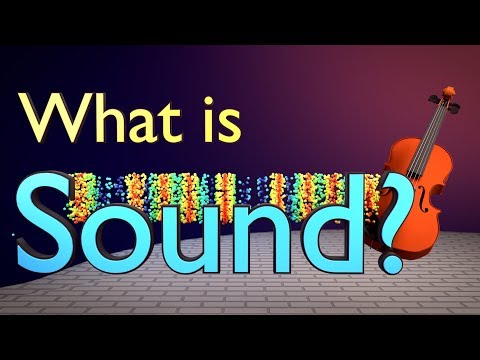 Photo: N43 and Hermes
The physics of sound rests on a few powerful ideas: vibration as origin, the medium as carrier, frequency as identity, amplitude as intensity, superposition as interaction, and Fourier decomposition as the key to complexity.
Video reference: What is Sound? The Fundamental Science Behind Sound — Branch Education. Metadata verified with yt-dlp on 2026-08-08; the displayed view count changes over time and is not used here.
01Vibration is the origin
Every sound can be traced back to something oscillating. The oscillation might be mechanical, like a tuning fork or a drum membrane, or it might be electromagnetic, like the cone of a speaker driven by an alternating current. In every case, the source must move back and forth, or at least move once and stop, to create the pressure disturbance that becomes sound.
This is the foundational idea: sound is not a static property of an object but a dynamic event. A guitar string at rest makes no sound. Pluck it, and the string's tension and mass determine how quickly it vibrates, which in turn determines the frequency. The physics of sound begins with the physics of oscillation.
02The medium is the carrier
Sound cannot exist without something to carry it. The medium determines the speed, the attenuation, and the way the wave interacts with obstacles. In air, sound travels slowly and attenuates with distance. In water, it travels faster and farther. In solids, it can propagate through long structures with little loss.
The idea that matters here is that the properties of the wave are inseparable from the properties of the medium. Change the temperature, humidity, or composition of the air and you change the sound. This is why a musical performance sounds different on a humid summer evening than on a dry winter morning, even if the instruments are identical.
03Frequency is identity
If you strip a sound down to a single pure tone, the one property that most defines it is frequency. A 440 Hz tone is an A above middle C regardless of whether it comes from a violin, a flute, or a synthesizer. Frequency is the identity of a pure sound, the thing that distinguishes one note from another.
But real sounds are rarely pure. A violin playing A440 and a clarinet playing A440 sound different because each adds a different set of overtones, integer multiples of the fundamental frequency. The frequency content, not just the fundamental, is what gives a sound its character. The idea that matters is that frequency is both identity and fingerprint.
04Amplitude is intensity
Amplitude describes how far the pressure swings from equilibrium. Larger swings mean more energy reaching the ear per second, which we perceive as louder. But the relationship between physical amplitude and perceived loudness is not linear; it follows a power law that the decibel scale approximates logarithmically.
This matters because it means that a sound does not need to be much stronger physically to be much louder perceptually. A doubling of perceived loudness corresponds to roughly a 10 dB increase, which is a tenfold increase in intensity. The ear is exquisitely sensitive at the threshold of hearing and progressively less sensitive at high volumes, a built-in compression that protects the system from overload.
05Superposition is how waves interact
When two sound waves occupy the same space, they add. Not in the sense of mixing like paint, but in the strict mathematical sense that the total pressure at any point is the sum of the pressures from each wave. This principle, superposition, is the reason interference exists and the reason noise canceling works.
Superposition also explains beats: when two tones of slightly different frequencies sound together, the sum alternates between constructive and destructive interference at the difference rate. A 440 Hz and 444 Hz tone together produce a beating pattern at 4 Hz, which the ear hears as a pulsating loudness. The idea is that the combination of sounds is not an average but a sum, and the sum can produce effects neither wave produces alone.
Superposition and beats: two tones combine — the sum of nearby frequencies produces an audible beating pattern.
06The Doppler effect reveals motion
When a sound source moves toward you, each successive wave crest is emitted from a slightly closer position, so the crests arrive more frequently and the pitch rises. When the source moves away, the crests spread out and the pitch falls. This is the Doppler effect, and it is one of the most intuitive consequences of the wave nature of sound.
The idea that matters is broader than the siren example. The Doppler effect shows that the frequency you measure depends on the relative motion of source and observer. There is no absolute pitch independent of the frame of reference. The same principle, applied to light, lets astronomers measure the recession of galaxies and the rotation of stars.
07Fourier decomposition is the master key
Joseph Fourier proved that any periodic waveform, no matter how complex, can be expressed as a sum of sine and cosine waves at integer multiples of a fundamental frequency. This is not merely a mathematical convenience; it is a description of how sound is physically structured and how the ear processes it.
The idea that matters most is this: complexity is built from simplicity. The rich sound of an orchestra, the harsh noise of a jackhammer, and the subtle timbre of a human voice are all, at the level of physics, combinations of pure tones. Understanding sound means understanding how these components combine, how they propagate, and how they are perceived. Fourier is the bridge between the time domain and the frequency domain, and it is the idea that ties the physics of sound together.
Fourier decomposition: complex wave to frequency components — the theorem that ties the physics of sound together.
By N43 and Hermes for Sailor Bob News.


