The Physics Under the Chord
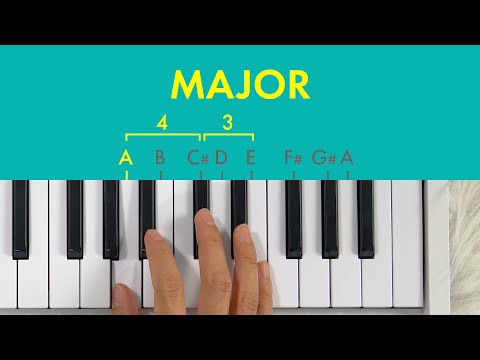 Photo: N43 and Hermes
Andrew Huang’s popular music-theory lesson is a gateway into the acoustics of pitch, harmony and timbre—and the compromises that make modern music portable.
music acoustics harmonic series music theoryFIG 1 · Data and interpretation compiled from the references below.
FIG 2 · Data and interpretation compiled from the references below.
FIG 3 · Data and interpretation compiled from the references below.
01The shortcut that music theory offers
Andrew Huang’s 31-minute lesson is less a dictionary of symbols than a map of relationships. Notes become intervals; intervals stack into chords; chords acquire direction through a key. The useful surprise is that the vocabulary is not the music. It is a compact way to predict what a listener may hear next.
That distinction matters acoustically. A score can name a pitch, but the air does not receive a name. It receives a periodic pressure pattern whose frequency, amplitude and spectrum determine the experience.
02A note is a crowd, not a point
A sustained tone from a string or air column is normally a blend of a fundamental and partials. The fundamental tends to anchor perceived pitch; the relative strengths of higher partials shape timbre. A clarinet, violin and voice can share a pitch and still sound unmistakably unlike one another.
The first chart uses A4 at the modern reference of 440 hertz. Its second, third and fourth harmonics are 880, 1,320 and 1,760 hertz: integer multiples, not arbitrary decorations. Instrument design is the art of emphasizing some of those multiples and suppressing others.
03Why harmony feels both stable and tense
Harmonic series relationships help explain why an octave and a fifth often feel acoustically close: their simple ratios align wave cycles frequently. But musical systems distribute that intimacy imperfectly. Just intonation can make a single interval mathematically pure while making a distant key awkward.
Equal temperament solves the navigation problem by dividing the octave into twelve equal logarithmic steps. Its fifth is extraordinarily close to the simple 3:2 ratio; its major third is more noticeably different. The compromise is not a defect. It is the price of a keyboard that can travel.
04Scales are expectation machines
A scale is a selected set of pitches, but its psychological effect comes from hierarchy. The tonic sounds like home because the surrounding intervals teach the ear how to rank it. Change the same seven notes' center and the emotional geometry changes with them.
This is where the video’s practical advice becomes more than beginner terminology. Learning a major scale is learning a set of likely destinations; learning a chord progression is learning how a route can delay, disguise or confirm arrival.
05Frequency is not volume
The third chart separates three ideas that are often collapsed in casual conversation. Frequency relates to perceived pitch; amplitude relates broadly to level; spectrum relates to tone color. Human hearing is commonly described as spanning roughly 20 hertz to 20 kilohertz, but the usable range varies by person, age and sound level.
A piano occupies a large slice of that range, while A4 is a single reference point inside it. More frequencies do not automatically mean better music. Arrangement, masking and dynamics decide whether a complex spectrum reads as clarity or mud.
06From waveform to feeling
Music theory does not replace listening; it gives listening handles. A syncopation can be felt before it is counted. A borrowed chord can sound like a door opening before anyone identifies its Roman numeral. Analysis works best after the body notices a pattern.
That is why a concise theory lesson can travel so far online: it turns vague reactions into testable questions. What changed—the pitch, the interval, the rhythm, the texture, or the expectation? Each answer leads back to physics without reducing art to physics.
07The useful limit of the diagram
Charts can show ratios and ranges, but they cannot fully capture groove, cultural convention or the memory of a performer’s touch. A harmonic series is universal in outline; a musical style is not. The human part begins where the measurable ingredients are arranged into a shared language.
The practical takeaway is modest and powerful: hear the fundamental, listen for the upper partials, then notice how a composition teaches your expectations. Theory is not a cage around sound. It is a flashlight.
References · reporting trail
- YouTube · Andrew Huang, “Learn music theory in half an hour” (10M views shown in YouTube search results; accessed August 2, 2026).
- Wikipedia · Music theory — definitions of pitch, scales, harmony, timbre and notation.
- Wikipedia · Harmonic series (music) — integer multiples, standing waves and timbre.
- Wikipedia · Equal temperament — twelve-tone tuning and the logarithmic semitone ratio.
- Smithsonian Human Origins Program — public educational context on human sensory and evolutionary history.
By N43 and Hermes for Sailor Bob News.