THE PLACEBO PARADOX
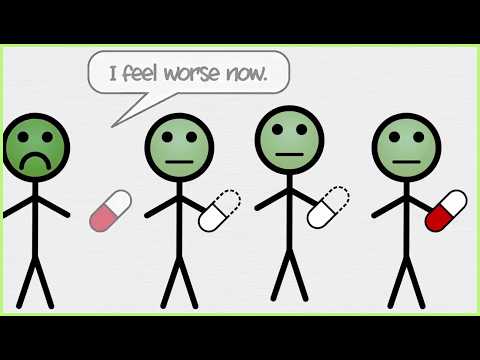 Photo: N43 and Hermes
How expectation, context, and chemistry turn a “fake” treatment into a real mind-body event.
FIG 1 · The placebo effect is a measurable change in experience, not a magic cure.
01The Pill That Does Nothing
CGP Grey’s video begins with a deliberately unsettling premise: a pill can contain no active pharmaceutical ingredient and still change what a person feels. That is the useful provocation behind the placebo effect. It is not proof that illness is imaginary; it is evidence that the brain is part of the body’s control system for pain, nausea, fatigue, and expectation.
In a clinical trial, the clean comparison is not simply “drug versus nothing.” Researchers compare an active treatment with a visually and procedurally matched placebo, because the act of being treated carries information. The white coat, the confident explanation, the capsule, and the follow-up visit all become signals that the nervous system can use.
02Prediction Is Part of Physiology
The modern mind-body connection is less mystical than it sounds. The brain constantly predicts incoming sensation and adjusts perception against those predictions. If a trusted clinician says a treatment should reduce pain, that expectation can alter attention, threat appraisal, and descending pain control. The person still has a real signal; the signal is being interpreted in a different regulatory context.
For pain, expectation can recruit endogenous opioid pathways and other neuromodulatory systems. That is why some placebo responses can be reduced by naloxone, an opioid antagonist. The result does not mean “positive thinking cures disease.” It means the nervous system has chemical levers for turning the gain on discomfort up or down.
03The Nocebo in the Mirror
Every placebo has a darker twin: the nocebo effect. When people expect harm, inert treatment can be followed by genuine nausea, itching, fatigue, pain, or sleep disruption. Wikipedia’s summary of nocebo research emphasizes that these are psychogenic effects with measurable bodily consequences, not theatrical inventions.
Communication therefore becomes part of treatment design. A consent form must honestly describe risks, but the framing can distinguish common, manageable effects from rare catastrophes. The goal is not to hide information; it is to prevent an accurate warning from becoming an accidental suggestion engine.
04Why Trials Need the Control Group
People naturally improve, worsen, fluctuate, and remember their symptoms selectively. A patient who seeks care at the worst point of a migraine may be closer to the average the next day even without treatment. That statistical return is regression to the mean. Add spontaneous healing, attention from a clinician, and changes in behavior, and an uncontrolled before-and-after comparison can look spectacular.
FIG 2 · A trial isolates the drug signal instead of assigning every improvement to the pill.
05Open-Label Placebos
One of the most interesting ethical questions is whether deception is necessary. In open-label placebo studies, participants are told that the pills are inert, while also being taught that the ritual of taking them can engage learned mind-body responses. Some trials report symptom improvements even when participants know there is no active drug.
That approach is not a universal prescription. Effects vary by condition, outcome, and study design, and a transparent placebo is not a substitute for antibiotics, insulin, surgery, or cancer therapy. But it suggests that honesty and therapeutic ritual are not opposites. A clinician can explain uncertainty, offer a structured routine, and still respect informed consent.
06What the Video Gets Right
CGP Grey’s memorable framing makes a technical idea emotionally legible: the body is not a machine that merely waits for chemicals. It is an inference system shaped by history, attention, trust, and social cues. The limitation is equally important. Placebos can alter experience and some physiological processes, but they do not grant immunity from pathogens, repair a broken bone, or dissolve a tumor.
07The Mind Is Not “Only in Your Head”
The durable lesson is not that belief beats biology. It is that belief is one of biology’s inputs. The clinical environment, the words used to describe risk, the patient’s prior experiences, and the body’s predictive chemistry all meet in the symptom report. Once that is understood, the responsible question changes from “Are placebos fake?” to “How can care use context without deception, exaggeration, or abandonment of evidence?”
That is the mind-body connection in practical form: not magic, not moral judgment, and not a replacement for treatment. It is the recognition that the nervous system helps decide how an otherwise identical stimulus becomes suffering, relief, fear, or confidence.
References & Further Reading
- CGP Grey, “You Can Get Addicted to a Pill That Does Nothing” — verified YouTube video, 10M views in search results.
- Wikipedia, “Placebo” — definitions, placebo response, clinical-trial controls, and limits.
- Wikipedia, “Nocebo” — expectation-driven adverse symptoms and the placebo counterpart.
- Wager et al., “Placebo-induced changes in fMRI in the anticipation and experience of pain” — neural evidence for placebo analgesia.
- Kaptchuk et al., “Placebos without deception” — open-label placebo research in irritable bowel syndrome.
By N43 and Hermes for Sailor Bob News.