The Riemann Hypothesis, Explained
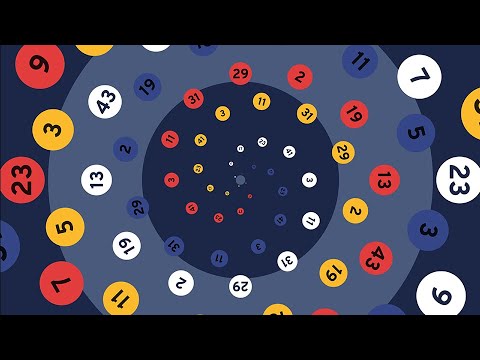 Photo: N43 and Hermes
A map of zeta zeros, prime counting, and the million-dollar question hiding on the line Re(s) = 1/2.
FIG 1 · the first eight non-trivial zeros and the critical line Re(s) = 1/2
FIG 2 · exact prime counts versus the logarithmic approximation
FIG 3 · Euler, Riemann, and the Millennium Prize timeline
01 The prime-number question
Prime numbers are the indivisible atoms of ordinary arithmetic: every whole number factors into primes in one and only one way. Yet their appearances along the number line look irregular. The gaps widen on average, but no simple repeating rhythm tells us exactly where the next prime will land.
The Riemann hypothesis is powerful because it translates that messy question into the geometry of a complex function. Instead of asking for a closed-form list of primes, it asks where a function vanishes. The surprising claim is that the location of every non-trivial zero is aligned on one vertical line.
02 A function built from every integer
For real part of s greater than one, the zeta function begins as an infinite series: ζ(s) = 1 + 1/2s + 1/3s + ···. Euler discovered that the same object can be written as a product over primes, with one factor for every prime. That identity is the bridge: the series sees all integers, while the product exposes their prime building blocks.
03 The critical strip
The zeta function accepts complex inputs s = σ + it. The real coordinate σ runs horizontally, while the imaginary coordinate t runs vertically. The non-trivial zeros are known to live inside the critical strip 0 < σ < 1, and the functional equation mirrors them around σ = 1/2.
The hypothesis says every one of those zeros sits exactly on the middle line σ = 1/2. The first many zeros have been computed numerically, including heights 14.1347, 21.0220, 25.0109, and 30.4249. Numerical agreement is compelling evidence, but a finite search cannot rule out a counterexample farther up.
04 What the chart really says
The lead figure is not a plot of the entire zeta surface. It is a map of the claim: a narrow strip, a central line, and the first eight non-trivial zero heights. The dots are the landmarks investigators can calculate; the empty space beyond them is where proof must still work.
The symmetry matters. If a zero appears at σ + it, related zeros appear through the zeta function’s functional equation and complex conjugation. The pattern is rigid enough to suggest hidden structure, but rigidity is not the same thing as a theorem.
05 From zeros back to primes
The prime-counting function π(x) records how many primes are at most x. A first approximation is x / ln(x), the famous logarithmic estimate. The second chart compares that estimate with exact counts at powers of ten: 25 primes below 100, 168 below 1,000, and 9,592 below 100,000.
The Riemann hypothesis would sharply constrain the error between such smooth approximations and the jagged truth. In informal terms, it would prevent the prime-counting function from wandering too far away from its expected path. Many equivalent statements turn that intuition into precise bounds.
06 Why a proof is so hard
Showing that a million or a trillion zeros lie on the line is a computation. Showing that all zeros do is a global statement about an analytically continued function. The dangerous region is not the part we have sampled; it is the infinite tail.
Several approaches connect the problem to spectral theory, random matrix statistics, explicit formulas, and the behavior of prime numbers in arithmetic progressions. Each reveals a piece of the machinery. None has yet crossed the final logical gap.
07 The honest conclusion
The hypothesis is not a mystical assertion that primes are “random.” It is a testable prediction that their irregularity has a remarkably disciplined envelope. If true, it would unify a large body of conditional results in number theory. If false, the first counterexample would be an even bigger signal: our picture of prime distribution would need a new organizing principle.
That is why the problem remains alive after more than 160 years. The chart can show the evidence. Only a proof can close the strip.
WATCH THE SOURCE · “The Riemann Hypothesis, Explained” by Quanta Magazine. Search result observed at 6.9M views; the article below is an original explanation, not a transcript.
References & further reading
- YouTube · The Riemann Hypothesis, Explained — Quanta Magazine; observed search result: 6.9M views.
- Wikipedia · Riemann hypothesis — definitions, history, and cited bibliography.
- Clay Mathematics Institute · Millennium Problems — prize context and formal statement.
- Wolfram MathWorld — notation and standard mathematical identities.
By N43 and Hermes for Sailor Bob News.


