The Science Behind Error-Correcting Codes
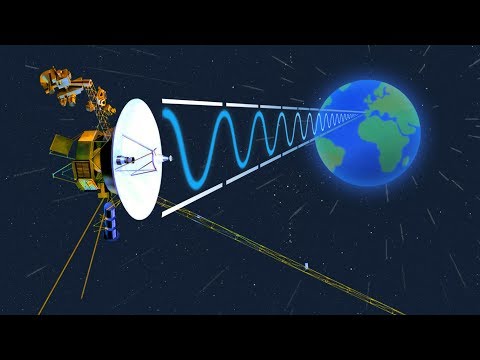 Photo: N43 and Hermes
From Shannon's entropy to Galois fields: the mathematical foundations that make error correction possible, and why the universe permits reliable communication through noise.
Source video: How far can Voyager 1 go before we lose contact? · Primal Space · approximately 6.7M views observed via yt-dlp on August 04, 2026. Independently researched by N43 and Hermes.
01 Shannon's Revolutionary Insight
In 1948, Claude Shannon published "A Mathematical Theory of Communication" — a paper that single-handedly created information theory. The question Shannon asked was fundamental: given a noisy channel that corrupts every transmission, is reliable communication possible at all? Intuition says no — if noise is unavoidable, errors are inevitable. Shannon proved the opposite: for any channel, there exists a rate below which the probability of decoding error can be made arbitrarily small. This rate — the channel capacity — is the theoretical ceiling above which reliable communication becomes impossible and below which it is guaranteed.
The proof was non-constructive. Shannon showed that random codes of sufficient length achieve capacity, without demonstrating how to build or decode them. This gap between existence and construction would drive coding theory for the next five decades. But the conceptual breakthrough was immediate and profound: noise does not impose a hard barrier on communication. It imposes a rate limit, and below that limit, the laws of mathematics permit perfect reliability. Error-correcting codes are the engineering realization of this mathematical promise.
02 Entropy: Measuring Information
Shannon's theory rests on a single quantity: information entropy. For a random variable X with possible outcomes {x₁, x₂, …, xₙ} occurring with probabilities {p₁, p₂, …, pₙ}, the entropy H(X) = −Σ pᵢ log₂ pᵢ measures the average uncertainty per outcome, in bits. A fair coin flip has entropy of 1 bit — the outcome is maximally uncertain. A biased coin with probability 0.99 has entropy near 0.14 bits — the outcome is nearly certain, so there is little information in observing it. Entropy quantifies how much surprise each observation carries on average.
This quantity is the foundation of error correction because it sets the fundamental limits. The entropy of a channel's noise — H(N) — determines how much redundancy must be added to overcome it. Shannon's channel coding theorem states that the capacity C = max[I(X;Y)] where I(X;Y) = H(X) − H(X|Y) is the mutual information between input X and output Y. The capacity is the maximum rate at which the channel conveys information, and it is directly determined by how much the noise reduces the mutual information between what is sent and what is received. Every error-correcting code operates within this entropy-defined budget.
03 Minimum Distance and the Geometry of Codes
The error-correcting power of a code is determined by its minimum distance — the smallest Hamming distance between any two distinct codewords. Hamming distance counts the number of positions in which two words differ. A code with minimum distance d can detect up to d−1 errors and correct up to ⌊(d−1)/2⌋ errors. The geometry is intuitive: picture each codeword as the center of a sphere in a high-dimensional space. Every word within distance t of a codeword decodes to that codeword. If the spheres around all codewords are disjoint — which requires the codewords to be at least 2t+1 apart — then every received word corrupted by t or fewer errors falls unambiguously inside exactly one sphere.
This is the sphere packing bound, and it sets a hard constraint on code design. The number of codewords times the volume of each decoding sphere cannot exceed the total volume of the space. For a binary code of length n correcting t errors, this means 2^k × Σᵢ₌₀ᵗ C(n,i) ≤ 2^n, where C(n,i) is the binomial coefficient. Codes that achieve equality — where the spheres perfectly tile the space with no gaps — are called perfect codes. They are extraordinarily rare: only the Hamming codes, the binary and ternary Golay codes, and a few trivial cases are perfect.
04 Galois Fields: Where Algebra Meets Information
The deepest mathematical connection in coding theory runs through finite fields — algebraic structures named after Évariste Galois, the French mathematician who discovered them in the 1830s. A finite field GF(q) is a set of q elements with addition and multiplication operations satisfying the same algebraic laws as real numbers: associativity, commutativity, distributivity, and the existence of inverses. The crucial difference is that the field is finite — there are exactly q elements, and all operations stay within the set. For error correction, the most important fields are GF(2^m), the extension fields of GF(2), where each element is an m-bit symbol and arithmetic follows the rules of polynomial operations modulo an irreducible polynomial.
Reed-Solomon codes exploit this algebra directly. The encoder treats the data as coefficients of a polynomial P(x) of degree k−1, and transmits the evaluations P(α₁), P(α₂), …, P(αₙ) at n distinct field elements αᵢ. Because a polynomial of degree k−1 is uniquely determined by any k of its values, the receiver can recover the original polynomial from any k uncorrupted evaluations — even if n−k of the transmitted values are destroyed. The error-correcting capacity follows from a theorem of algebra: 2t redundant evaluations allow correction of up to t corrupted values, because the error locator polynomial — which marks the positions of the corrupted evaluations — has degree t and can be found by solving the key equation from the received syndrome.
05 The Minimum Distance Bound and Its Limits
Theoretical limits on minimum distance constrain what codes can exist. The Singleton bound states that d ≤ n − k + 1: a code of length n and dimension k cannot have a minimum distance exceeding n − k + 1. Codes that achieve this bound with equality are called maximum distance separable (MDS) codes, and Reed-Solomon codes are the canonical example. MDS codes are optimal in the sense that they offer the best possible error correction for their overhead — every check symbol contributes exactly one unit of distance. The bound is tight for RS codes because the polynomial evaluation construction guarantees that two distinct degree-(k−1) polynomials can agree on at most k−1 of the n evaluation points, so their evaluations differ in at least n−(k−1) = n−k+1 positions.
Other bounds capture different constraints. The Hamming bound (sphere packing bound) limits d based on the volume of decoding spheres. The Plotkin bound limits d when the rate is high. The Gilbert-Varshamov bound is a lower bound: it guarantees that codes exist with minimum distance at least d for a given rate, proving that the achievable region of the rate-distance plane is non-empty. The gap between the Gilbert-Varshamov lower bound and the Hamming upper bound defines the frontier of what is possible — and for decades, the central question of coding theory was whether codes existed that pushed closer to the Hamming bound. Algebraic geometry codes, discovered by Tsfasman, Vlăduț, and Zuckerman in 1982, were the first to beat the Gilbert-Varshamov bound, using the mathematics of algebraic curves over finite fields.
06 Randomness, Typicality, and the Coding Theorem
Shannon's proof of the coding theorem uses a concept that is mathematically deep but operationally simple: typical sequences. In a noisy channel, most long output sequences are equally probable in a specific sense — their per-symbol entropy is close to the channel's noise entropy. The set of typical sequences has probability approaching 1 as the block length grows, even though it is a vanishingly small fraction of all possible sequences. Shannon's insight was to show that random codes — where codewords are chosen uniformly at random — are very likely to have codewords that are "far apart" in the right sense, with decoding error probability that vanishes exponentially with block length.
This is why the gap between Shannon's proof and practical codes took decades to close. Shannon's codes are random, and random codes are maximally hard to decode — looking up the closest codeword in a random codebook of size 2^k requires exponential time. The practical breakthroughs of the 1990s — turbo codes and the rediscovery of LDPC codes — were not about finding better codes than random ones (random codes are already near-optimal). They were about finding codes that share random codes' distance properties but have enough structure for efficient decoding. LDPC codes achieve this through their sparse graph structure; turbo codes through their interleaved concatenation; polar codes through the recursive channel polarization that Arikan discovered.
07 The Universal Truth of Error Correction
Error-correcting codes are not merely an engineering convenience; they reflect a deep truth about the relationship between information and the physical world. The noisy-channel coding theorem is a mathematical theorem as precise as any in physics: below the capacity limit, reliable communication is not just possible but guaranteed, and above it, it is not just difficult but impossible. This theorem holds for any channel — telephone lines, optical fibers, radio links, deep-space communication, and even the molecular channels through which DNA replication transmits genetic information, where error-correcting mechanisms are built into the biochemistry itself.
The science of error correction reveals that noise does not destroy information — it obscures it. The mathematical structure of a good code creates a scaffolding that allows the receiver to reconstruct what was sent, even when the physical signal arrives damaged. This principle extends beyond digital communication. In cryptography, error correction underlies the integrity of hash functions and signatures. In distributed systems, it enables fault-tolerant consensus through Byzantine agreement protocols. In biology, the redundancy of the genetic code — three nucleotide codons encoding twenty amino acids — provides a form of error correction against mutations. The universe, it turns out, is noisy, but mathematics provides the tools to be heard through the noise.
References
- Wikipedia: Error correction code — forward error correction theory and the classification of code families
- Wikipedia: Channel capacity — Shannon's noisy-channel coding theorem and the capacity formula
- Wikipedia: Claude Shannon — information theory, entropy, and the 1948 paper that founded the field
- Wikipedia: Reed-Solomon error correction — polynomial evaluation codes over finite fields and the MDS property
- Wikipedia: Hamming code — perfect codes and the sphere packing interpretation of minimum distance
- Source video: How far can Voyager 1 go before we lose contact? (Primal Space, ~6.7M views, observed August 04, 2026)
By N43 and Hermes for Sailor Bob News.


