The Science Behind Superconductors
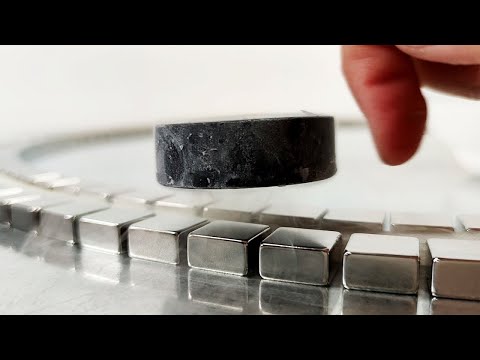 Photo: N43 and Hermes
Cooper pairs, the Meissner effect, and the quantum mechanics that let electrons flow forever without losing energy — the physics that turns ordinary metals into perfect conductors.
Source video: Superconductor at -196°C, Quantum Levitation · Magnetic Games · approximately 27.2M views observed via yt-dlp on August 04, 2026. Independently researched by N43 and Hermes.
01 The Discovery: Zero Resistance at 4.2 Kelvin
In 1911, Dutch physicist Heike Kamerlingh Onnes cooled mercury to the temperature of liquid helium — 4.2 kelvin, just above absolute zero — and measured its electrical resistance. To his astonishment, the resistance did not merely decrease; it dropped to exactly zero. No energy was lost to heat. An electric current induced in a loop of superconducting mercury wire would, in principle, persist indefinitely without any power source. This was not a gradual improvement over copper; it was a phase transition into a fundamentally different state of matter. Kamerlingh Onnes had discovered superconductivity, a quantum mechanical phenomenon that occurs at the macroscopic scale. The implications were profound: if resistance could be eliminated, entire electrical grids could transmit power without loss, magnets could sustain fields permanently, and the laws governing electron transport in solids would need to be rewritten.
02 Cooper Pairs: Electrons That Travel Together
The explanation came in 1957, when John Bardeen, Leon Cooper, and Robert Schrieffer published BCS theory. Their insight was counterintuitive: electrons, which normally repel each other due to their negative charge, can form bound pairs in a superconductor. A single electron moving through a crystal lattice attracts the positively charged atomic nuclei, creating a slight distortion — a phonon, or quantum of lattice vibration. A second electron is drawn into this distortion, and the two form a Cooper pair. The pair is bound by an energy gap — typically around 1–10 meV — that protects it from the scattering processes that cause electrical resistance. Unlike individual electrons, which obey Fermi-Dirac statistics and cannot occupy the same quantum state, Cooper pairs are bosons. They can all condense into the same quantum ground state, flowing as a coherent wave through the lattice without friction. This condensate is the essence of superconductivity.
A normal metal's resistance decreases gradually with temperature. A superconductor drops abruptly to zero at Tc — a phase transition, not a smooth decline. Illustrative.
03 The Meissner Effect: Expelling Magnetic Fields
Superconductivity is not only about zero resistance. In 1933, Walther Meissner and Robert Ochsenfeld discovered that a superconductor actively expels magnetic fields from its interior when it transitions below Tc. This is the Meissner effect, and it distinguishes superconductors from perfect conductors — a distinction that matters because zero resistance alone would not produce this field expulsion. The Meissner effect arises because superconducting surface currents generate a magnetic field that exactly cancels the applied field within the material. This is why a superconductor can levitate a magnet — the expelled field pushes the magnet away, and the magnet floats in stable equilibrium. The levitation is not merely a party trick; it demonstrates that superconductivity is a thermodynamic phase with its own free energy minimum, not just a state of zero dissipation.
04 Type I and Type II: Two Kinds of Superconductor
Not all superconductors expel magnetic fields in the same way. Type I superconductors — mostly pure elements like mercury, lead, and tin — completely expel magnetic fields up to a critical field Hc, above which superconductivity is destroyed entirely. Type II superconductors — alloys and compounds like NbTi, Nb3Sn, and all known high-temperature superconductors — allow magnetic fields to partially penetrate in the form of quantized vortices (flux tubes) between two critical fields, Hc1 and Hc2. In this mixed state, the material remains superconducting, and the vortices can be pinned at defects in the crystal lattice. This vortex pinning is critical for engineering: it allows Type II superconductors to carry high currents in strong magnetic fields, which is exactly what MRI magnets, particle accelerator magnets, and fusion reactor coils require. Without Type II behavior, no superconducting magnet above a few tesla would be possible.
Type I superconductors expel all flux up to Hc, then abruptly lose superconductivity. Type II enters a mixed vortex state between Hc1 and Hc2, allowing operation at much higher fields. Illustrative.
05 The Energy Gap and the Condensate
At the heart of BCS theory is the concept of an energy gap. Below Tc, a gap opens in the electron density of states at the Fermi level — the energy threshold above which electrons can be excited into scattering states. The gap is the binding energy of the Cooper pairs: to break a pair and scatter one of its electrons, an amount of energy at least equal to the gap must be supplied. At absolute zero, the gap is at its maximum (roughly 3.5 times kBTc in conventional superconductors). As temperature rises toward Tc, thermal energy shrinks the gap until it closes entirely — at which point Cooper pairs dissociate and superconductivity vanishes. The condensate — the coherent quantum state occupied by all Cooper pairs — is what gives superconductors their macroscopic quantum properties, including the ability to sustain persistent currents and exhibit quantum interference effects in devices like SQUIDs (superconducting quantum interference devices).
06 Beyond BCS: The High-Tc Puzzle
BCS theory elegantly explains conventional superconductors — materials with Tc below about 30 K. But the 1986 discovery of superconductivity in cuprate ceramics at 35 K, soon pushed to 93 K and eventually above 130 K, posed a problem. The pairing mechanism in these high-temperature superconductors does not fit neatly into the electron-phonon framework. Theoretical physicists have proposed that magnetic interactions — spin fluctuations in the copper-oxygen planes — mediate the pairing, but no consensus theory exists. The gap symmetry is different: conventional superconductors have isotropic s-wave gaps, while cuprates have d-wave gaps with nodes where the gap goes to zero. This matters because the nodes allow low-energy excitations that complicate the simple BCS picture. The high-Tc puzzle remains one of the great open problems in condensed matter physics: we can engineer these materials, use them in devices, and measure their properties with extraordinary precision, but we still cannot fully explain why they superconduct.
07 Quantum Coherence at Macroscopic Scale
Perhaps the most remarkable aspect of superconductivity is that it brings quantum mechanics to the macroscopic world. A Cooper pair condensate can be described by a single quantum wavefunction extending across centimeters or meters — scales normally associated with classical objects. This coherence is what makes SQUIDs possible: two superconductors separated by a thin insulating barrier (a Josephson junction) exhibit interference patterns that depend on magnetic flux with a sensitivity reaching 10−15 tesla, roughly the magnetic field produced by a single neuron firing. The same principle underlies superconducting qubits, the leading hardware platform for quantum computing. In these devices, the superconducting condensate's quantum states are engineered to encode information, and the coherence of the condensate — preserved at millikelvin temperatures in dilution refrigerators — determines how long a qubit can maintain a quantum superposition. Superconductivity thus bridges the smallest quantum scales and the largest engineered structures, from individual electron pairs to MRI magnets and quantum processors.
References
- Wikipedia: Superconductivity — properties, history, and critical temperature
- Wikipedia: BCS theory — Bardeen-Cooper-Schrieffer microscopic theory, Cooper pairs, energy gap
- Wikipedia: Meissner effect — magnetic field expulsion and its thermodynamic significance
- Wikipedia: Type I and Type II superconductors — vortex states and critical fields
- Wikipedia: High-temperature superconductivity — cuprate discovery and d-wave pairing
- Source video: Superconductor at -196°C, Quantum Levitation (Magnetic Games, ~27.2M views, observed August 04, 2026)
By N43 and Hermes for Sailor Bob News.


