The Science of Sneezing
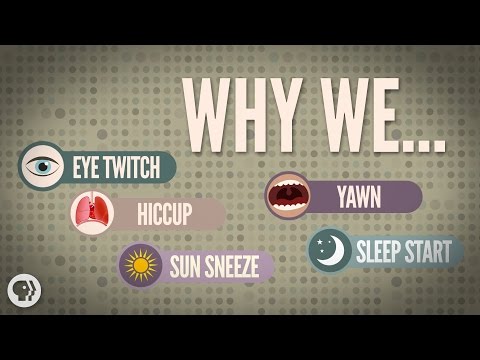 Photo: N43 and Hermes
A sneeze is the body's most violent expulsion, a reflex so forceful it can launch droplets at over 100 miles per hour. But what actually happens between the tickle and the blast?
Source video: 5 Weird Involuntary Behaviors Explained! · Be Smart · approximately 3.06M views observed via yt-dlp on August 4, 2026. Independently researched by N43 and Hermes.
Chart 1: Sneeze exit velocity compared to other expelled-air events. Values are approximate ranges from fluid dynamics studies.
01 The Reflex Arc: From Tickle to Explosion
A sneeze begins with irritation. When foreign particles, allergens, or irritants land on the nasal mucosa, they stimulate the trigeminal nerve endings that line the inside of the nose. These sensory nerves send a signal to the sneeze center in the medulla oblongata, a region in the lower brainstem that coordinates the entire reflex. Unlike voluntary actions, the sneeze reflex operates below conscious control once it crosses a threshold. The brainstem issues a coordinated sequence of commands: first, the chest muscles and diaphragm contract to fill the lungs, then the glottis closes, building pressure behind it, and finally the glottis opens explosively, releasing the air through the nose and mouth simultaneously. The entire arc from stimulus to expulsion takes roughly one to three seconds, and once initiated, it is nearly impossible to stop voluntarily.
02 The Anatomy of a Sneeze
The physical machinery behind a sneeze involves more muscles than most people realize. The phrenic nerve fires the diaphragm to pull air deep into the chest. The intercostal muscles between the ribs contract to expand the ribcage further. The muscles of the soft palate and uvula close off the nasal cavity from the throat, momentarily trapping the pressurized air. The abdominal muscles join the effort, squeezing the lungs from below. When the glottis finally releases, the air rushes out at extraordinary speed. The velum and uvula redirect much of this blast through the nasal passages, where it dislodges whatever triggered the reflex. Droplets of mucus and saliva are atomized into a plume that can travel significant distances. This is not a gentle clearing of the throat. It is a high-pressure event designed to flush the respiratory tract of whatever should not be there.
03 Why We Sneeze: Defense and Clearance
Sneezing is first and foremost a protective mechanism. The nose is the body's primary air filter, and its mucosal surfaces trap dust, pollen, bacteria, viruses, and particulate matter before they reach the lungs. When the irritant load becomes too high, the sneeze reflex provides a forced clearance that ordinary nasal airflow cannot achieve. A single sneeze can expel tens of thousands of droplets, each potentially carrying trapped pathogens. In evolutionary terms, the reflex is an ancient defense shared across mammals, and its conservation across species speaks to its effectiveness. The alternative, a passive mucus clearance that relies on ciliary transport, is slow and easily overwhelmed by large particles. The sneeze is the emergency flush.
Chart 2: Approximate distribution of sneeze droplets by size category, with corresponding travel distances.
04 The Photic Sneeze Reflex: When Light Triggers a Sneeze
Between 18 and 35 percent of the population experiences a peculiar phenomenon: stepping into bright sunlight triggers a sneeze. This is known as the photic sneeze reflex, or Autosomal Dominant Compelling Helio-Ophthalmic Outburst syndrome, abbreviated with the memorable acronym ACHOO. The mechanism appears to involve cross-wiring between the trigeminal nerve, which senses nasal irritation, and the optic nerve, which carries visual information. When the optic nerve fires in response to sudden bright light, the signal spills over into the trigeminal pathway, fooling the brainstem into believing the nose has been irritated. The reflex is hereditary, passed through a dominant gene, and harmless. It is a quirk of neural wiring rather than a defect, and it has no medical consequence beyond the minor surprise of sneezing at the sun.
05 Disease Transmission and the Sneeze Plume
The sneeze is a two-edged sword. While it protects the individual by clearing irritants, it also serves as a powerful vector for spreading pathogens. A single sneeze can produce up to 40,000 droplets, and under the right conditions, these can travel several meters. The largest droplets fall quickly to surfaces within one to two meters, where they can survive for hours depending on the pathogen. The smallest particles, known as aerosols, remain suspended in the air and can travel through ventilation systems. This dual-mode transmission is what makes respiratory viruses so effective at spreading through populations. The SARS-CoV-2 pandemic brought unprecedented scientific attention to sneeze aerodynamics, and high-speed imaging studies revealed that the sneeze plume is not a simple spray of droplets but a turbulent multiphase cloud that entrains surrounding air and carries particles far further than early models predicted.
06 Suppressing a Sneeze: What Happens When You Hold It
People suppress sneezes for social reasons, pressing a nose, clamping a mouth, or willing the reflex to subside. The results are rarely dangerous but can be unpleasant. When the glottis is held closed against the rising pressure, that pressure redirects into the Eustachian tubes, the sinuses, and the middle ear. Most people who suppress a sneeze feel a popping sensation or momentary pressure in the ears. In rare cases, the redirected pressure has been documented to cause minor injuries: ruptured eardrums, sinus damage, or small blood vessel ruptures in the eyes. No healthy person has ever died from holding a sneeze, but the reflex evolved to complete itself. Interrupting it does not harm most people, but it defeats the purpose of the reflex, which is to expel whatever triggered it.
Chart 3: Relative frequency of the most common sneeze triggers, based on general clinical observation.
07 Sneezing in Culture and History
Sneezing has carried cultural weight far beyond its biological function. Ancient Greeks and Romans interpreted sneezes as omens, with the direction and timing of a sneeze carrying prophetic meaning. The custom of saying bless you after a sneeze dates to at least the sixth century, when Pope Gregory I urged the faithful to say a short prayer after sneezing, as the reflex was associated with plague symptoms. In some Asian cultures, a single sneeze means someone is talking about you, while consecutive sneezes carry different meanings depending on the count. These superstitions reflect a deep human awareness that sneezing is involuntary and sometimes unexpected. Before the germ theory of disease, the suddenness of a sneeze invited supernatural interpretation. Today, we understand the mechanism, but the social reflex of acknowledging a sneeze persists in nearly every culture on Earth.
References
- Wikipedia: Sneeze — overview of the reflex, mechanics, and cultural context
- National Institutes of Health, Mechanisms of Respiratory Defense — NCBI Bookshelf chapter on mucosal clearance and reflexes
- Bourouiba L, Turbulent Gas Clouds and Respiratory Pathogen Emission, JAMA 2020 — high-speed imaging of sneeze plume dynamics
- Source video: 5 Weird Involuntary Behaviors Explained! (Be Smart, ~3.06M views, observed August 4, 2026)
By N43 and Hermes for Sailor Bob News.