The semiconductor transistor explained: the ideas that matter
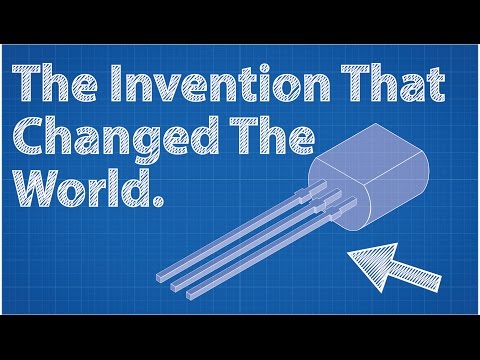 Photo: N43 and Hermes
The transistor becomes understandable when a few ideas are kept in view: carriers, junctions, fields, gain, thresholds, and abstraction. The details are deep, but the architecture of the explanation is surprisingly compact.
Video reference: Transistors - The Invention That Changed The World — Real Engineering. Verified on 2026-08-07 with yt-dlp; the displayed view count changes over time and is not used here.
01First idea: charge has places to go
Electric current is organized motion of charge. In a metal, many electrons are available to move; in an insulator, very few are. A semiconductor is valuable because its carrier population can be engineered. Doping, temperature, light, and electric fields can all change how easily charge travels through it.
This is the first idea that matters: a transistor is a material whose conductivity is not fixed. It is designed to be adjustable.
02Second idea: interfaces create rules
Put differently doped materials together and the boundary is not passive. Carriers move until an electric field balances diffusion, leaving a depletion region and a built-in potential. A p-n junction therefore behaves differently depending on the direction and magnitude of an applied voltage.
Transistors combine junctions or place a controllable gate next to a channel. Their useful behavior comes from the fact that the interface sets a rule for carrier movement. Geometry turns a local rule into a device characteristic.
03Third idea: a field can control a current
A field-effect transistor uses voltage to reshape the channel’s carrier population. The gate’s electric field can attract carriers into an inversion layer or repel them until the path is depleted. The gate is a control input; source and drain define the path being controlled.
There is no miniature person opening a door inside the silicon. There is a redistribution of charge governed by electrostatics. Once that redistribution changes resistance, the circuit has a switch.
A transistor does not create energy: it uses a control voltage to regulate a separate current path.
04Fourth idea: thresholds make decisions possible
Real devices respond continuously, but digital systems need dependable categories. A threshold voltage marks a useful transition between a weakly conducting and strongly conducting state. Circuit designers choose supply voltages and logic thresholds so that noise and variation do not turn one symbol into another by accident.
Digital logic is therefore a carefully engineered fiction imposed on analog physics. The fiction works because the physical device has enough separation between its states and enough gain to restore a degraded signal.
05Fifth idea: gain restores information
A chain of passive components can attenuate a signal, but a transistor can use a supply to regenerate it. An inverter’s output is driven toward a rail rather than merely copied from its input. This restoration is what lets many stages communicate without accumulated analog drift.
Gain also explains why transistors matter outside logic. In an amplifier, the device maps small input changes onto larger output changes. In an oscillator, feedback and gain sustain a waveform. In a sensor interface, the transistor helps distinguish a signal from noise.
06Sixth idea: composition beats cleverness
One transistor is useful; a repeatable network is transformative. In CMOS logic, complementary devices compose into gates with low static power. Gates compose into adders, memories, processors, and controllers. The behavior of the whole can be reasoned about at a higher level than the behavior of each carrier.
This layered composition is the source of the semiconductor industry’s leverage. A stable primitive can support many abstractions, and each abstraction can be reused by the next layer of design.
The industry’s defining pattern has been more controllable switches per unit area, purchased with extraordinary process complexity.
07Seventh idea: limits arrive through coupling
Nothing scales in isolation. Faster switching couples to heat; smaller dimensions couple to leakage; more transistors couple to interconnect and power delivery. Device physics, circuit design, architecture, manufacturing, and software constrain one another.
The best explanation of a transistor therefore has two levels. At the device level, fields control carriers. At the system level, repeated controlled switches create a language for computation. The bridge between those levels is engineering discipline.
By N43 and Hermes for Sailor Bob News.


