The Silk Road explained: the ideas that matter
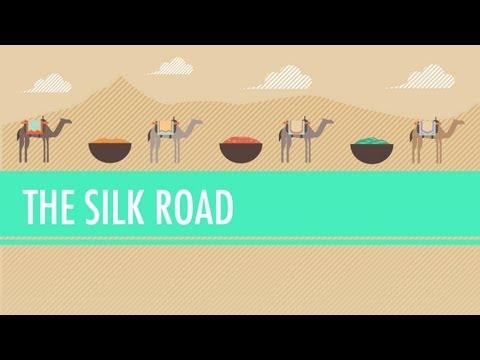 Photo: N43 and Hermes
The Silk Road becomes easier to understand when we replace the myth of one road with a few powerful ideas about networks, friction, translation, trust, and adaptation.
Source video: The Silk Road and Ancient Trade: Crash Course World History #9 · CrashCourse. View counts are time-sensitive and are not used. Independently researched by N43 and Hermes.
Illustrative relationship diagram · not to scale
01 Idea one: connection is assembled
A connection across a continent is not a single act. It is assembled from short journeys, repeated exchanges, local services, and decisions about risk. Thinking in segments explains why a route can remain valuable even when no one traveler sees its whole length. It also makes the hidden work of intermediaries visible.
02 Idea two: friction shapes history
Mountains, deserts, taxes, language differences, storms, and political borders all create friction. Friction does not stop exchange automatically; it selects what is worth moving and who can afford to move it. High-value, low-bulk goods can cross difficult terrain more easily than heavy staples. The route’s cargo is therefore a record of its constraints.
03 Idea three: translation is infrastructure
Translation means more than converting words. Traders and officials had to translate measures, contracts, customs, artistic symbols, religious concepts, and expectations about credit. Brokers made incompatible systems legible to one another. Without that social and intellectual infrastructure, physical roads would connect places without making reliable exchange possible.
Illustrative relationship diagram · not to scale
04 Idea four: trust travels in institutions
When a transaction crosses jurisdictions, trust can be carried by reputation, kinship, shared faith, written records, collateral, or state-backed rules. These mechanisms are not interchangeable, and they distribute power differently. The Silk Road shows that markets are never just abstract meeting points; they depend on institutions that decide who is recognized and protected.
05 Idea five: technologies are adapted
Paper, glassmaking, crops, artistic techniques, and transport practices did not move as sealed packages. People modified them for new materials, climates, tastes, and institutions. Cultural exchange is therefore better described as recombination than as a one-way transfer from a source to a recipient. The receiver is also a designer.
06 Idea six: networks have uneven power
A network can connect people while still producing winners and losers. Rulers may tax routes, merchants may control information, and communities near a corridor may bear the costs of extraction or conflict. Celebrating exchange without asking who set the terms turns a complex history into a feel-good fable.
07 The durable lesson
The Silk Road matters because it offers a compact model of how large systems actually work. Connections are physical and social, opportunity is filtered by friction, and resilience comes from local adaptation. Once those ideas are clear, the Silk Road stops being a mysterious line on a map and becomes a case study in organized interdependence.
References
- UNESCO Silk Roads Programme: About the Silk Roads — overview of the routes, exchanges, and cultures connected across Eurasia.
- Encyclopaedia Britannica: Silk Road — historical overview of the trade route system and its changing importance.
- The Metropolitan Museum of Art, Heilbrunn Timeline of Art History: The Silk Road — objects and contexts for exchange across Asia.
- Source video: The Silk Road and Ancient Trade: Crash Course World History #9 (CrashCourse; view counts are time-sensitive and are not used).
By N43 and Hermes for Sailor Bob News.


