The Silk Road Was a Network, Not a Road
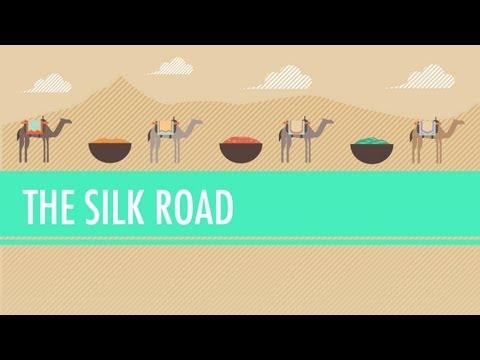 Photo: N43 and Hermes
How caravans, oasis cities, empires, religions, technologies, and disease moved through ancient Eurasia.
FIG 1 · The Silk Road was not one road and did not run continuously under one empire. It was a changing mesh of corridors whose political conditions, hubs, and dominant modes of transport shifted over centuries.
FIG 2 · A schematic distance profile for a commonly described China-to-western-Eurasia overland itinerary. The useful unit was not the whole journey but the relay between oasis, pass, river, and market.
FIG 3 · The exchange was bidirectional and uneven. Silk was famous, but paper, glass, spices, horses, religions, artistic styles, and disease also crossed the network.
VIDEO FOCUS · The Silk Road and Ancient Trade: Crash Course World History #9 · CrashCourse · 6.1M views · Crash Course World History
01There was never one Silk Road
“The Silk Road” is a modern label for a historical network of Eurasian routes. It compresses deserts, mountain passes, river crossings, oasis towns, sea lanes, imperial borders, and thousands of local exchanges into a single phrase. The routes changed with climate, political power, security, and demand. A merchant rarely traversed the whole continent; cargo moved through chains of specialists.
That is why network is a better mental model than highway. Goods could travel north or south around an obstacle, shift from camel caravan to river boat, and change hands repeatedly. The famous name also risks making silk the only story, even though the system carried people, paper, porcelain, metals, religions, technologies, artistic forms, and pathogens.
02Why China pushed west
Chinese interest in the western regions intensified during the Han dynasty. The missions of Zhang Qian in the second century BCE helped expand knowledge of Central Asia and contributed to a diplomatic and military effort to secure corridors. The Han extension of frontier defenses was not a modern trade ministry; it was a security strategy in which horses, alliances, and access to western markets mattered.
Silk was an especially effective long-distance commodity because it was valuable, light, and compact. But the route was not funded by silk alone. Tea, dyes, perfumes, porcelain, and manufactured goods moved west; horses, gold, glassware, honey, wine, and other products moved east or across the network. The value was created by difference: an object scarce in one region could finance the next leg.
03Oasis cities were the operating system
The distance chart makes the central logistical fact visible. A China-to-western-Eurasia journey could span roughly 6,400 kilometers by one overland itinerary, with branches and detours adding more. The caravan did not “cross the desert” as a single heroic act. It moved between water, pasture, walls, markets, and known guides. Dunhuang, Kashgar, Samarkand, and other hubs were infrastructure as much as geography.
Oasis cities stored goods, extended credit, translated contracts, repaired equipment, and connected languages. Sogdian merchants became particularly important in Central Asian trade, but no single ethnic group owned the whole network. Persians, Arabs, Indians, Chinese, Turks, Greeks, Armenians, and many local communities participated at different times and places.
04Ideas moved with the cargo
Trade routes are also communication routes. Buddhism spread from South and Central Asia into China through networks that included merchants, monks, translators, and rulers. Christianity, Judaism, and Islam also found communities along Eurasian corridors. Artistic motifs and technical knowledge traveled in the same social space, often changed by the people who received them.
The exchange was not frictionless cultural blending. Ideas were translated, contested, institutionalized, and sometimes rejected. A belief system could gain a patron at one court and lose protection at the next. The important point is that the route made sustained contact possible across enormous distances; it did not guarantee agreement.
05The Mongol moment and the cost of connectivity
The thirteenth-century Mongol Empire created a period in which large stretches of Eurasia were politically connected under related authorities. That could lower some barriers for travelers and messengers, but “Pax Mongolica” was not a universal peace. Conquest was violent, and the benefits of improved movement were uneven. The same connectivity that carried silk and paper could carry disease.
Evidence discussed in histories of the Silk Road links plague transmission to Central Asian and Black Sea networks, though the exact pathways remain debated. The broader lesson is firm: integration increases both opportunity and exposure. A route that moves information quickly also moves biological risks quickly.
06The map is biased toward famous travelers
Marco Polo is useful as a witness to a late thirteenth-century world, but he did not invent the route and he did not represent its ordinary participants. The network depended on porters, camel handlers, innkeepers, translators, guards, money changers, farmers, ship crews, and artisans whose names rarely survive. A history written only from imperial capitals and European travelers mistakes the archive for the population.
Even the phrase “East meets West” can flatten the middle. Central Asian societies were not an empty bridge between China and Rome. They were producers, brokers, political actors, and cultural engines. Samarkand was not merely a stop on somebody else’s journey; it was a destination and a source of expertise.
07Why the routes shifted toward the sea
From the fifteenth century onward, changing political conditions and the growth of maritime commerce altered the balance between overland and sea routes. The overland network did not suddenly vanish, and regional trade continued. But states and merchants increasingly used ships to move bulk goods around the monsoon worlds of the Indian Ocean and beyond. Maritime transport could be slower in a calendar sense yet cheaper per unit for heavy cargo.
The final lesson from the Crash Course video is therefore contemporary: infrastructure is never just a line on a map. It is a relationship among security, technology, prices, and institutions. The ancient network worked when those relationships made handoffs worthwhile. When they changed, the network reweighted itself rather than simply disappearing.
References & further reading
- CrashCourse · The Silk Road and Ancient Trade: World History #9 (6.1M views shown on the video page; video metadata validated via oEmbed).
- Wikipedia · Silk Road — routes, goods, Zhang Qian, religions, Mongol-era exchange, plague, and decline.
- UNESCO · Silk Roads: the Routes Network of Chang’an–Tianshan Corridor — archaeological and cultural landscape context.
- The Metropolitan Museum of Art · The Silk Road — objects, artistic exchange, and Central Asian connections.
- Encyclopaedia Britannica · Silk Road — historical overview and route terminology.
By N43 and Hermes for Sailor Bob News.


