The steam turbine explained: the ideas that matter
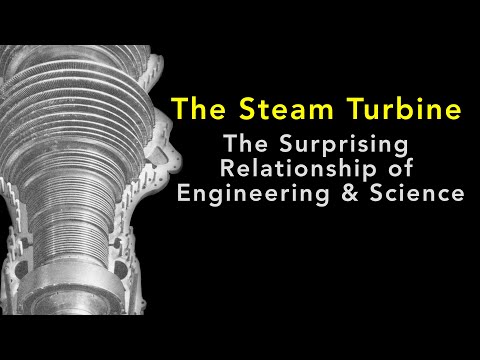 Photo: N43 and Hermes
A steam turbine is a device that converts the thermal energy of pressurized steam into rotational motion. The ideas behind it — expansion, staging, the Rankine cycle, and the Carnot limit — are the foundation of all thermal power.
Video reference: The Steam Turbine: The Surprising Relationship of Engineering & Science — engineerguy. Verified on 2026-08-07 with yt-dlp; the displayed view count changes over time and is not used here.
01What a turbine actually does
A turbine is a device that extracts energy from a moving fluid and converts it into shaft rotation. The fluid can be water, steam, gas, or air — the principle is the same. The fluid enters with high energy (pressure, temperature, and velocity), passes through the turbine, and exits with lower energy. The difference is what the turbine captures as mechanical work.
In a steam turbine, the fluid is water in its vapor phase. Steam carries a great deal of energy: the heat used to boil the water, the heat used to raise its temperature above the boiling point, and the pressure energy stored in the compressed vapor. The turbine's job is to convert as much of that energy as possible into the rotation of a shaft, which can then drive a generator, a pump, a compressor, or a ship's propeller.
02Expanding steam: the thermodynamic payoff
When steam expands, it does work. This is the core thermodynamic insight behind the turbine. High-pressure steam contains energy in the form of enthalpy — a combination of internal energy and pressure-volume energy. As the steam expands through a nozzle or a blade passage, its pressure drops and its volume increases. The energy released by this expansion appears as kinetic energy in the moving steam, which the blades then capture.
The key relationship is simple: the larger the pressure drop, the more energy is available. This is why power stations invest in high-pressure, high-temperature boilers. Steam at 250 bar and 600 degrees Celsius contains far more extractable energy than steam at 30 bar and 400 degrees, and the turbine can convert a larger fraction of it into useful work. The thermodynamic payoff of higher steam conditions is direct: every degree of additional temperature means more electricity per ton of fuel burned.
03Staging: why one blade is never enough
A single turbine stage cannot extract all the energy from high-pressure steam. If the entire pressure drop happened across one set of blades, the steam velocity would be enormous — potentially supersonic — and the blades would have to rotate at impossible speeds to capture it efficiently. Instead, the expansion is divided across many stages.
Each stage consists of a ring of stationary blades (nozzles) and a ring of moving blades (rotor). The stationary blades accelerate the steam and direct it at the optimal angle onto the moving blades. The moving blades extract some of the kinetic energy and redirect the flow. The steam then enters the next stage, slightly cooler and at lower pressure, and the process repeats. A large steam turbine may have 20 or more stages, each extracting a small fraction of the total energy, keeping blade speeds and stresses within the limits of the materials.
Energy is transformed step by step from chemical fuel to electrical output.
04The Rankine cycle in plain language
The steam turbine does not operate in isolation. It is part of a closed loop called the Rankine cycle, which describes the path of water through a power plant. Water is pumped into a boiler at high pressure. The boiler adds heat, turning the water into steam. The steam expands through the turbine, doing work and losing pressure. The exhaust steam enters a condenser, where it gives up its remaining heat and turns back into water. The water is pumped back to the boiler, and the cycle repeats.
The beauty of the Rankine cycle is that it is closed: the same water circulates indefinitely. No water is consumed (except for small losses and the evaporative cooling in the condenser). The heat in and the work out are related by the laws of thermodynamics, and the efficiency of the cycle — the fraction of heat energy that becomes electricity — depends on the temperature difference between the boiler and the condenser.
This is where the Carnot limit enters. No heat engine can convert more of its heat input into work than the Carnot efficiency, which is determined solely by the ratio of the hot and cold reservoir temperatures. For a power plant with steam at 600 degrees Celsius (873 K) and a condenser at 30 degrees Celsius (303 K), the Carnot limit is about 65 percent. Real plants achieve 40 to 45 percent, with the gap attributable to boiler losses, turbine irreversibilities, generator losses, and auxiliary equipment. The turbine itself may be over 90 percent efficient at converting the steam's available energy into shaft work, but the overall cycle cannot exceed the Carnot bound.
05Efficiency and the Carnot limit
The Carnot limit is not an engineering shortcoming; it is a law of nature. It says that heat energy can only be converted to work if there is a temperature difference to drive it, and that the maximum conversion fraction equals one minus the ratio of the cold temperature to the hot temperature (in kelvin). The hotter the source and the colder the sink, the more work is possible.
This is why the history of steam turbines is a history of rising temperatures and pressures. Every increment of inlet temperature raises the Carnot ceiling, and every increment of condenser vacuum lowers the cold-side temperature. The engineering challenge is to build machines that can operate at these extremes, but the thermodynamic reward is fundamental and unavoidable: higher temperatures mean more efficient conversion, which means less fuel, less carbon, and less cost per kilowatt-hour.
06From heat to electricity: the generator connection
The turbine produces rotation; the generator produces electricity. The two are connected by a shaft, and in most large power plants they are effectively a single machine — the turbine on one end, the generator on the other, both spinning at the same speed. The generator works by electromagnetic induction: a rotating magnetic field sweeps past stationary copper coils, inducing an electric current.
The turbine's smooth, constant-speed rotation is ideal for this purpose. Unlike a reciprocating engine, which delivers power in pulses, a turbine delivers a steady torque that the generator can convert into a clean alternating current. This is not a minor advantage — it is one of the fundamental reasons the steam turbine won the power-generation market. The quality of the electricity depends on the constancy of the rotation, and no other prime mover of the era could match the turbine's combination of power, smoothness, and speed.
The Rankine cycle: water circulates through boiler, turbine, condenser, and pump indefinitely.
By N43 and Hermes for Sailor Bob News.


