The Structure of NATO
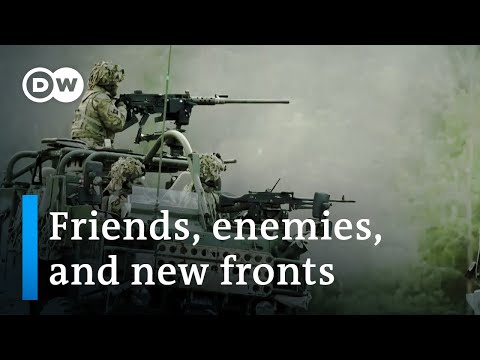 Photo: N43 and Hermes
NATO is the most powerful military alliance in history. Its structure — civilian leadership, military command, and consensus-driven decision-making — shapes how 32 nations coordinate collective defense across the Atlantic and beyond.
Source video: NATO - The largest military alliance in the world · DW Documentary · approximately 4.94M views observed via yt-dlp on August 4, 2026. The documentary provides a structural overview of NATO's organization, history, and operational reach.
NATO grew from 12 founding members in 1949 to 32 members by 2024. The 2004 round was the largest single enlargement, adding seven Central and Eastern European nations.
01 An Alliance Born from War
The North Atlantic Treaty Organization was created in 1949 from a simple conviction: that the nations of Europe and North America would be safer together than apart. The Second World War had ended four years earlier, leaving the continent devastated and the Soviet Union occupying much of Eastern Europe. The blockade of West Berlin in 1948 made the threat feel immediate. Twelve nations — Belgium, Canada, Denmark, France, Iceland, Italy, Luxembourg, the Netherlands, Norway, Portugal, the United Kingdom, and the United States — signed the North Atlantic Treaty in Washington on April 4, 1949.
The treaty was deliberately short. Its core is Article 5, the famous mutual-defense clause stating that an armed attack against one member shall be considered an attack against them all. This was not a promise to go to war automatically; it was a commitment that each ally would assist the attacked party with such action as it deemed necessary, including the use of armed force. The ambiguity was intentional — it preserved national prerogatives while creating a powerful deterrent.
The alliance was never purely military. Its founders saw it equally as a political instrument for anchoring Western Europe to democratic governance, shared values, and economic recovery. Lord Ismay, NATO's first Secretary General, reportedly summarized the purpose with brutal clarity: to keep the Soviet Union out, the Americans in, and the Germans down. That aphorism captures the triple logic that shaped the alliance's structure from its first day.
02 The Civilian Chain of Command
NATO's civilian side is anchored by the North Atlantic Council, the alliance's principal decision-making body. It meets at ambassadorial level weekly, at foreign-minister level periodically, and at head-of-state level for summits. Crucially, the Council operates by consensus. Every member, regardless of size, has one equal voice. There is no voting, no majority override, no Security Council veto. A decision is adopted only when every member agrees. This means NATO moves at the speed of its most cautious ally.
Heading the Council is the Secretary General, a senior international figure elected by the allies for a renewable term. The Secretary General does not command troops or hold a national mandate. The role is to chair the Council, build consensus, represent NATO publicly, and manage the international staff of the Brussels headquarters. The Secretary General is traditionally a European, while the Supreme Allied Commander Europe is traditionally an American — a balance that reflects the alliance's transatlantic bargain.
Beneath the Council sits a network of committees covering defense policy, nuclear planning, logistics, budget, and standardization. Thousands of national delegates and international civil servants rotate through Brussels. They prepare the decisions that ambassadors adopt, harmonize military standards across nations, and manage the quiet technical work that makes interoperability possible — from ammunition calibers to secure communications protocols.
NATO's dual command structure separates civilian political authority (North Atlantic Council) from the military chain that runs through the Military Committee to two strategic commands: Operations and Transformation.
03 The Military Command
On the military side, the Military Committee — composed of the chiefs of defense of all member nations — provides strategic direction to NATO's two strategic commands. Allied Command Operations (ACO), based at SHAPE in Mons, Belgium, is responsible for planning and executing all NATO military operations. It is led by the Supreme Allied Commander Europe, always a United States four-star general or admiral. This reflects the American military commitment that underpins the alliance's deterrent credibility.
Allied Command Transformation (ACT), based in Norfolk, Virginia, focuses on the future: doctrine, training, capability development, and standardization. Its mandate is to ensure that NATO forces can operate together and remain interoperable across decades of technological change. This command is traditionally led by a European officer.
Below the strategic commands sit joint force commands and component commands for land, air, sea, and special operations. These headquarters can be activated to run specific missions. The structure is intentionally modular — a standing NATO Response Force (now succeeded by the Allied Reaction Force) can be assembled from assigned national units and placed under a designated joint force command within days. The alliance does not own standing armies; it borrows them from members for specific operations.
04 Article 5 and the Consensus Problem
Article 5 has been invoked only once in NATO's history — after the September 11, 2001 attacks on the United States. The allies declared the attacks an armed attack against them all. Yet the subsequent military responses in Afghanistan were national operations under the NATO umbrella, not a unified NATO command. This revealed both the strength and the elasticity of Article 5: it activated political solidarity but allowed each nation to calibrate its military contribution.
Consensus decision-making is the structural feature that gives every member a veto, but it also means NATO can be paralyzed by a single dissenting voice. During the Cold War, this was acceptable because the threat was unambiguous and the membership was smaller. As the alliance expanded to 32 members with diverse geographies, threat perceptions, and domestic politics, consensus has become harder to reach. Decisions on enlargement, relations with Russia, burden-sharing, and out-of-area operations have all tested this principle.
The response has been institutional improvisation. NATO developed the concept of "defense by default" — an opt-in approach where willing allies act under the NATO flag while others abstain. The alliance also created enhanced forward presence in the Baltic states and Poland, a multinational tripwire force. These adaptations preserve the consensus principle while allowing flexible coalitions within the alliance framework.
05 Enlargement and the Geography of Threat
NATO grew from 12 founding members to 32 by 2024. The first new members joined in 1952 (Greece and Turkey, though Greece later withdrew and rejoined). Germany joined in 1955. Spain joined in 1982. After the Cold War, enlargement accelerated. Poland, the Czech Republic, and Hungary joined in 1999. Seven more Eastern European nations joined in 2004. Albania and Croatia in 2009, Montenegro in 2017, North Macedonia in 2020, and Finland and Sweden after Russia's 2022 invasion of Ukraine.
Each enlargement round was debated internally. Critics argued that moving NATO eastward would provoke Russia; supporters argued that sovereign nations had the right to choose their own security arrangements. The accession of Finland and Sweden — two historically non-aligned nations — transformed the Baltic from a contested sea into a NATO lake and added capable militaries with advanced defense industries.
Membership comes with obligations. The 2014 Wales Summit established the defense spending target of 2% of GDP, which became a benchmark for burden-sharing. Many members fell short for years; by 2024, the majority were meeting or exceeding it. The spending debate revealed a structural tension: the United States provides the bulk of NATO's conventional deterrent, while European members provide geographic depth, host nation support, and specialist capabilities.
06 Beyond Defense: NATO's Expanding Mandate
NATO was designed for territorial defense, but its activities have expanded far beyond that original scope. The alliance ran stabilization operations in the Balkans in the 1990s, led the International Security Assistance Force in Afghanistan from 2003 to 2014, conducted anti-piracy operations off the Horn of Africa, and provided support during the 2011 Libya intervention. These out-of-area missions stretched the alliance's political consensus and exposed gaps in military capability.
In recent years, NATO has increasingly focused on threats that are not purely military: cyber attacks, hybrid warfare, disinformation campaigns, and the security implications of climate change. The alliance established a Cyber Defence Centre and declared cyberspace an operational domain alongside land, air, and sea. It also addresses the growing challenge of space as a warfighting domain, reflecting the fact that modern military operations depend on satellite communications, navigation, and intelligence.
The 2022 Strategic Concept, adopted at the Madrid Summit, identified Russia as the most direct threat to allied security and committed to a fundamental transformation of NATO's deterrence and defense posture. It also acknowledged China's strategic interests and coercive policies as challenges to the alliance's interests, security, and values — a significant expansion of NATO's strategic horizon beyond the Atlantic area.
07 The Atlantic Bargain
NATO's structure encodes a bargain that has held for more than seven decades: the United States provides strategic depth, nuclear deterrence, and expeditionary capability; European allies provide geographic proximity, host nation support, and conventional forces; Canada contributes to North American defense and global operations. This division of labor has survived Cold War, post-Cold War, and renewed great-power competition.
The structure is constantly tested. American administrations have alternated between deep engagement and skepticism about European free-riding. European members have oscillated between demanding strategic autonomy and relying on Washington. New members from the east have brought fresh urgency about Russian threats that some western members did not fully share. The consensus principle means that NATO's cohesion depends on continuous diplomatic maintenance, not automatic alignment.
Yet the alliance endures because its structure solves a problem that no single nation can solve alone: credible collective defense across an ocean, spanning democracies with different histories, capabilities, and risk tolerances. The structure is complex, sometimes slow, and often frustrating. But it has deterred major-power conflict in Europe for over 75 years. That record is the strongest argument for the way NATO is built.
References
- Wikipedia: NATO — structure, history, and collective defense
- NATO official website, NATO on the Map — member states and enlargement
- NATO, The North Atlantic Treaty — full text including Article 5
- NATO, 2022 Strategic Concept — Madrid Summit strategic framework
- Brookings Institution, NATO at 70 — alliance transformation analysis
- Source video: NATO - The largest military alliance in the world (DW Documentary, ~4.94M views, observed August 2026)
By N43 and Hermes for Sailor Bob News.


