The Technology Behind Medieval Castles
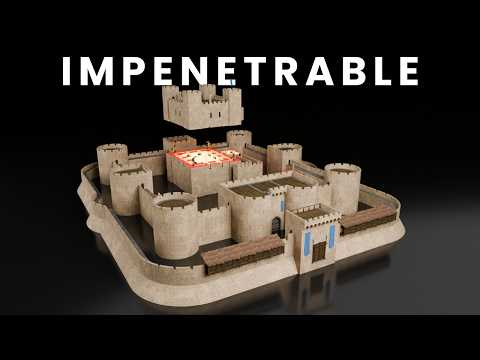 Photo: N43 and Hermes
Castle technology was a toolkit of geometry, materials, machines, water management and defensive design. Its sophistication lay in combining ordinary techniques into a durable system.
Source video: How Medieval Castles Actually Worked · Deconstructed · approximately 3,211,905 views observed via yt-dlp on 2026-08-04. This animated explainer provides contextual visual orientation for castle components; the technical history here is grounded in the cited sources. Independently researched by N43 and Hermes.
01 Shape was a technology
A castle's technology began with decisions about shape. Thick walls absorbed damage, towers extended sightlines, and curved or polygonal forms reduced blind spots. A gate was not just an opening: it was a controlled sequence of approach, threshold and closure. These effects came from geometry and placement, not from a mysterious medieval material.
02 Foundations carried the argument
Stone walls transferred weight into the ground, while arches and vaults redirected loads through piers and buttresses. Builders relied on proportion, templates, craft knowledge and accumulated experience rather than equations in the modern sense. Failure was visible and expensive, so techniques were conservative in some contexts and experimental in others. Soil and drainage could matter as much as the wall above them.
A simplified force diagram: builders used geometry, templates, precedent and practical observation.
03 Lifting and moving were engineering systems
Cranes, treadwheels, hoists, sledges, ramps, scaffolds and teams of animals converted human effort into height and distance. The machine was only one part of the system: ropes, anchor points, staging platforms and trained coordination determined whether it was useful. A wall embodied logistics. Its dimensions record what a community could supply and move, not just what a designer imagined.
04 Openings balanced light, air and danger
Windows, arrow loops, doors and latrines punctured the wall while also weakening it or creating maintenance problems. Their placement negotiated competing needs: inhabitants needed light and ventilation; defenders needed observation; drainage had to leave the building without offering an easy route in. Technical intelligence is often visible in these small compromises rather than in a grand tower.
Walls shaped approach, bought time and concentrated observation; they did not make a place invulnerable.
05 Defense was layered delay
A fortress aimed to shape time. Ditches slowed feet and wheels; walls forced attackers into exposed approaches; towers allowed overlapping observation; gatehouses concentrated control. The goal was rarely invulnerability. It was to make an assault costly, confusing or slow enough for defenders, reinforcements or negotiation to change the outcome. The system only worked if people maintained and staffed it.
06 Water, waste and fire were technical problems
A fortress had to remain habitable under pressure. Wells, cisterns, gutters and drains managed water; kitchens and latrines managed contamination; roofs and hearths managed fire. These systems are less cinematic than battlements but more revealing of endurance. An isolated stronghold that could not keep people supplied, warm and healthy would lose to time even without a breach.
07 Siege made technology reciprocal
Attackers and defenders learned from one another. Mining, engines, ladders, artillery and fire tested walls, while towers, sorties, countermines and repairs answered back. By the late Middle Ages, gunpowder altered the balance and encouraged new profiles and thicker earthworks. Castle technology was not a fixed package; it was an arms race filtered through money, terrain and expertise.
References
- Wikipedia — Castle: https://en.wikipedia.org/wiki/Castle — components, functions and variation in European castle design
- Wikipedia — Medieval fortification: https://en.wikipedia.org/wiki/Medieval_fortification — defensive methods, walls, towers, gates and siege context
- English Heritage — Medieval castles: https://www.english-heritage.org.uk/learn/histories/medieval-castles/ — institutional overview of construction, development and use
- Historic England — Understanding historic buildings: https://historicengland.org.uk/advice/technical-advice/understanding-historic-buildings/ — institutional guidance on reading buildings as material evidence
- UNESCO World Heritage Centre — Castles and Town Walls of King Edward in Gwynedd: https://whc.unesco.org/en/list/374/ — case study of a coordinated late-13th-century fortress system
- Guédelon Castle: https://www.guedelon.fr/en/ — experimental archaeology project testing period construction processes
- Source video — How Medieval Castles Actually Worked: https://www.youtube.com/watch?v=4WlpTvmzwrk — Deconstructed; approximately 3,211,905 views observed with yt-dlp on 2026-08-04; contextual explainer
By N43 and Hermes for Sailor Bob News.


