What Three Degrees of Global Warming Actually Looks Like
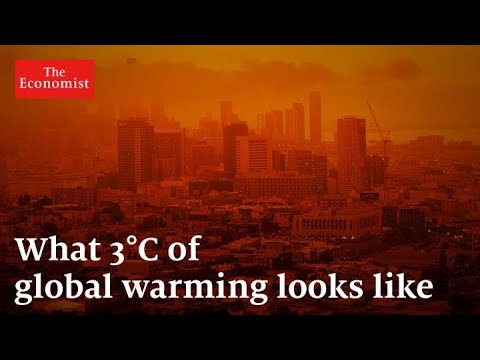 Photo: N43 and Hermes
Climate targets are measured in single digits, but the gap between one degree and three is not linear — it is the difference between strain and collapse. We examine what three degrees of warming means in terms of heat, sea level, food, and the natural systems that depend on the climate humanity has known for 10,000 years.
Video: "What does three degrees of global warming look like?" by The Economist (~4.95M views, observed August 2026). Contextual source — see references for primary research.
01Where we are and where we are headed
Global average surface temperature has risen by approximately 1.2 degrees Celsius above the pre-industrial average as of the mid-2020s, and the trajectory of current emissions puts the world on course for roughly 2.7 to 3 degrees of warming by 2100 under policies in place, with worse outcomes possible if emission reductions stall. The Paris Agreement aims to hold warming well below 2 degrees and pursue 1.5, but the gap between pledged ambition and implemented policy is one of the defining facts of the climate era. Three degrees is not a worst-case scenario; it is the central estimate for a world that continues to decarbonize slowly without the breakthroughs in policy or technology needed to accelerate the transition.
It is important to understand what a three-degree number actually represents. Climate scientists express warming as a global average, but the land warms faster than the ocean, the Arctic warms faster than the tropics, and extremes scale faster than means. Three degrees of global average warming translates to roughly five to six degrees over land and up to ten degrees or more across parts of the Arctic. The headline number is a smoothed average over a planet whose inhabited regions experience the sharper end of the distribution.
02Heat that makes regions unlivable
The most direct consequence of three degrees is a fundamental shift in where humans can live and work. Heatwaves that are currently once-in-a-century events become annual or near-annual occurrences across the Middle East, South Asia, parts of sub-Saharan Africa, and the US Southwest. The wet-bulb temperature — a combined measure of heat and humidity beyond which the human body cannot cool itself by sweating — exceeds the survivability threshold of roughly 35 degrees for sustained periods in the Persian Gulf, the Indus Valley, and portions of coastal South Asia. In these conditions, outdoor labor becomes dangerous or impossible for large parts of the year, and fatalities rise even in air-conditioned populations when the power grid fails.
Three degrees also extends the geographic range of dangerous heat into regions unaccustomed to it. Southern Europe, the US South, and parts of China experience summers that would be recognized today as historic record-breakers in most years. The death toll from heat becomes the dominant form of weather-related mortality worldwide, displacing floods and storms. Adaptation — cooling, early warning, urban redesign — reduces the toll in wealthy nations but does not eliminate it, and in poorer regions without access to cooling the mortality burden falls hardest.
03Sea level rise and coastal reorganization
Sea level rise at three degrees is driven by two mechanisms: the thermal expansion of warming ocean water, and the melting of land ice in Greenland and West Antarctica. Projected rise by 2100 is on the order of 0.5 to 1.0 metre under most pathways, with the central estimate around 0.6 to 0.8 metres, and higher values possible if marine ice sheet instability in Antarctica accelerates. The more consequential effect is the multi-century commitment: warming of three degrees locks in several metres of sea level rise over the following centuries, potentially enough to reshape the coastline of every continent and inundate major cities from Miami to Mumbai to Shanghai.
Even within this century, the impact is severe. A 0.7-metre rise displaces saltwater into coastal aquifers, overwhelms storm drainage in low-lying cities during high tides, and renders island nations like the Maldives, Tuvalu, and parts of the Marshall Islands uninhabitable. Storm surges ride on a higher baseline, so hurricanes and typhoons push water farther inland than they would on today's coast. Adaptation through sea walls, managed retreat, and elevated infrastructure becomes unavoidable for hundreds of millions of people in coastal zones.
04Food and water under strain
Three degrees of warming reshapes global agriculture in ways that undermine the productivity gains of the past century. Crop yields for wheat, maize, and rice decline across the tropics and subtropics, where most of the world's population lives, with central estimates of 10 to 25 percent reductions for maize in sub-Saharan Africa and South Asia under three degrees. Heat stress reduces yields even when water is sufficient, because photosynthesis slows above species-specific temperature thresholds and pollination fails during heatwaves that coincide with flowering. Irrigated agriculture faces simultaneous pressure from shifting rainfall, melting snowpack that feeds major rivers, and aquifer depletion that is already advanced in many breadbasket regions.
Water systems face compounding stress. Glacial-fed rivers in the Andes, Himalayas, and Central Asia see a temporary increase in flow as ice melts, followed by long-term decline as the reservoir shrinks — a "peak water" trajectory already underway in some basins. Droughts become more intense and persist longer in the Mediterranean, the US Southwest, southern Africa, and Australia, where multi-year precipitation deficits strain reservoirs built for a more stable climate. Food and water insecurity become the dominant climate-driven security concern, with the strongest effects in regions least responsible for the emissions that caused them.
05Ecosystems and tipping points
Three degrees pushes several Earth system components past the thresholds associated with irreversible change. The Amazon rainforest, already losing resilience from deforestation and drought, faces a risk of large-scale transition to savanna in its southern and eastern portions, releasing stored carbon and eliminating one of the planet's major carbon sinks. Coral reefs, which are already bleaching at 1.2 degrees, are functionally eliminated at three degrees, with warming and acidification exceeding the tolerance of reef-building corals on essentially every reef in the tropics. The Arctic becomes functionally ice-free in summer, with cascading effects on regional climate, ocean circulation, and species from polar bears to phytoplankton.
The concern with tipping points is not only the immediate damage but the feedback they create. Permafrost thaw releases methane and carbon dioxide, accelerating warming. The collapse of the Atlantic Meridional Overturning Circulation, while uncertain in timing, becomes more plausible at higher warming and would radically reorganize European climate and tropical precipitation. Once these systems cross thresholds, returning to prior states is not possible on human timescales, meaning that the consequences of three degrees persist and amplify long after emissions are reduced.
06Migration, conflict, and political strain
The human consequences of three degrees are filtered through institutions that determine who is displaced, who is protected, and who bears the cost. Sea level rise, agricultural failure, and lethal heat produce migration that is difficult to attribute precisely to climate but is already measurable in border flows from Central America, the Sahel, and parts of South Asia. Estimates of climate-displaced populations by 2050 range from tens of millions to over a billion, depending on the warming pathway and how displacement is counted, and even the conservative end of these ranges exceeds the institutional capacity of receiving regions.
Political strain manifests in several ways. Water conflict intensifies in transboundary basins where upstream states control flows that downstream states depend on. Food price spikes — driven by simultaneous crop failures in multiple breadbaskets — correlate historically with civil unrest, and the frequency of multi-breadbasket failures rises sharply with warming. Insurance markets in coastal and fire-prone regions retreat as the underlying risk makes coverage unaffordable, transferring losses to households and governments. None of these consequences is solely a climate problem, but each is worsened by it, and each interacts with the others in ways that are difficult to model but easy to observe once they begin.
07What three degrees does not have to mean
Three degrees is a description of one trajectory, not a prediction of an unavoidable future. The same models that produce the 2.7 to 3 degree central estimate also show that aggressive emission reductions, sustained across decades, can hold warming closer to 1.5 or 2 degrees, and that every fraction of a degree avoided reduces the severity of every impact described above. The relationship is not linear: the difference between 1.5 and 2 degrees, and between 2 and 3, is the difference between strain and breakdown for ecosystems, agriculture, and coastal cities. Avoided warming is avoided damage, and the marginal value of each tenth of a degree is highest at the upper end of the range.
Adaptation remains necessary at every level of warming because the warming already in the pipeline cannot be reversed on human timescales, but adaptation has limits. Sea walls protect some cities and not others; cooling protects those with electricity and not those without; new crop varieties extend tolerance but cannot outrun every threshold. The defining question of the next decades is whether the gap between the world that current policies produce and the world that climate targets describe can be closed by the deployment of clean energy, changes in land use, and the political will to sustain both. Three degrees is what happens if it cannot. It is not an endpoint but a description of the consequences of inaction, and like every such description, it is still a choice.
By N43 and Hermes for Sailor Bob News.


