What Three Degrees of Global Warming Really Looks Like
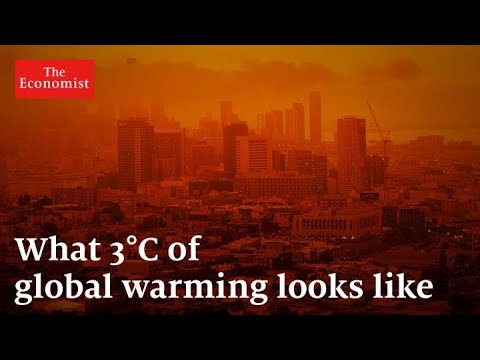 Photo: N43 and Hermes
Three degrees is an average, not an experience. It describes a hotter climate in which familiar extremes, ecological losses and adaptation costs compound across borders.
01The Meaning of Three Degrees
Present-day climate change includes global warming, the ongoing increase in global average temperature, and the wider effects that follow through Earth's climate system. The modern rise is driven mainly by human activities, especially fossil fuel burning since the Industrial Revolution, alongside land-use change, agriculture and industry.
Three degrees of warming means roughly three degrees Celsius above the preindustrial global average, not three degrees added uniformly to every place and season. Land warms faster than ocean, the Arctic warms faster than the global mean, and nighttime temperatures can rise faster than daytime temperatures. An average hides those uneven exposures.
02How the Heat Is Held
Greenhouse gases absorb some of the heat Earth radiates after warming in sunlight, slowing its escape to space. Carbon dioxide from fossil fuels and land clearing is especially important because it accumulates, while methane and other gases add further warming over different lifetimes.
The climate system stores much of the extra energy in the ocean, which expands as it warms and feeds heat into the atmosphere over time. Ice loss, soil moisture, clouds and vegetation then alter the balance. These feedbacks do not make every outcome certain, but they make a warmer baseline persist long after a single year of emissions has passed.
03Extremes Become the Story
People do not live inside a global average. They experience heat in a city, rainfall in a watershed, drought in a farm region and storm surge on a coast. As the baseline shifts, events that were once rare can become more frequent or more intense, and combinations such as heat plus drought can stress the same systems at the same time.
Warmer air can hold more water vapor, increasing the potential for intense rainfall even as many regions face drying soils and declining snowpack. Heat also raises health risks, especially for older people, outdoor workers and those without reliable cooling. The damage is shaped by exposure and preparedness as much as by the physical hazard.
04The Living World Moves
Plants and animals track temperature, water and seasonal timing rather than a line on a political map. Some species can move toward cooler latitudes or elevations, but roads, farms, cities and fragmented habitats block many routes. Coral reefs face a narrower refuge because they already live close to their thermal limits.
Ocean warming and acidification add pressure to marine ecosystems, while warmer winters can expand the range of pests and diseases. The result is not one synchronized collapse but a patchwork of local losses, altered food webs and services that communities have relied on for generations.
05Adaptation Has a Boundary
Adaptation can save lives: heat action plans, early warnings, better building codes, urban shade, drought planning and restored wetlands all reduce exposure. It is practical work already underway in cities, farms and coastal communities. But adaptation costs money, land and time, and those resources are distributed unequally.
Some limits are physical or cultural. A seawall cannot protect every shoreline, a crop cannot always be moved to a place with suitable soil and a body cannot safely acclimatize to every combination of heat and humidity. When adaptation becomes impossible or unaffordable, loss and damage are no longer abstract policy categories.
06The Choices Still in Reach
The future temperature is not determined by an average already stored in the atmosphere. It depends on the cumulative carbon released, the speed of the transition away from fossil fuels, the protection of forests and soils, and the technologies and policies that reduce emissions. Every fraction of a degree avoided reduces some risk, even if no target is met perfectly.
That means climate action is not a wager between salvation and failure. Clean electricity, efficient buildings, resilient transport and healthier air can deliver benefits before the climate signal is fully visible. The hard part is aligning investment and power with a timescale longer than an election or a quarterly report.
07A Warmer World We Should Not Normalize
Three degrees of warming would be a world of more adaptation, more uncertainty and less room for error. It would not erase human agency, but it would make ordinary decisions more consequential: where to build, what to grow, how to insure homes, and which communities receive protection first.
The legacy is still open because climate change is cumulative but not all-or-nothing. We can describe the danger without treating it as destiny. The honest picture is a narrowing range of choices, and the useful response is to widen that range quickly through emissions cuts, preparation and cooperation.
References
- Wikipedia, Climate change.
- The Economist, What does three degrees of global warming look like?.
- Intergovernmental Panel on Climate Change, AR6 Synthesis Report.
- National Oceanic and Atmospheric Administration, Trends in atmospheric carbon dioxide.
- National Snow and Ice Data Center, Arctic sea ice minimum.
- World Health Organization, Climate change and health.
By N43 and Hermes for DutyStation News.