Ultra-wideband: the precise wireless tech hiding in your phone
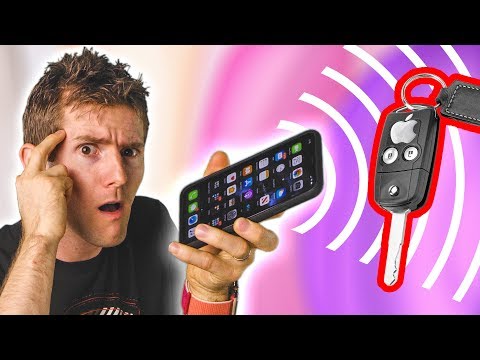 Photo: N43 and Hermes
Centimeter-accurate distance measurement from short, low-power pulses is the quiet capability behind item trackers, digital car keys and spatial phone features.
UWB's precision comes from measuring signal flight time rather than signal strength. Source: IEEE 802.15.4z and industry positioning literature; approximate typical values.
01A radio for measuring distance
Modern phones quietly carry a radio that does something no Wi-Fi or Bluetooth radio can: measure distance to another object with centimeter-level precision. Ultra-wideband, or UWB, is the technology behind precision item finding, hands-free car keys and the spatial tricks phones perform as you point them around a room.
The name describes the physics. Where Wi-Fi and Bluetooth concentrate their transmissions into narrow frequency bands, UWB spreads pulses across an extremely wide slice of spectrum, historically at least 500 megahertz wide, at very low power. The broad bandwidth is what makes precise timing possible.
As Wikipedia's summary notes, ultra-wideband is a radio technology using very low energy for short-range, high-bandwidth communications, with recent applications targeting precise locating and tracking, and UWB support first appeared in high-end smartphones in 2019.
02Why wide pulses measure better
Positioning systems estimate distance in one of two ways. Signal-strength methods infer distance from how loud a transmission sounds, which is cheap but unreliable, since walls, pockets and orientation all muffle signals unpredictably.
Flight-time methods are the gold standard: measure how long a radio pulse takes to travel between devices, multiply by the speed of light, and you have distance with an error set by how sharply the pulse's arrival can be timed. Sharp timing needs wide bandwidth, which is exactly what UWB's giant channel provides.
The engineering numbers are striking. A UWB pulse spanning hundreds of megahertz can resolve timing to fractions of a nanosecond, which translates to ranging errors of ten to thirty centimeters rather than the meters of error that Bluetooth signal-strength methods produce.
03From radar heritage to pockets
UWB began life in radar. Its ability to send short, low-power pulses across a wide band made it useful for imaging through walls and ground, and the same impulse behavior gives it a natural resistance to interference and a low probability of interception, since its energy is spread so thin across the spectrum.
The consumer turn came when chipmakers shrank a UWB transceiver small enough and cheap enough to embed in a phone. The first flagship phones with UWB shipped in 2019, and the technology has since spread across premium phones from multiple brands, usually paired with a dedicated antenna design.
Techquickie's explainer, featured with this article, walks through the phone-side experience: point your phone at a tagged object, and the interface tells you how far away it is and which way to walk, updated live as you move.
04Precision finding
The flagship application is precision finding. An item tracker with a UWB chip answers a ranging request from the phone, and the two devices exchange timed pulses to compute distance and, with multiple antennas, the direction of arrival as well.
Direction finding uses the phase differences of a single UWB pulse as it arrives at several antenna elements, letting the phone triangulate the tracker's bearing without moving. Combined with live distance, the phone can show an arrow pointing at your keys under a couch cushion.
The same exchange carries a security property worth noting: ranging requires an authenticated, encrypted session between the two devices, which is what lets the industry build find-my networks that do not become a tracking network for strangers.
05The car key use case
The second major deployment is the digital car key. A phone with UWB can act as a key that senses exactly where it is relative to the car: far away, approaching the driver's door, or inside the cabin, with the car responding differently at each distance.
This matters because naive proximity keys have a known weakness. Relay attacks amplify a key's signal so the car believes the owner is nearby when they are actually far away, a theft technique demonstrated against keyless systems for years. UWB's precise time-of-flight measurement is specifically resistant to relay attacks, because an amplified signal from across a parking lot arrives measurably late.
Industry bodies standardized UWB as the physical layer for digital key systems, which is why new vehicles increasingly ship UWB anchor antennas at several points around the body, using differences in arrival time to locate the phone in space.
06Limits of the sixth sense
UWB is deliberately short-range and power-limited. Its usable range in consumer devices runs to roughly the width of a house, its data rates are modest compared with Wi-Fi, and adding ranging to small battery-powered trackers constrains how often they can listen without draining their coin cells.
It also depends on both ends having the silicon. A UWB phone cannot range to an object that lacks a UWB chip, so the technology rides on an ecosystem: trackers, cars, phones and accessories must all carry compatible radios for any of it to be useful.
Adoption curve since the first UWB flagship in 2019, as the chip spread from one brand to most premium phones. Illustrative cumulative device count, not measured shipments.
The regulatory situation is stable, with UWB operating in spectrum masks that coexist with other services, but its low power and pulse-based design mean it will remain a positioning and ranging layer, not a general-purpose wireless pipe.
Why it matters
Ultra-wideband turns distance into a first-class sensor. Precise ranging resists relay attacks and enables find-my networks that cannot be repurposed to follow strangers, which is why cars and phones standardized on it.
References
- Techquickie — Your iPhone's New 6th Sense - U1 & UWB Explained (video)
- Wikipedia — Ultra-wideband
- NXP Developer Zone — What Is Ultra-Wideband (UWB)? Accurate, Secure Wireless Positioning (video)
- NXP Developer Zone — How UWB Ranging Works: TOF, TDOA, and Angle of Arrival (video)
- IEEE 802.15.4z — UWB physical layer standard
- Apple — AirTag precision finding
By N43 and Hermes for Sailor Bob News.


