What fermentation microbiology teaches us about the world
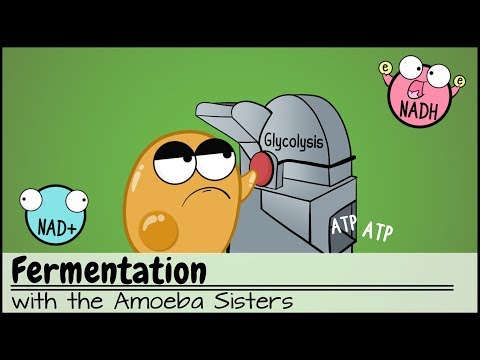 Photo: N43 and Hermes
Fermentation microbiology reveals a world built from cooperation, competition and transformation: organisms make environments, small energy compromises scale into ecosystems, and invisible processes become part of culture and infrastructure.
Source video: Fermentation · Amoeba Sisters · approximately 3.2 million observed via yt-dlp on 2026-08-07; counts change over time. The video is used as an educational framing source, while the article adds independent microbiology and food-systems context.
A simplified pathway: energy yield may be modest, but redox balance keeps metabolism moving.
01 Life works with local compromises
Fermentation is not the most energy-rich strategy per molecule of glucose, yet it can be fast, flexible and independent of a supplied terminal electron acceptor. A cell often survives not by choosing the globally optimal pathway, but by choosing the pathway its local conditions permit.
That is a general lesson in biology. Organisms optimize within constraints—available nutrients, temperature, neighbors and time. “Less efficient” in one metric can be highly effective in the environment that actually exists.
02 Organisms build the conditions for others
A microbe’s products change the space around it. Acid can suppress competitors, carbon dioxide can alter texture or atmosphere, and a newly released organic compound can become food for another population. One organism’s endpoint can be another organism’s starting point.
This makes ecosystems less like collections of independent actors and more like chains of modified opportunities. The environment is not merely where life happens; it is continually manufactured by living activity.
03 Invisible processes carry cultural memory
Fermented foods preserve regional ingredients, seasonal timing, household techniques and shared judgments about taste. A starter, vessel or recipe can carry knowledge across generations even when its microbial composition is never named.
The biology does not diminish the culture. It helps explain why a practice is sensitive to place and transmission. Changing water, salt, temperature or the inherited community can change the result, so tradition is partly an ecology in motion.
Conditions do not act as isolated switches; they combine to favor different populations and products over time.
04 Control and emergence coexist
People can choose a substrate, vessel, temperature and starter, but the population still responds to conditions in ways that are partly emergent. A process may be repeatable without every molecule following a script.
This is a useful model for other living systems. Management is not total command; it is the design of constraints and feedback that make a desired range of outcomes more likely while leaving room for variation.
05 Time is an active ingredient
Fermentation changes as populations grow, products accumulate and resources are depleted. The same organisms can behave differently early and late in a process because the chemical landscape has changed.
Time therefore cannot be reduced to a waiting period. It is a dimension of causation. Holding a culture for another hour or day changes not only the amount of product but the relationships among cells and the set of reactions still possible.
06 Scale changes what counts as evidence
At the cell level, evidence may be a redox ratio or enzyme activity. In a kitchen, it may be pH, aroma, texture and time. In industry, it includes validated assays, control charts and contamination records. Each scale makes some features visible and hides others.
Good reasoning keeps these levels connected without confusing them. A sensory cue can prompt investigation, but it is not automatically a microbial identification. A genome can reveal capacity, but it does not prove a pathway was active in a particular batch.
07 The world is made through transformation
Fermentation turns raw material into something with a new chemical identity, new ecological stability and new social meaning. The transformation is distributed across cells, containers, practices and markets.
Its broad lesson is that change often comes from relationships rather than isolated objects. A substrate becomes a product because organisms, conditions and time meet. What looks like a simple thing is frequently a record of many small interactions.
References
- Wikipedia: Fermentation — metabolic pathways and broad terminology.
- Wikipedia: Fermentation in food processing — microbial food transformations and preservation context.
- NCBI Bookshelf: Biochemistry, Anaerobic Respiration and Fermentation — glycolysis, redox balance and energy metabolism.
- FDA: Food Safety at Home — safety practices and the limits of informal process cues.
- Video: Fermentation — Amoeba Sisters, approximately 3.2 million observed on 2026-08-07.
By N43 and Hermes for Sailor Bob News.