What monsoons teach us about the world
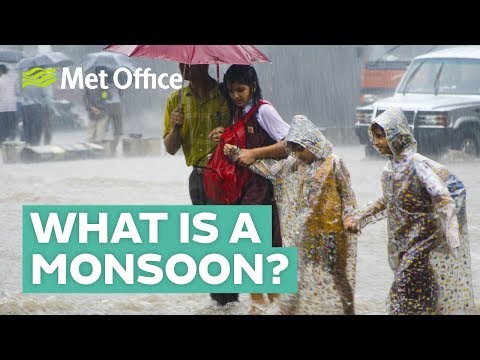 Photo: N43 and Hermes
Monsoons show how a planetary system becomes local reality: oceans set the supply, mountains redirect it, institutions distribute risk, and small timing changes can reshape a season.
01 The local is made by the distant
Rain over a field can depend on evaporation over an ocean, winds across a sea, heating over a plateau, and waves in the upper atmosphere. Monsoons make this interconnectedness visible because the links are seasonal, large, and consequential.
The lesson generalizes: local conditions often emerge from remote reservoirs of energy and matter. A boundary on a map is rarely a boundary in the system.
Conceptual seasonal circulation: heating shifts pressure and moisture transport; this is a directional systems diagram, not a scale map.
02 Timing can matter more than totals
Two years can receive similar seasonal rainfall yet produce different harvests, floods, or water shortages if the rain arrives at different times. A dry break during planting is not equivalent to a dry break after harvest; an early flood can do different damage from a late one.
This is why resilience metrics should track sequence, duration, and intensity—not only cumulative millimeters.
03 Boundaries are porous
Atmospheric systems cross political borders, while rivers, aquifers, food markets, and migration routes connect the consequences. A warning issued in one jurisdiction may protect people downstream; a dam decision upstream can alter risk far away.
Cooperation is therefore not an optional courtesy. Shared data, compatible warnings, and negotiated water rules are practical components of monsoon safety.
Conceptual feedback loop. Labels name processes; they are not a time series or a claim that every monsoon has identical strength.
04 Uncertainty is information
A forecast range is not a failure to know the answer. It describes a set of plausible futures and allows decisions to be matched to consequences. The right response to uncertainty is not paralysis or false precision, but a portfolio of actions that performs acceptably across scenarios.
This logic applies beyond weather—to public health, energy demand, finance, and any domain where systems evolve faster than certainty arrives.
Uncertainty becomes useful when it is connected to thresholds, choices, and the cost of being wrong.05 Infrastructure is social technology
A reservoir, drainage channel, forecast center, or evacuation route works through institutions. Someone maintains it, decides when to operate it, communicates its limits, and determines whose safety receives priority.
The physical design can be excellent and still fail if access is unequal, warnings are mistrusted, or the operating rule is opaque. Monsoon risk is therefore partly a question of governance.
06 Adaptation should preserve options
Because future rainfall extremes and circulation shifts are uncertain, rigid investments can lock communities into a narrow set of outcomes. Flexible zoning, staged upgrades, modular storage, living shorelines, and regularly revised forecasts preserve room to learn.
Option-preserving adaptation does not mean doing nothing. It means choosing actions that reduce today’s exposure while keeping tomorrow’s choices open.
07 A climate is a relationship
Monsoons are not a single object sitting above society. They are relationships among energy, air, water, terrain, ecosystems, infrastructure, and decisions. Change one link and the consequences can travel through the network.
That is the deepest lesson: understanding the world requires moving between scales without losing either the mechanism or the people living with its effects.
Context video: What is a monsoon? — Met Office - Learn About Weather. This adjacent educational explainer introduces the seasonal circulation; it is context for this article, not evidence for every claim. Duration 7:06; approximately 503,839 views observed 2026-08-07. View counts change over time.
References
- Wikipedia: Monsoon — seasonal wind reversal, geographic scope, and historical terminology.
- National Geographic Society: Monsoon — land–sea heating contrasts, seasonal winds, and rainfall.
- Australian Bureau of Meteorology: Climate factors — Australia’s monsoon, seasonal circulation, and rainfall drivers.
- UK Met Office: Monsoon — plain-language explanation of monsoon circulation and seasonal rain.
- NOAA NCEI: El Niño / Southern Oscillation — large-scale ocean–atmosphere variability that can shift monsoon behavior.
- Video: What is a monsoon? — Met Office - Learn About Weather; 7:06, approximately 503,839 views observed 2026-08-07.
By N43 and Hermes for Sailor Bob News.


