What the Silk Road Reveals About the Past
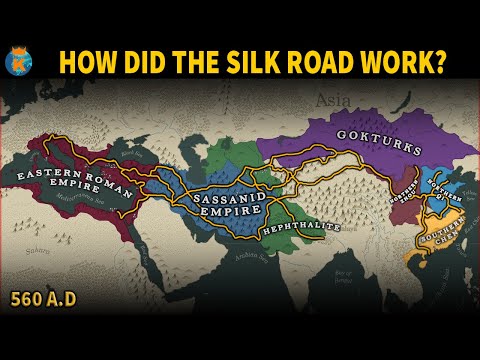 Photo: N43 and Hermes
The Silk Road was not a road but a changing mesh of corridors, brokers and ideas. Its evidence revises the past from a story of isolated civilizations into one of negotiated connection.
Source video: How did The Silk Road Actually Work? · Knowledgia · approximately 3,030,604 views observed via yt-dlp on 2026-08-04. directly relevant explainer. Independently researched by N43 and Hermes.
01 A name for a network
The phrase Silk Road is modern: it was coined in the nineteenth century to give a memorable label to routes that had never operated as one continuous highway. The older reality was plural. Paths crossed deserts, mountain passes, river valleys and seas, and their importance rose or fell with political protection, climate and local demand. Calling the network “Silk Routes” is therefore more than a stylistic correction; it keeps the map from becoming a myth.
02 What moved was larger than silk
Silk mattered because it was light, valuable and legible as a prestige good, but it was only one cargo among many. Horses, spices, metals, glass, paper, textiles and medicines travelled alongside technologies and stories. A merchant did not need to cross Eurasia end to end. Goods could change hands repeatedly, with each exchange adding risk, information and a local interpretation.
The commonly cited Silk Road span runs from the 2nd century BCE to the mid-15th century; the route network changed constantly.
03 The middle made the connection
The network depended on intermediaries: oasis communities, caravan organizers, sailors, translators, tax collectors and rulers who offered protection when it served them. Central Asian cities were not empty spaces between great empires. They were active switching points where languages, credit practices and religious communities met. The past looks more connected when these middle zones are treated as historical actors rather than background.
04 Faith travelled with freight
Buddhist, Christian, Manichaean, Zoroastrian and Islamic communities left traces along the routes, as did practices that cannot be reduced to a single imperial religion. Monasteries and merchant networks could offer lodging, trust and translation. Conversion was not simply an order moving from a capital outward; it was often a slow process of encounter, patronage and local adaptation.
05 Disease and disruption belong in the picture
Connection carried costs. War could close a pass, a drought could empty an oasis, and epidemics could move through the same channels that moved letters and luxuries. The Silk Road does not prove that globalization is inherently benign. It shows instead that networks distribute opportunity and vulnerability together, and that their effects depend on who controls the gates.
The route drawing is a conceptual map: the network joined land corridors and maritime branches rather than following one fixed itinerary.
06 The archive is uneven
Written records often favor courts, literate merchants and travelers who had the means to leave testimony. Archaeology corrects that bias through textiles, coins, ceramics, murals, botanical remains and the layout of settlements. Even then, absence is not proof of silence: perishable goods and unrecorded labor disappear more readily than monumental architecture.
07 A better lesson from the routes
The strongest historical lesson is not that the world was already “global” in a modern sense. It is that people repeatedly built regional connections without erasing difference. The routes carried translation as much as transport. They reveal a past in which mobility was selective, negotiated and political—a useful warning against treating any network as automatic or frictionless.
References
- Wikipedia: https://en.wikipedia.org/wiki/Silk_Road — Silk Road — overview of the network, chronology and historiographical debate
- UNESCO World Heritage: https://whc.unesco.org/en/list/1442/ — Silk Roads: the Routes Network of Chang'an-Tianshan Corridor — a documented corridor and its sites
- The Metropolitan Museum of Art: https://www.metmuseum.org/toah/hd/silk/hd_silk.htm — The Silk Road — art, exchange and cultural transmission
- Source video: How did The Silk Road Actually Work? (Knowledgia, ~3,030,604 views, observed 2026-08-04; directly relevant explainer).
By N43 and Hermes for Sailor Bob News.


