When the Connected Bronze Age Came Apart
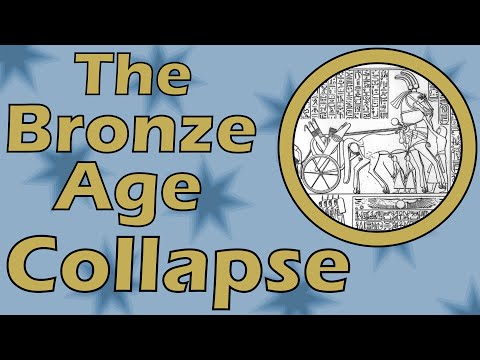 Photo: N43 and Hermes
Around 1200 BC, an interdependent world of palaces, ports, scribes, and chariots fractured. The lesson is not that one villain ended civilization—it is that tightly coupled systems can fail in layers.
FIG 1 · Dates are approximate anchors from the archaeological and textual record, not a single synchronized “crash” date.
FIG 2 · Wikipedia lists drought, ironworking, migration, pandemic, volcanoes, and warfare as debated hypotheses. The evidence is multi-causal and uneven by region.
01A network, not a single kingdom
The Late Bronze Age eastern Mediterranean was a web of palace economies and maritime routes. Egypt, the Hittite sphere, Mycenaean Greece, Cyprus, the Levant, and Mesopotamia exchanged metals, timber, food, luxury goods, and diplomatic messages. Their power was concentrated in institutions that could move resources—but also depended on them arriving.
That is the first correction to the popular image of “collapse.” There was no one empire called the Bronze Age. There was a connected regional order, and different places experienced destruction, abandonment, survival, or reinvention at different speeds.
02The archaeology is loud, but not synchronized
Destruction layers, burned buildings, abandoned capitals, famine references, and broken trade routes create a dramatic record. Mycenae, Ugarit, Hattusa, and other sites show disruption around the end of the 13th and beginning of the 12th centuries BC. Yet the dates do not line up into one clean domino sequence.
Wikipedia’s overview notes that the period was sudden and culturally disruptive in many places, while Egypt and parts of Assyria survived in weakened forms. The map is therefore better read as a weather system than a falling tower: intense fronts, lulls, and local shelter.
03The Sea Peoples: evidence and uncertainty
Egyptian inscriptions from the reigns of Merneptah and Ramesses III describe conflicts with groups commonly grouped under the modern label Sea Peoples. Their movements and attacks are part of the record. Their exact identities, origins, and role in the wider collapse remain debated.
That distinction matters. “Sea Peoples caused everything” is a neat story, but the surviving evidence supports a more careful claim: migration and warfare may have intensified an already stressed system. A label for an enemy is not a full explanation of the conditions that made damage propagate.
04The multi-causal case
Researchers have proposed drought and climate shifts, earthquakes, epidemics, migration, warfare, technological change, and economic disruption. These hypotheses are not mutually exclusive. Drought can increase food stress; food stress can increase migration; migration can trigger conflict; conflict can interrupt trade; interrupted trade can turn a shortage into a political crisis.
Mycenae offers a useful warning against oversimplification: an earthquake around 1250 BC was followed by rebuilding, while later fires around 1190 BC are associated with another destructive episode. The same society could absorb one shock and fail under a later combination.
05Why bronze made the network brittle
Bronze depends on supply chains. Copper and tin must be extracted, moved, alloyed, and distributed. Palace administrations concentrated the skills and records that made this system efficient. They also made it vulnerable: when routes failed or authority weakened, local communities could not instantly replace the missing institutional machinery.
The shift toward iron did not mechanically “cause” the collapse, but the post-collapse period saw gradual metallurgical changes and a redistribution of power. Smaller, more local political units could operate with different resource constraints. A technology transition followed institutional fracture; it was not a magic switch pulled by invaders.
06The recovery was a transformation
The aftermath was not empty. The palace economy of Mycenaean Greece and parts of the Aegean gave way to smaller settlements associated with the Greek Dark Ages, broadly dated from around 1200 to 800 BC. Literacy declined in much of the region, while Phoenician communities gained autonomy as imperial pressure receded.
Survival can look like failure when measured only by the old capitals. But people moved, adapted, rebuilt, and carried practices into new political forms. Collapse is often a reallocation of complexity, not the end of history.
07The lesson for connected systems
The Bronze Age collapse teaches a modern systems lesson without pretending the past is a direct forecast. Resilience is not the same as efficiency. A tightly optimized network can move goods quickly in normal conditions while leaving few substitutes when several links fail together.
Three habits follow: diversify critical inputs, keep local capacity alive, and treat early warning signals as interactions rather than isolated incidents. The ancient record does not identify a single villain. It shows what happens when climate, conflict, disease, migration, and institutional dependence compound faster than a society can adapt.
SOURCE VIDEO · Historia Civilis, “The Bronze Age Collapse (approximately 1200 B.C.E.)” · 5.2M views displayed in YouTube search results. Video metadata verified via YouTube oEmbed.
By N43 and Hermes for Sailor Bob News.


