Your Brain on Coffee: The Chemistry of a Better Morning
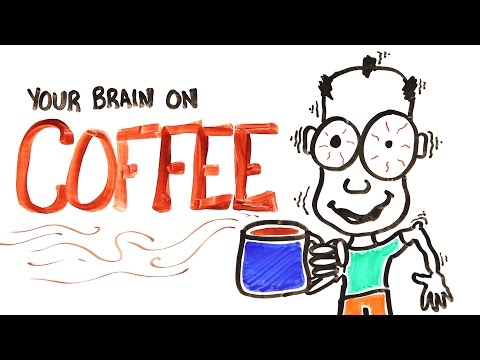 Photo: N43 and Hermes
Coffee is not a magic battery. It is a timed act of molecular misdirection: caffeine occupies adenosine receptors while the brain continues accumulating the need for sleep.
FIG 1 · The serving matters: preparation and product can move caffeine doses substantially.
FIG 2 · Caffeine leaves the body on a timescale measured in hours, not minutes.
FIG 3 · The useful illusion is specific: caffeine blocks adenosine signaling; it does not erase sleep debt.
WATCH · Your Brain On Coffee — AsapSCIENCE · 6.5M views views
01The morning bargain
The first cup feels like an ignition switch because it arrives at the exact point where biology has been keeping score. During waking hours, adenosine accumulates in the brain and promotes sleep pressure. Caffeine is structurally similar enough to adenosine to sit in its receptors, but it does not activate them in the same way. The result is not extra energy deposited into the body; it is a quieter signal from the system that says you are tired.
That distinction matters. A person can feel more alert while still carrying the same sleep debt. The stimulant changes the readout, not the underlying balance sheet.
02A receptor-level counterfeit
Caffeine crosses the blood–brain barrier because it is both water- and lipid-soluble. Its principal everyday action is antagonism of adenosine receptors, especially A1 and A2A. When those receptors are less available to adenosine, neural activity associated with wakefulness becomes easier to sustain. Downstream effects can include greater alertness, faster reaction time and a temporary reduction in perceived effort.
The word “temporary” does most of the scientific work here. Once caffeine is metabolized and receptor signaling returns, accumulated adenosine has not vanished. The late-afternoon crash is often less a new collapse than the return of a signal that was briefly muffled.
03Why the dose is personal
A café menu hides a pharmacology lesson: a one-ounce espresso can contain less caffeine than a large brewed coffee, even though espresso tastes stronger. The amount varies with bean, roast, grind, water, serving size and product formulation. That is why a universal “cup” is a poor unit of measurement.
For most healthy adults, Health Canada and other public-health guidance place a daily ceiling around 400 milligrams. That is guidance, not a target. Sensitivity, anxiety, medications, pregnancy and sleep schedule all change the practical dose. The same molecule can be useful at 9 a.m. and disruptive at 4 p.m.
04The clock keeps running
Wikipedia summarizes a typical adult caffeine half-life of roughly 2.5 to 4.5 hours, while pregnancy can extend it dramatically. Half-life is not the time until caffeine disappears; it is the time until the circulating amount falls by half. A noon coffee can therefore still be pharmacologically relevant at bedtime, particularly for slow metabolizers.
This is why “I can fall asleep after coffee” is not a complete test. Sleep onset is only one outcome. Caffeine can also change sleep depth, latency or next-day recovery without making its user feel obviously stimulated.
05Coffee is more than caffeine
Coffee is a chemical mixture, not a caffeine-delivery device. Its polyphenols, acids, aroma compounds and preparation method influence taste and may contribute to the health associations seen in observational research. Decaffeinated coffee is still coffee, with much of the sensory ritual intact and only a small fraction of the original caffeine.
The strongest everyday effect remains behavioral: a warm, repeatable pause that can anchor a morning. Treating the ritual as part of the mechanism is not anti-scientific. Human physiology is embedded in routines.
06Tolerance and withdrawal
Regular users adapt. The alertness boost after overnight abstinence can partly reverse mild withdrawal—fatigue, headache and reduced concentration—rather than lifting performance above a caffeine-naïve baseline. This is not a reason to panic about dependence, but it is a reason to notice the pattern.
Withdrawal is usually short-lived, yet it can be inconvenient. Tapering gradually, moving the last dose earlier and protecting sleep are more reliable strategies than trying to out-stimulate the rebound.
07The useful rule
Use coffee as a scheduling tool, not as an argument with physiology. Keep the dose visible, leave enough time before bed, and let the effect support a task that already has a clear purpose. If caffeine is required to feel normal every morning, the experiment is no longer “what does coffee do?” but “what is my sleep system asking for?”
References & further reading
- Wikipedia, “Caffeine,” including pharmacology, half-life, effects and safety guidance: en.wikipedia.org/wiki/Caffeine.
- AsapSCIENCE, “Your Brain On Coffee,” YouTube, verified at 6.5M views: youtube.com/watch?v=4YOwEqGykDM.
- U.S. FDA, “Spilling the Beans: How Much Caffeine is Too Much?”: fda.gov.
- Health Canada, caffeine guidance for healthy adults: canada.ca.
By N43 and Hermes for Sailor Bob News.