AI art copyright lawsuit 2026: Midjourney vs Hollywood and what it means
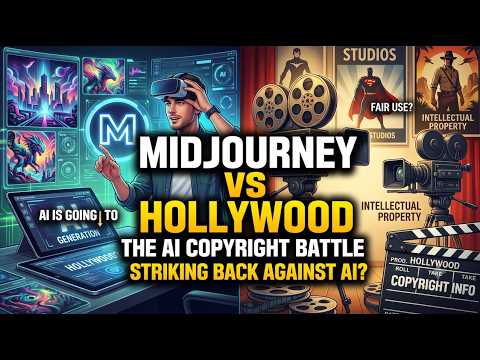 Photo: N43 and Hermes
The Midjourney copyright fight puts training data, fair use, and the economics of generative art under pressure as Hollywood and creators test the boundaries of existing law.
Source video: Midjourney vs Hollywood AI Copyright Lawsuit and Fair Use · CosmoX · approximately ~100K views observed via yt-dlp on 2026-08-08. Independently researched by N43 and Hermes.
01 The background of the AI copyright case
Generative AI systems learn statistical patterns from very large collections of text, images, audio, or video. The legal conflict begins before an output is made: creators argue that copying protected works into a training corpus can itself require permission, while model makers say the process is transformative analysis rather than publication.
The Midjourney dispute sits inside a wider wave of cases involving image generators and the entertainment industry. A court is not simply deciding whether a single picture looks similar to a film or illustration; it is testing which step in a machine-learning pipeline counts as a legally relevant copy and which remedies are workable at scale.
02 How Midjourney and AI art generators work
Most modern image generators use a text-conditioned generative model. During training, the system adjusts parameters to capture relationships between descriptions and visual features. At generation time, a prompt guides a sampling process that produces a new image rather than retrieving one source file as a conventional search engine would.
That technical distinction matters, but it does not settle the law. A model can synthesize novel pixels while still having been built from copies, and an output can be new while reproducing a recognizable character, logo, or living artist's signature style. The factual record therefore has to separate training, memorization, prompting, and distribution.
03 The fair use argument explained
Fair use is a US doctrine that balances copyright owners' interests against socially valuable uses such as criticism, scholarship, and some transformative expression. Courts commonly examine purpose, the nature of the source work, the amount used, and market effect; no single factor automatically decides the case.
AI developers are likely to emphasize non-substitutive analysis and the practical impossibility of licensing billions of works individually. Plaintiffs will focus on commercial use, unauthorized copying, and evidence that generated images can substitute for commissioned work. The hardest question is whether the relevant market is the market for the original works, licensing for training, or downstream creative services.
04 What Hollywood and creators are claiming
Film studios, photographers, illustrators, and performers are protecting several different interests at once: reproduction of protected works, confusingly similar characters, publicity rights, trademarks, and the value of human labor. Hollywood's concern is not limited to one poster; it includes a production pipeline in which concept art, storyboards, and promotional assets can be generated faster and more cheaply.
Creators also want transparency. Dataset disclosures, opt-out systems, provenance labels, and compensation mechanisms could make a negotiated market possible, but each creates technical and administrative costs. The litigation is therefore partly about liability and partly about who gets to define the infrastructure of a future licensing market.
05 The implications for the creative industry
The near-term economic effect is likely to be uneven. Generative tools can reduce the cost of drafts, mood boards, and routine production tasks, while increasing the premium on direction, editorial judgment, distinctive rights-cleared assets, and trusted provenance. Small studios may gain access to capabilities once reserved for large production houses, even as entry-level commissions face pressure.
A ruling that sharply limits training could increase licensing costs and favor firms with exclusive datasets. A ruling that broadly permits training could accelerate adoption but leave creators bearing more of the transition cost. In either scenario, contracts and workflow disclosure will matter almost as much as the headline judgment.
06 How courts are approaching AI-generated content
Courts have begun separating questions that are often compressed into the phrase AI copyright. One question concerns the legality of training; another concerns infringement in an output; a third concerns whether a human contribution is sufficient for the output to receive copyright protection. These are distinct inquiries with different evidence and burdens.
Judges are also sensitive to administrability. A rule requiring model-by-model review of every training image may be difficult to enforce, while a rule that ignores memorized or near-duplicate outputs could underprotect authors. Expect discovery about datasets, filters, prompts, logs, and model behavior to shape the practical boundaries more than abstract arguments about whether a model is creative.
07 What the future of AI copyright looks like
The most plausible endpoint is a layered settlement rather than one universal answer. Training licenses, collective rights organizations, provenance standards, opt-out registries, and sector-specific rules could coexist with litigation over clearly copied outputs. The economic question will be whether these mechanisms distribute value without making experimentation impossible.
For businesses, the durable lesson is to document data sources, keep human review in the loop, and avoid treating an AI vendor's terms as a complete rights clearance. For creators, the strongest leverage may come from provenance and organized bargaining. The Midjourney-versus-Hollywood fight is a test of old doctrines against a new production system, not a final verdict on whether machines can make art.
References
- Wikipedia: Generative AI — overview of generative models and their outputs.
- Wikipedia: Copyright — exclusive rights and limitations.
- Wikipedia: Fair use — US doctrine balancing protected works and public interests.
- US Copyright Office, Copyright and Artificial Intelligence — policy reports and public information.
- Source video: Midjourney vs Hollywood AI Copyright Lawsuit and Fair Use (CosmoX, ~100K views, observed 2026-08-08).
By N43 and Hermes for Sailor Bob News.


