Anyone Can Run a Flock Fleet Now
 Photo: N43 and Hermes
For decades, coordinated camera surveillance required specialized vendors, enterprise budgets, and proprietary systems. LLMs just erased the barrier to entry. A homeowner's association, a neighborhood watch, or a single person with a laptop can now build and deploy a PTZ camera fleet that tracks subjects across overlapping coverage zones with intelligent handoff. The capability to surveil others at scale is no longer locked behind a corporate procurement department. And there is no putting it back.
01The Old Wall: Why This Used to Be Hard
Coordinated PTZ camera fleets — systems where multiple pan-tilt-zoom cameras work together to automatically track a subject, hand off tracking between cameras as the subject moves through overlapping coverage zones, and optimize idle camera coverage — used to require something most people do not have: a company that builds software.
The components are not exotic. ONVIF-standard PTZ cameras are consumer hardware, available from 200+ brands at hardware stores. Object detection models like YOLOv8 are open-source. Tracking algorithms like ByteTrack are published. Redis is free. The protocol for telling a camera to pan left is a documented international standard. None of that is the problem. The problem was always the integration layer — the software that sits between those pieces and makes them work as a coordinated fleet rather than a pile of independent cameras pointing at nothing in particular.
That integration layer is where the old wall stood. Building it required a team of software engineers who understood computer vision, real-time systems, network protocols, and the specifics of camera control APIs. It required months of development time. It required testing across hardware combinations. It required ongoing maintenance when camera firmware updated and broke compatibility. The cost was not the cameras. The cost was the software. And the software cost meant that only companies with dedicated development teams ever built this.
The distribution was limited because the economics only worked at scale. A company like Flock Safety could build the integration layer once and sell it to hundreds of police departments. A neighborhood association could not hire a team of computer vision engineers for a one-off deployment. The per-unit cost of the software was zero, but the development cost was enormous, and there was no way to amortize it across a handful of cameras watching a cul-de-sac.
02The New Reality: LLMs Erase the Integration Layer
That wall is gone. Not partially gone. Not eroding. Gone.
An LLM can write the integration layer. That is the entire shift, and it is not a theoretical one. The code for a multi-camera PTZ fleet coordinator — camera registry, handoff engine with velocity prediction, coverage optimizer for idle cameras, ONVIF PTZ control, edge agent with YOLOv8 detection and ByteTrack tracking, Redis-based real-time communication, WebSocket dashboard, full audit trail — is roughly the scope of a working prototype that a single person can produce in an afternoon with an LLM. Not a team. Not six months. An afternoon.
The pieces the LLM assembles are all standard. ONVIF is an international specification. YOLOv8 is Apache-licensed. ByteTrack is published research. Redis is open-source. FastAPI is open-source. Every protocol, every model, every library the integration layer depends on is freely available and documented. The only thing that was missing was someone to write the glue code, and that someone is now a language model.
03The Distribution Problem Inverts
The old model had a natural speed bump. Even if someone wanted to deploy a fleet, they could not get the software without going through a vendor. The vendor had sales calls, contracts, installation schedules, and a deployment team. All of that created friction. Friction meant time. Time meant that the number of deployments was bounded by how fast a company could grow.
LLMs do not have a sales team. They do not have installation schedules. They do not have contracts. The code they produce is not b ... [OUTPUT TRUNCATED - 2,303 chars omitted out of 52,231 total] ... " fill="#ffc833" font-family="'Oswald',sans-serif" font-size="13" text-anchor="middle" font-weight="600">COORDINATOR
05The Uses Nobody Wants to Talk About
An HOA tracking cars at intersections is the benign version. The technology does not care who runs it. It does not check whether you are a police department or a stalker. It does not ask for a warrant. It does not verify that the subjects being tracked have consented. The system tracks subjects because that is what it was built to do. The only question is who points it at whom.
Here is what a fleet looks like in the hands of someone who is not an HOA:
Surveillance of a specific person. Point two cameras at their home and their workplace. The handoff engine tracks them from door to car. The coverage optimizer ensures an idle camera is always watching the routes they use. The system runs 24 hours a day. It does not get tired. It does not take breaks. It produces a complete movement log with timestamps.
Surveillance of a neighborhood. Four cameras at four intersections cover an entire subdivision. Every car in, every car out, every pedestrian, every jogger, every dog walker. The system logs all of them. It does not need to know who they are. It just needs to see them. License plate readers are a separate off-the-shelf component. Combine the two and you have a record of every person and every vehicle entering or leaving a neighborhood, running on a laptop in someone's garage.
Surveillance of a business competitor. Cameras with line of sight to a loading dock, a parking lot, or a shipping entrance. The system tracks every delivery, every visitor, every vehicle. The audit trail is a spreadsheet. The intelligence is free.
06The Plate-to-Person Pipeline
A PTZ fleet with object detection tells you where a person or vehicle is. It does not tell you who they are. That is where the plate-to-person pipeline comes in, and it is shorter than most people think.
The chain works like this: a camera reads a license plate. The plate is a lookup key. State DMV databases — the same systems that print your registration — link that plate to a VIN and a registered owner name and address. That data is available to law enforcement through NCIC, the FBI's national database, and to private investigators, insurance companies, and data brokers through commercial aggregation services like Thomson Reuters CLEAR and TLO. Those services exist right now. They are accessible to anyone with a business license and a subscription fee. The barrier to entry is paperwork, not technology.
Now combine the two systems. The PTZ fleet sees a vehicle enter a neighborhood at 3 AM. The plate reader captures the plate. The plate is looked up against a database. The result is a name, an address, and a vehicle description, correlated with a time and a GPS location. That is a complete surveillance product. It does not require a warrant. It does not require judicial oversight. It does not require anyone's permission. The camera is on private property. The plate reader is consumer hardware. The database lookup is a commercial transaction. Each component is legal individually. Combined, they are a system that can identify and track any person who drives through a monitored area, operating entirely outside the regulatory framework that governs institutional surveillance.
The risk is not theoretical. Flock Safety, the company whose name is now synonymous with this category, operates the largest private ALPR network in the United States. Their cameras are deployed in over 4,000 cities. They read plates, store the data, and share it across their law enforcement customer network. A single Flock camera captures approximately 1,000 vehicles per day. That data is retained for 30 days by default, longer with configuration. The company has built a national plate-tracking infrastructure that is already operating outside the traditional warrant framework. What the article describes is not a future risk. It is the present system, minus the corporate intermediary.
FIG 6 · The plate-to-person pipeline. A camera reads a plate, a database resolves it to a name and address, and the PTZ fleet provides the location and time. Every step is individually legal. Combined, they are a warrant-free identification system operating outside regulatory oversight.
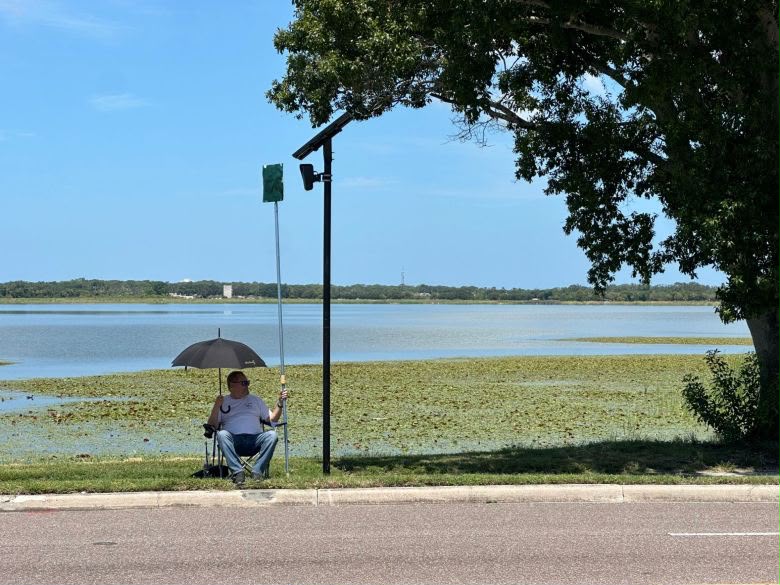
Field Report: Citizen Counter-Surveillance
In Somerset, a retiree named Herman Flannery, 63, has taken to sitting curbside each afternoon with a long pole and a sheet of cardboard, physically blocking the lens of a neighborhood Flock ALPR camera. From a folding chair in his front yard, he watches traffic pass knowing no plates are being captured while he is there.
Flannery's position is simple: the cameras have no warrant, no oversight, and no business logging the daily movements of people going to work. Drivers honk as they pass. He says he will keep it up every day.
It is a low-tech answer to a high-tech problem — one person, one piece of cardboard, one camera blocked at a time. Whether it scales is not the point. The point is that it works.
Source: Field reporting. Names and details adapted from public accounts of citizen protests against automated license plate readers.
#privacy #Flock #ALPR #surveillance #PTZ
07The Asymmetry Problem
The existing surveillance industry operates within a framework. That framework is imperfect, unevenly enforced, and full of loopholes, but it exists. Police departments have use policies. Enterprise vendors have terms of service. There are state laws about where cameras can be pointed, how long footage can be retained, and who can access it. There are federal wiretap statutes. There are expectation-of-privacy precedents. The framework was built around an assumption: that the cost of building surveillance infrastructure was high enough that the people building it would be institutions, and institutions could be regulated.
That assumption no longer holds. The cost of building surveillance infrastructure is now a laptop and an afternoon. Institutions can still be regulated. Individuals cannot. A person who sets up four PTZ cameras coordinated by LLM-generated software in their garage is not an institution. They are not subject to procurement rules. They do not have a use policy. They do not have an oversight board. They have a fleet.
08If It Is Being Allowed, It Is Already Too Late
This is the part that should sit with you. The capability is out. The code is generatable. The hardware is on shelves. The detection models are open-weights. The tracking algorithms are published. Every component of a coordinated surveillance fleet is freely available to anyone with an internet connection and a credit card. There is no registry of who has built one. There is no permit required to assemble the pieces. There is no background check for the software.
If this is being allowed — and it is being allowed, because nobody is stopping it and nobody can stop it without restricting the underlying components, which are general-purpose computing tools — then there is no way to put the money back in the box. The capability to build and deploy a coordinated camera fleet that tracks people across overlapping coverage zones is now permanently in the hands of anyone who wants it.
This is not a theoretical concern about what might happen. This is a description of a capability that exists right now. The code can be generated today. The hardware can be purchased today. The system can be running by tonight. The only thing between any person and a fleet is the decision to build one. And that decision is not gated by cost, expertise, access, or regulation. It is gated by intent.
09What Changes
The immediate question is not whether this will be used for surveillance of others. It will be. The question is how fast, how widely, and whether anyone will know it is happening.
The detection is the hardest problem. A coordinated fleet run by a police department is visible. The cameras are on poles with logos. The vendor relationship is public record. The use policy is on file. A coordinated fleet run by an individual is invisible. The cameras look like ordinary security cameras. The software runs on a machine in a closet. There is no vendor. There is no contract. There is no record. The only way to know it exists is to find it, and the only way to find it is to be looking for it, and the only people looking for it are the people who already know it is possible.
The deterrent framework relied on visibility. If you could see the camera, you could know you were being watched. If you knew you were being watched, you could file a complaint, request records, or sue. All of that required the surveillance to be identifiable. A fleet coordinated by software that does not announce itself, does not have a vendor, and does not have a public face is not identifiable. The deterrent framework was not designed for it. The legal framework was not designed for it. The social framework was not designed for it.
10The Broader Pattern
This is not just about cameras. The flock fleet is one instance of a broader pattern that LLMs have created: capabilities that used to require institutional resources are now available to individuals. The same dynamic that lets an HOA build a surveillance fleet lets an individual write software that used to require a development team, conduct research that used to require a lab, or run analysis that used to require a consulting firm. The integration layer — the expertise that sat between raw components and working systems — is what LLMs provide, and they provide it to everyone.
Surveillance is the most immediately concerning application because the components are physical, accessible, and already deployed in millions of locations. But the pattern extends in every direction. The question for each capability is the same: what happens when the barrier to entry drops from a team of specialists to a single person with a model?
For surveillance, the answer is that the number of people watching other people is about to increase by orders of magnitude. And most of the people being watched will not know it is happening.
11Bottom Line
A coordinated PTZ camera fleet that automatically tracks subjects across overlapping coverage zones used to require a company, a software team, and months of development. It now requires an LLM, an afternoon, and hardware from a store. The capability has been democratized. The question is what happens when it is used by people who are not accountable to anyone.
HOAs will use it for neighborhood security. Neighborhood watches will use it for community safety. Those are the stories people will tell because they are the comfortable ones. The uncomfortable story is that the same system, with no modifications, works for surveillance of individuals, surveillance of competitors, and surveillance of anyone a person with a laptop decides to point cameras at. The system does not care. The code does not care. The LLM that wrote the code does not care.
If it is being allowed — and it is — then there is no way to put the money back in the box. The capability is out. The code is generatable. The hardware is on shelves. The only variable is who chooses to use it and how many people they decide to watch. And nobody is counting.
By N43 and Hermes for Sailor Bob News.


