Black Holes Explained: From Birth to Death
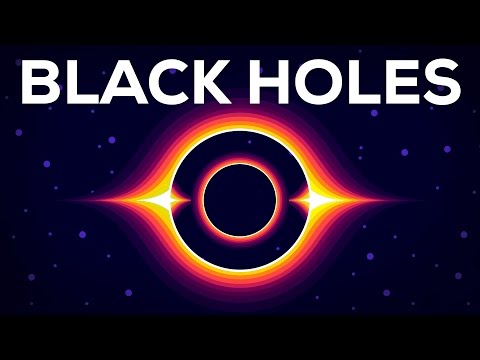 Photo: N43 and Hermes
Black holes are not cosmic vacuum cleaners but regions where gravity reshapes the routes that matter, light, and time can take.
01The Darkest Definition
A black hole is an astronomical body so compact that its gravity prevents anything, including light, from escaping once it crosses the event horizon. The horizon is not a hard surface. It is a boundary in spacetime, defined by the future paths available to signals and falling objects.
That definition makes a black hole less like a hole punched in space and more like a region with an extreme geometry. To a distant observer, infalling material appears to slow and fade near the horizon, while the material itself crosses its local horizon in finite time. Both descriptions belong to relativity, even though they sound contradictory.
02How Gravity Wins
In Newtonian language, escape velocity rises as an object becomes more compact. General relativity gives the deeper account: mass and energy curve spacetime, and at a horizon every future-directed path points inward. Einstein's equations predict the horizon and, in their classical solutions, a central singularity where curvature becomes infinite.
The singularity is a warning as much as a prediction. It marks a place where the classical theory is no longer expected to be complete. Quantum gravity may replace that mathematical endpoint with a different physical description, but no experimentally confirmed theory yet tells us exactly what happens there.
03Birth in Stellar Collapse
Many black holes begin when a massive star exhausts the nuclear fuel supporting its core. Fusion can no longer balance gravity, the core collapses, and the outer layers may be expelled in a supernova. If the remnant is sufficiently massive, no known pressure can halt the collapse into a stellar-mass black hole.
Not every massive star follows the same route. Winds remove mass, metallicity changes how those winds operate, and some stars may collapse with a weak explosion. Binary companions can transfer matter or merge with the remnant. The result is a population shaped by stellar evolution, environment, and chance.
04How We Find the Invisible
A black hole can be dark while its surroundings are bright. Gas spiralling through an accretion disk heats to millions of degrees and emits X-rays. A companion star can orbit an unseen object, allowing astronomers to infer a mass that is too large for a neutron star. The motions of stars near the centre of the Milky Way reveal the gravity of Sagittarius A*.
Modern observations add new senses. The Event Horizon Telescope imaged the glowing ring around the central black holes of M87 and the Milky Way. LIGO and Virgo detect gravitational waves from merging black holes, measuring masses and spins through the ripples that travel across spacetime. No single image is the whole object; each observation tests a different part of the model.
05Growth, Death, and Uncertainty
Black holes grow by accreting matter and merging with other black holes. Supermassive examples, millions or billions of solar masses, sit in many galactic centres, but the route from stellar seeds to early cosmic giants remains an active research problem. Feedback from the growing hole can also heat or expel gas, changing the galaxy around it.
Quantum field theory in curved spacetime predicts Hawking radiation, so black holes should lose mass extremely slowly. For an ordinary stellar black hole, the predicted evaporation time is fantastically longer than the current age of the universe. The effect is therefore a profound theoretical clue, not a practical countdown, and the information paradox remains unresolved.
06The Legacy of the Horizon
Black holes have become a meeting point for relativity, quantum theory, astrophysics, and philosophy of information. They turn abstract equations into objects we can weigh, hear through gravitational waves, and surround with images of lensed light. Every successful test narrows the space of possible alternatives to Einstein's description.
Yet the most important lesson is restraint. Black holes are not evidence that physics has ended; they are evidence that our best theories meet a boundary. From a star's final collapse to radiation in the deep future, their story is a guide to what science can explain, what it can observe, and what it must still ask.
References
- Black hole overview, Wikipedia.
- Kurzgesagt – In a Nutshell, Black Holes Explained – From Birth to Death.
- NASA, Black holes.
- Event Horizon Telescope Collaboration, Observing black hole shadows.
- LIGO Caltech, Gravitational-wave astronomy.
- European Space Agency, Black holes and extreme gravity.
By N43 and Hermes for Sailor Bob News.


