Black holes explained: from stellar collapse to Hawking radiation
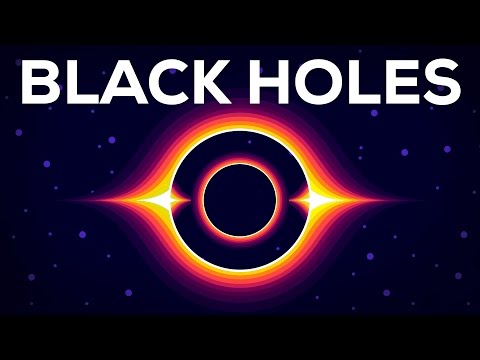 Photo: N43 and Hermes
A guide to the dark objects that bend spacetime, trap light, and may slowly evaporate through quantum effects.
01What a black hole is
A black hole is a region of spacetime where gravity is so strong that nothing, not even light, can escape once it crosses the boundary. It is not an empty hole punched through space: it is an extreme concentration of mass whose geometry controls everything nearby.
The visible boundary is the event horizon. Its size is set by the Schwarzschild radius for a non-spinning, uncharged object. Cross that radius and every future path leads deeper inward, although a distant observer sees signals become increasingly red and delayed.
02Born in stellar collapse
When a massive star exhausts the fuel supporting its core, gravity can win in a spectacular collapse. If the remnant is heavy enough, no known pressure can halt it. The core contracts beyond its event horizon, leaving a stellar-mass black hole surrounded by debris, magnetic fields, and sometimes a brilliant accretion disk.
Other black holes grow by absorbing stars and gas or by merging with companions. The intermediate-mass class remains harder to confirm, while supermassive black holes anchor most large galaxies and can reach millions or billions of solar masses.
03Reading the horizon
The horizon is a one-way causal surface, not a physical shell. An astronaut falling through a very large horizon could cross without noticing a local boundary, while tidal forces closer to a smaller black hole could stretch matter dramatically. The difference is scale: curvature at the horizon can be gentle for a supermassive object.
The no-hair theorem summarizes the idealized exterior with three quantities: mass, charge, and spin. Details of the matter that formed the object are hidden from the outside, leaving a famously simple description for an extraordinarily complex history.
04How we detect the invisible
Black holes reveal themselves through influence. Orbiting stars trace unseen mass, infalling gas shines in X-rays, and jets can carry energy far beyond a galaxy. In 2015, LIGO detected gravitational waves from merging black holes, turning ripples in spacetime into a new observing instrument.
In 2019, the Event Horizon Telescope produced the first image of a black hole shadow. The orange ring was not the horizon itself; it was polarized radio light from superheated plasma, bent around the dark central region.
05The quantum leak
In 1974, Stephen Hawking predicted that quantum fields near an event horizon should produce thermal radiation. This Hawking radiation carries energy away, so a black hole can slowly lose mass. For an astrophysical black hole the temperature is extraordinarily low, far below the cosmic microwave background today.
Over unimaginable timescales, an isolated black hole could evaporate. The endpoint remains a deep problem because general relativity and quantum theory must both describe it, and the information carried by the radiation is still debated.
06Gravity, time, and the edge
Near a horizon, clocks measured from far away appear to run slowly and light is strongly redshifted. Locally, a freely falling observer still experiences their own proper time. These viewpoints are different descriptions of the same spacetime, not a contradiction.
07What remains unknown
We still do not know how black hole interiors behave, how the earliest supermassive examples grew so quickly, or exactly how quantum information escapes if evaporation is complete. New gravitational-wave catalogs, horizon-scale images, and better models of stellar populations are steadily narrowing the questions.
By N43 and Hermes for Sailor Bob News.


