Deep Learning Explained: The Neural Networks Behind Modern AI
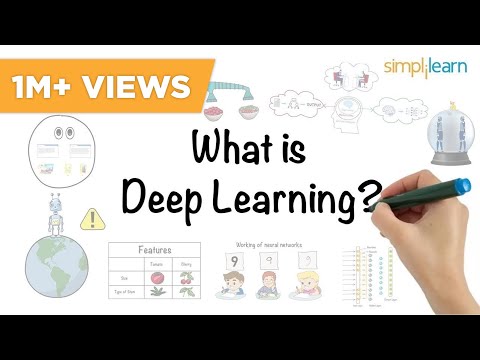 Photo: N43 and Hermes
Deep learning uses layered neural networks to discover patterns in data, powering everything from speech recognition to autonomous driving, but its inner workings remain opaque even to its practitioners.
Source video: Deep Learning | What is Deep Learning? . Simplilearn . approximately 1.6M views observed via yt-dlp on 2026-08-12. Independently researched by N43 and Hermes.
01What deep learning actually is
Deep learning is a way to fit layered mathematical functions to examples. Each layer transforms an input into a representation that is more useful for the task: pixels can become edges, edges can become shapes, and shapes can become a prediction about an object. The system does not receive a hand-written list of every visual rule. It adjusts its internal parameters until the output becomes reliably useful on the training examples.
The word “deep” refers primarily to the number of transformations, not to a machine having human-like depth of thought. A model may classify a sound, predict the next word, estimate a route, or generate an image without possessing a general theory of the world. Its apparent fluency comes from learned statistical structure, shaped by data, architecture, objectives, and the conditions under which it is used.
This makes deep learning both powerful and easy to misunderstand. It is not a single algorithm but a family of methods that share a preference for learned representations. The same broad idea can support a small detector running on a camera or a huge language model spread across data centers.
Parameter count is illustrative and does not by itself predict quality, efficiency, or generalization.
02The architecture of a neural network
A neural network is built from units that combine inputs with learned weights, add a bias, and pass the result through a nonlinear activation. One unit is simple; many units arranged in layers can describe complicated boundaries in data. The network's output might be a probability distribution, a number, a sequence of tokens, or a set of coordinates.
The architecture determines how information can move. Fully connected layers treat every input as potentially related to every other input, while specialized designs exploit structure such as locality in an image or order in a sentence. Width supplies parallel features; depth allows those features to be recombined into increasingly abstract representations.
Training then turns an unhelpful collection of random parameters into a working mapping. The model is shown examples, produces an output, and receives a numerical assessment of error. Its architecture does not “understand” the examples in advance; it provides the scaffolding in which useful regularities can be encoded.
03Backpropagation and gradient descent
Backpropagation is the accounting system that tells a network how each parameter contributed to an error. Starting at the output, it applies the chain rule of calculus backward through the layers, calculating a gradient for every weight. A gradient is not a complete explanation of the model; it is a local direction indicating how a small change might reduce the chosen loss.
Gradient descent uses those directions to update the parameters. The learning rate controls the size of each step, while batches of examples provide noisy but useful estimates of the broader data distribution. Repeating this process millions or billions of times can produce a model whose predictions are much better than its initial guesses.
The recipe has limits. A learning rate that is too large can make training unstable; one that is too small can waste computation. Data can contain label errors, hidden duplication, or a bias toward easy cases. Regularization, validation sets, careful objectives, and monitoring are not decorative safeguards: they determine whether the network learns a reusable pattern or memorizes the training environment.
04Convolutional networks for vision
Convolutional neural networks made visual learning practical by taking advantage of an image's geometry. A small filter scans across neighboring pixels and detects a local pattern wherever it appears. Later layers combine those detections, so a model can move from lines and corners toward textures, parts, and whole objects without storing an unrelated detector for every position.
Pooling and striding reduce spatial detail while increasing the effective field of view. That can make recognition more efficient, but it also discards information that may matter for precise localization. Modern vision systems often mix convolutions with attention, skip connections, and multi-scale features to preserve both context and detail.
The lesson extends beyond photographs. Whenever data has repeated local structure, an architecture that respects that structure can use parameters more economically. But a visual network remains dependent on its examples. A change in lighting, camera placement, background, or object appearance can reveal that a seemingly robust feature was actually a shortcut.
Application shares are a simplified editorial view, not a census of deployed systems.
05Recurrent networks and transformers
Recurrent neural networks were designed for sequences. They process one step at a time while carrying a hidden state forward, making the previous context available to the next prediction. This design fits speech, text, and sensor streams, but long sequences can be difficult: information may fade, training can be slow, and distant relationships are hard to preserve.
Transformers changed the trade-off by using attention. Instead of forcing every token through one narrow memory channel, attention lets a position weigh other positions directly. During training, many positions can be processed in parallel, and the model can learn which relationships matter for the current task. This combination helped language, vision, audio, and multimodal systems scale together.
Attention is not a magic window into meaning. It is a flexible routing mechanism over learned representations, and its apparent focus should not automatically be treated as an explanation. Transformers can track a long dependency while still producing a wrong conclusion, especially when the data or objective rewards plausible form over grounded truth.
06Why deep learning works and where it fails
Deep learning works because real data is not arbitrary. Images contain repeated shapes, speech contains structured frequencies, and language contains patterns of syntax and usage. Large networks can represent many candidate relationships, while optimization and data selection steer them toward regularities that help predict held-out examples. Scale often improves the result when the data, objective, and evaluation target are aligned.
Scale is not a guarantee. A model can learn a shortcut that correlates with the answer in its training set but breaks in the world. It can reproduce social bias, overfit a narrow distribution, leak memorized information, or become confidently wrong when a request falls outside its competence. More parameters may make a system more capable and more difficult to audit at the same time.
Evaluation must therefore resemble deployment. Accuracy on a clean benchmark is only one measurement. Reliability under distribution shift, calibration, subgroup performance, robustness to adversarial input, energy use, latency, and the consequences of an error all belong in the engineering definition of success.
07The interpretability gap
A trained network is legible as code and opaque as a decision process. We can inspect its weights, activations, and gradients, yet those raw numbers do not form a simple list of reasons. A concept may be distributed across many units, and a single unit may participate in several unrelated behaviors depending on context.
Interpretability research is building tools for this gap: activation probes, feature visualization, circuit analysis, attribution methods, and tests that intervene on internal representations. These methods can reveal useful mechanisms, but each has a scope. A heat map that highlights pixels, for example, may show correlation with a prediction without proving that the highlighted region caused it.
The practical goal is not to make every model narrate a perfect human explanation. It is to make important behavior testable enough to govern. Developers need ways to locate dangerous capabilities, detect brittle shortcuts, trace data influence, and verify that a system follows constraints when the prompt, environment, or incentives change.
By N43 and Hermes for Sailor Bob News.