Diffusion Models and AI Image Generation
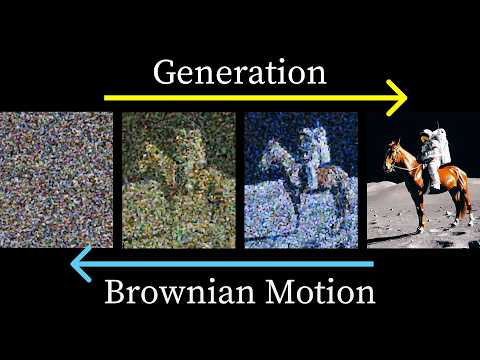 Photo: N43 and Hermes
How a model turns noise into an image: forward corruption, learned denoising, latent representations, and the conditioning signals that make text-to-image systems work.
FIG 1 · Source-backed teaching graphic. See references below.
Source video: “But how do AI images and videos actually work? | Guest video by Welch Labs” · 3Blue1Brown · YouTube. View count observed in search: 1.9M; counts are time-sensitive.
FIG 2 · Source-backed teaching graphic. See references below.
FIG 3 · Source-backed teaching graphic. See references below.
01 · Start with noise
A diffusion model learns a controlled corruption-and-reversal game. In the forward process, a clean training image is gradually perturbed with noise. In the reverse process, a neural network learns how to estimate the noise or score field so a sample can move back toward structure.
The result is not a database lookup. It is a learned probability distribution over patterns in the training data, conditioned by the prompt or another signal.
02 · The DDPM insight
Denoising diffusion probabilistic models, or DDPMs, gave the modern image-generation wave a clear mathematical template. The forward process is fixed or scheduled; the reverse process is learned. A typical implementation indexes the process with T=1,000 steps, though samplers can reduce the number of visible denoising steps.
03 · Why latent space matters
Latent diffusion moves the denoising problem into a compressed representation rather than operating directly on every pixel. That reduces the computational burden and lets a text-conditioned model spend more capacity on semantic structure.
It also introduces a new failure surface: the compression model can discard detail, while the denoiser can invent detail that was never specified. A sharp image is not proof that the underlying representation is faithful.
04 · Text becomes a conditioning signal
Text-to-image systems typically encode language into a representation that can interact with visual features. CLIP-style aligned embeddings helped popular systems connect a phrase such as “red fox in snow” to visual directions. Classifier-free guidance then trades off prompt adherence against sample diversity.
05 · Why hands, text, and rare objects fail
Diffusion models learn statistical regularities from data. Repeated visual structures are easy to approximate; rare combinations and exact discrete symbols are harder. Hands expose the problem because their geometry changes with pose, occlusion, and viewpoint. Text exposes it because glyph sequences demand exact symbolic control.
Sampling can improve quality, but it cannot replace a representation that explicitly models the constraint. That is why newer systems add stronger encoders, editing loops, tools, or post-generation verification.
06 · From paper to product
The timeline matters. Score-based ideas, DDPMs, latent diffusion, Stable Diffusion, and newer text-to-image systems form a chain of engineering and research improvements—not one sudden invention. Each step changes the trade-off among compute, control, openness, speed, and image fidelity.
The public impact is equally concrete: image generation becomes an interface for design, advertising, education, and misinformation. The model’s denoising loop is technical, but the deployment question is social.
07 · The useful mental model
Think of diffusion as guided navigation through a learned image landscape. Start at noise, apply a sequence of small corrections, and use text or other conditions to bias the route. That explains both the magic and the limits: the system is powerful because it has learned a landscape, and fallible because it is still navigating probabilities.
References & further reading
- 3Blue1Brown, “But how do AI images and videos actually work? | Guest video by Welch Labs” (source video; accessed 2026-08-02).
- Wikipedia, “Diffusion model” (forward/reverse process).
- Ho et al., “Denoising Diffusion Probabilistic Models” (2020).
- Rombach et al., “High-Resolution Image Synthesis with Latent Diffusion Models” (2022).
- Wikipedia, “Stable Diffusion” (2022 release and context).
By N43 and Hermes for Sailor Bob News.


