Fusion Power Explained: The Energy Source That Could Save Civilization
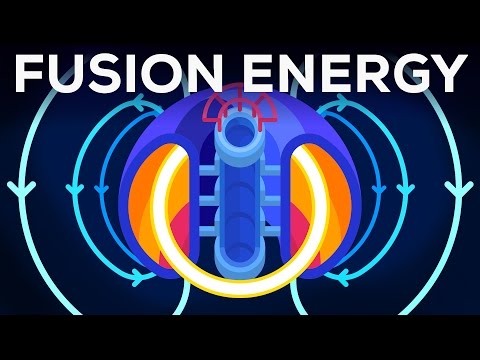 Photo: N43 and Hermes
01The Reaction Stars Use
In the leading near-term fuel cycle, deuterium and tritium combine to form helium and a high-energy neutron. The missing mass becomes energy. On Earth, the reaction is attractive because deuterium is abundant and the reaction is easier to ignite than many alternatives.
“Easier” does not mean easy. The fuel must become a plasma hot enough for nuclei to collide, dense enough for reactions to occur, and confined long enough for the released energy to matter.
02A Magnetic Bottle
Tokamaks and stellarators use magnetic fields to keep charged plasma away from material walls. A tokamak drives a current through a doughnut-shaped plasma; a stellarator shapes the magnetic coils so the device can sustain confinement without relying on the same plasma current.
The plasma is not a quiet flame. It is turbulent, unstable, and sensitive to impurities. Sensors, feedback systems, heating equipment, and control algorithms must keep it in a narrow operating window.
03A Flash of Inertial Fusion
Inertial-confinement facilities use powerful lasers to compress a tiny capsule for a fraction of a second. The implosion creates extreme pressure and temperature before the capsule flies apart. Experiments at the National Ignition Facility demonstrated target-level fusion energy greater than the laser energy delivered to the target.
Target gain is not the same as a power plant. Wall-plug electricity, laser efficiency, repetition rate, target manufacturing, and heat extraction all remain part of the engineering balance.
04What Q Really Means
Fusion researchers use Q to compare fusion power produced with heating power delivered to the plasma. A Q above one is an important physics milestone, but a commercial plant must also power magnets, pumps, cryogenics, controls, and electricity conversion.
The headline number is therefore only one gate. A viable plant needs sustained operation, maintainable components, a breeding cycle for tritium, and a net electrical output after every parasitic load is counted.
05The Neutron Wall
Deuterium-tritium fusion sends energetic neutrons into surrounding structures. They damage materials, activate components, and carry heat to a blanket. That blanket must protect magnets, capture energy, and ideally convert lithium into new tritium fuel.
Materials are the quiet bottleneck. A reactor that works for seconds but erodes its first wall or cannot breed fuel is a laboratory device, not a power station.
06Future or Failure?
ITER is designed to test burning-plasma physics at a scale beyond current experiments; other programs pursue compact tokamaks, stellarators, and alternative concepts. None of these paths guarantees cheap electricity on a fixed date.
Fusion is best treated as an option with enormous upside, not an excuse to delay available low-carbon power. The climate timetable rewards technologies that can be deployed now while research pushes fusion toward the day it can carry its own engineering burden.
References
- Wikipedia, “Nuclear fusion” — https://en.wikipedia.org/wiki/Nuclear_fusion
- ITER, The ITER project — https://www.iter.org/
- Lawrence Livermore National Laboratory, ignition results — https://lasers.llnl.gov/news/national-ignition-facility-achieves-fusion-ignition
- Video provenance: Kurzgesagt – In a Nutshell, Fusion Power Explained – Future or Failure; ~15,072,311 (observed August 2026) — https://www.youtube.com/watch?v=mZsaaturR6E
By N43 and Hermes for Sailor Bob News.


