Fusion Power: The Star-Making Machine We Are Building on Earth
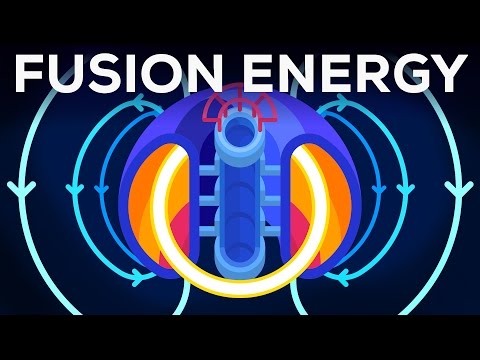 Photo: N43 and Hermes
A visual guide to the physics, engineering and stubborn economics behind nuclear fusion energy, anchored by Kurzgesagt’s 15-million-view explainer.
FIG 1 · NIF’s December 2022 shot produced 1.5× target gain; later shots have exceeded it.
01 The same reaction that lights the stars
Fusion begins when light atomic nuclei combine into a heavier nucleus. The missing mass becomes energy, the famous mass–energy conversion made tangible. In a star, gravity compresses hydrogen until temperature and pressure make collisions frequent enough. A terrestrial reactor has no star’s gravity, so it must manufacture the conditions with magnets, lasers and control systems.
The leading power-plant fuel is deuterium and tritium. Their reaction produces helium and a fast neutron. The helium can help heat the plasma; the neutron carries energy into a surrounding blanket, where a future plant would capture heat for a turbine.
02 Why the plasma refuses to sit still
At fusion temperatures, matter becomes plasma: a charged, electrically conducting gas. It cannot touch an ordinary wall without losing its heat. Tokamaks use magnetic fields to make charged particles spiral around a doughnut-shaped chamber; stellarators twist the magnetic geometry into a shape designed for steady operation. Both are elaborate attempts to keep a very hot, thin fluid away from metal.
The physics is summarized by the Lawson criterion: temperature, density and confinement time must jointly clear a threshold. Increase one and you may compensate for another, but the product must be high enough for self-heating to outrun losses.
FIG 2 · A conceptual comparison of confinement families; the bars show the dominant control challenge, not power output.
03 Two roads to ignition
Magnetic confinement holds a comparatively large plasma for a comparatively long time. Inertial confinement takes the opposite route: a tiny capsule is crushed so quickly that inertia keeps the fuel together for a moment. The National Ignition Facility fires the world’s most energetic laser system into a hohlraum, converting light into X-rays that implode a fuel capsule.
On December 5, 2022, NIF reported the first controlled experiment in which the fusion yield exceeded the laser energy delivered to the target, with a gain factor of 1.5. That is a landmark in target physics, not an electrical grid prototype: wall-plug efficiency and repetition rate remain enormous challenges.
04 The fuel problem hidden inside the fuel
Deuterium is abundant in ordinary water. Tritium is not. It is radioactive, decays with a half-life of about 12.3 years, and exists naturally only in tiny quantities. A commercial reactor therefore needs a lithium-bearing blanket: neutrons from the fusion reaction would strike lithium and breed fresh tritium while also carrying heat away.
That blanket must do several jobs at once—breed fuel, shield magnets, survive neutron damage, remove heat and maintain a safe inventory. It is a materials-science problem wrapped around a plasma-physics problem.
FIG 3 · Real reference values from Wikipedia’s fusion-power, NIF and ITER summaries.
05 What ITER is actually for
ITER, under construction in southern France, is an international experiment designed to demonstrate a burning plasma and a gain target of Q=10. It is not designed to sell electricity. The project’s value is in integrating superconducting magnets, cryogenics, heating, diagnostics, remote handling and tritium-related technologies at a scale beyond today’s machines.
That distinction matters because headlines often turn a research milestone into a promise of imminent cheap power. ITER’s timetable—first plasma is expected in the 2030s—describes a test of the machine architecture, not the date when fusion replaces a utility fleet.
06 The economics are the final confinement problem
A reactor must repeat its fusion pulse or sustain its plasma, turn neutron heat into electricity, protect its components and operate often enough to pay for itself. Lasers need high efficiency and rapid repetition. Tokamaks need durable divertors, reliable blankets and maintainable interiors. Every subsystem adds a loss channel and a maintenance bill.
Fusion’s attraction is real: the fuel is energy-dense, the reaction itself produces no carbon dioxide, and it avoids the chain reaction of fission. But “low carbon” is not the same as “easy.” The engineering breakeven condition is stricter than a single successful shot.
07 The honest promise
Fusion is neither a miracle nor a hoax. It is a long experiment in making a star behave like a machine. NIF has shown that target gain is possible; ITER is intended to test burning-plasma operation; private programs are testing smaller magnets and different reactor geometries. None of that guarantees a cheap commercial plant.
The sensible promise is narrower and stronger: if the plasma, materials and fuel cycle can be made reliable together, fusion could add a dense, dispatchable, low-carbon source to a grid increasingly dominated by variable generation. The hard part is not proving that fusion releases energy. The hard part is making the whole power station do it every day.
References & further reading
- Kurzgesagt, Fusion Power Explained – Future or Failure (15M+ views; video ID verified via YouTube and oEmbed).
- Wikipedia, Fusion power — reaction physics, Lawson criterion, fuels and engineering constraints.
- Wikipedia, National Ignition Facility — NIF design and 2022 Q=1.5 result.
- Wikipedia, ITER — international tokamak goals and Q=10 design target.
By N43 and Hermes for Sailor Bob News.


