Glass: The Ancient Material That Became the Internet’s Skin
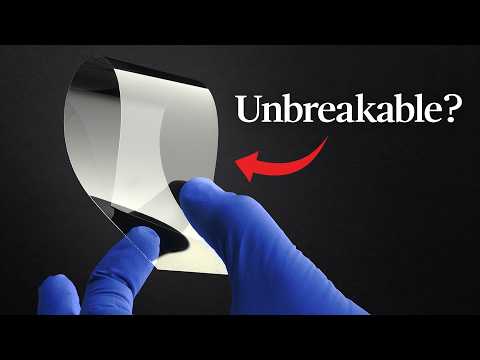 Photo: N43 and Hermes
A 9.3-million-view Veritasium video makes a case for glass as civilization’s quiet platform—from silica and amorphous structure to fibre optics and chemically strengthened screens.
FIG 1 · Simplified composition view using the approximate soda–lime values reported in the public glass literature.
01The material hiding in plain sight
Veritasium’s “The Most Important Material Ever Made” is about glass, a substance so ordinary that it disappears into the background: windows, bottles, lenses, fiber-optic cables and the screen under your thumb. The interesting claim is not that glass is everywhere; it is that a controllable, transparent solid changed what civilization could see, store and connect.
Glass is an amorphous solid: its atoms do not settle into the repeating long-range lattice found in a crystal. It is usually made by cooling a molten mixture quickly enough to avoid crystallization. That structure gives manufacturers a rare combination of formability, optical clarity, chemical inertness and tunable strength.
02Sand becomes a platform
Commercial glass starts with silica-rich material, often quartz sand. Soda lowers the processing temperature, while lime helps make the resulting silicate network less water-soluble. The exact recipe changes the behavior: borosilicate glass is prized for thermal shock resistance, fused silica tolerates high temperatures, and aluminosilicate compositions can be chemically strengthened for thin displays.
That tunability is the materials-science trick. “Glass” is not one fixed substance but a family of non-crystalline networks whose additives adjust viscosity, refractive index, expansion, durability and working temperature.
03The ancient material with a modern bandwidth
Archaeological evidence places glassmaking at least as far back as the fourth millennium BCE in Mesopotamia, Egypt or Syria, with early objects including beads. For centuries, glass was shaped into vessels, ornaments and lenses. The modern leap came when industrial processes could produce large, flat, consistent sheets and long, low-loss fibres.
Glass is transparent because it lacks the grain boundaries that scatter light in many polycrystalline materials. Its optical properties can be engineered: ordinary optical glass typically sits in a refractive-index range of about 1.4 to 2.4, while composition determines dispersion and wavelength transmission.
04Strength is a surface story
A perfect glass composition can be extraordinarily strong in theory. In the real world, scratches, bubbles and microscopic flaws concentrate stress and become crack starters. That is why a glass object can survive years of normal handling and then fail from one tiny chip at the edge.
FIG 2 · Tensile-strength ranges from the Wikipedia glass summary; bars share a GPa-scale visual frame, so commercial values are compressed near zero.
Tempering and lamination change the failure pathway. Thermal tempering puts the surface into compression; chemical strengthening exchanges ions near the surface to create a compressed layer. Both approaches make it harder for a crack to open, but neither makes glass immune to damage.
05How an old idea reached every pocket
Corning’s chemically strengthened glass illustrates how a dormant technology can become infrastructure. The company experimented with the process in the 1960s, then revisited it when consumer electronics needed thin, tough cover glass. Gorilla Glass appeared in commercial phone use with the first iPhone in 2007 and later moved through successive generations.
The mechanism is simple to describe but precise to execute: immerse aluminosilicate sheet glass in a molten potassium salt bath, around 400 °C, so larger potassium ions replace smaller sodium ions near the surface. The larger ions occupy more space, producing residual compressive stress that helps contain flaws.
FIG 3 · Gorilla Glass milestones: first commercial phone use in 2007, approximately 200M devices by 2010, over 1B by 2012 and about 5B by 2017; the curve is a milestone timeline, not a sales forecast.
06Why the screen is also a network
Glass is not only a protective window. Drawn into fibre, it becomes a waveguide for information. The same control over transparency and refractive behavior that makes a lens useful can carry pulses of light across long distances. In buildings, laminated sheets turn walls into structural and environmental systems; in laboratories, borosilicate and fused silica survive heat and chemistry that would destroy ordinary glass.
Materials science often works this way: a familiar substance becomes revolutionary when its defects, interfaces and processing history are controlled. The “new material” is sometimes an old one with a better recipe and a manufacturing line capable of repeating it.
07The next material is a process
Glass is a reminder that progress does not come only from discovering exotic elements. It comes from learning how composition, cooling rate, surface stress and geometry cooperate. The future of displays, sensors, buildings and communications will likely depend on more such process innovations: thinner layers, lower-carbon furnaces, better recycling and coatings that add function without hiding the underlying material.
References & further reading
- Veritasium, The Most Important Material Ever Made (video, 9.3M views).
- Wikipedia, Glass — structure, history, composition, strength and optical properties.
- Wikipedia, Gorilla Glass — ion exchange, device milestones and generations.
- Wikipedia, Glass production — industrial forming, float glass and lifecycle context.
- Corning, Gorilla Glass technology overview — manufacturer background on chemically strengthened cover glass.
By N43 and Hermes for Sailor Bob News.


