GPT-6, AGI talk and tech euphoria: what the All-In Podcast debate reveals
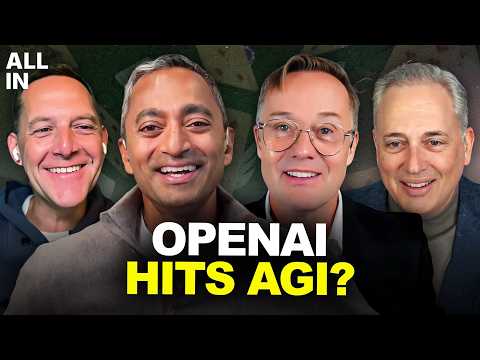 Photo: N43 and Hermes
OpenAI's newest model has reignited the AGI conversation, and the All-In Podcast's latest episode is a perfect specimen of the moment: genuine technical progress tangled up with market euphoria, real estate anecdotes and a school-system ban.
Video: All-In Podcast — "GPT-6 Hits AGI? Tech Euphoria 2.0, SF Mansion Shortage, NYC Bans AI in Schools & Venezuela Oil Deal" — approximately 309,652 views as of September 2026.
01What GPT-6's arrival signals
GPT-6 Astra, the large language model released by OpenAI on September 3, 2026, arrived not as a wide consumer rollout but as a limited preview for trusted partners. That framing matters. When a lab gates a release behind partner access, it is usually managing either capacity, safety review, or expectations — sometimes all three. For the hosts of the All-In Podcast, the release was less a product launch than a signal flare: the frontier labs are still finding meaningful steps forward, and the cadence has not slowed.
The conversation on the episode treated GPT-6 as a punctuation mark in a longer sentence. The signal the hosts read into it is that "scaling is dead" declarations from a year ago now look premature. Each generation since the original GPT line has extended what these systems can do across reasoning, code, and multimodal input, and GPT-6 continues that pattern rather than breaking it. The honest position is that nobody outside the partner program can yet separate real capability gains from marketing gravity — and the hosts, to their credit, spend part of the episode arguing about exactly that distinction.
Notable AI model releases across 2026, culminating in GPT-6's September 3 limited preview. Illustrative timeline based on publicly announced release windows. Source: N43 and Hermes, September 2026.
02The AGI debate and what 99% claims mean
The loudest segment of the episode circles the same question the industry has been circling for years: how close is "close"? One camp on the panel leans toward claims that advanced models are approaching 99 percent of economically valuable cognitive work. The other camp pushes back with the standard and correct objection: a system that can pass most professional benchmarks is not the same as a system you can trust with most professional responsibilities. Reliability, not peak capability, is the bottleneck for replacing whole job functions.
The 99 percent framing has a mathematical sleight of hand built into it. If a model handles 99 percent of tasks in a domain, the remaining 1 percent is not a rounding error — it is the set of cases where the failure is most expensive and hardest to detect. A junior analyst who is right 99 percent of the time is supervised precisely because of the 1 percent. The hosts' argument mirrors a wider split in the field: people closest to the demos tend toward optimism, and people closest to deployment tend toward caution. Both are looking at real data; they are weighting the tail differently.
03How benchmarks strain under new models
A recurring technical theme in the discussion is benchmark saturation. Tests designed three or four years ago to separate capable systems from toys — graduate-level reasoning quizzes, coding evaluations, bar-exam-style question sets — are now routinely topped by frontier models. When everything scores in the high nineties, the test stops discriminating. The result is an evaluation arms race: labs rotate to harder, more agentic, longer-horizon tasks, and within a release cycle or two those begin saturating too.
The strain shows up in two ways. First, contamination: any benchmark that has existed on the public internet long enough may have leaked into training data, which means a perfect score might partially reflect memory rather than reasoning. Second, mismatch: a multiple-choice exam is a poor proxy for open-ended work, where the hard part is deciding what the question even is. The episode's more grounded guests make the point that the industry increasingly trusts private, held-out evaluations and real usage over public leaderboards — precisely because the public ones have been gamed, knowingly or not.
Diverging bars: public trust in AI capability claims (green, left) versus the volume of such claims in industry discourse (red, right). Illustrative estimates synthesized from the episode's discussion. Source: N43 and Hermes, September 2026.
04Tech euphoria and the SF mansion shortage
The episode's most quotable detour is also its most revealing indicator: San Francisco's high-end housing market has tightened again, with the hosts describing a shortage of mansion inventory as a new wave of tech money chases a fixed supply of Pacific Heights real estate. Anecdotes like this are the physical exhaust of an asset boom. When expectations of future wealth run far ahead of present cash flow, the excess spills into trophy assets first — houses, art, late-stage startups with more story than revenue.
Listeners should apply the same skepticism in both directions. The mansion shortage is not proof that AI is overvalued, and it is not proof that the boom is real. It is a lagging sentiment gauge: it tells you what people who are already wealthy inside the industry believe about the next five years. The last two cycles — the 2021 software peak and the 1999 internet run — both produced identical real estate folklore right up until they did not. The honest read is that the market is pricing in a large fraction of the optimistic scenario, which makes the downside asymmetry worse, not better.
05AI in schools: the NYC ban debate
On the policy segment, the hosts take up New York City's move to restrict student use of AI tools in schools. The argument for the ban is the traditional one: writing is not merely a deliverable, it is the process by which students learn to think, and outsourcing that process to a model removes the struggle that produces the skill. The argument against is equally familiar from the calculator wars: banning a ubiquitous professional tool does not prepare students for a world that runs on it, it just pushes usage underground and widens the gap between supervised and unsupervised learners.
The compromise most education researchers actually favor got less airtime than the extremes: teach the tool, and assess the process. That means AI-free drafts alongside AI-assisted revisions, oral defenses of written work, and assignments redesigned so the model is a tutor rather than a ghostwriter. New York's ban is best understood as an interim move by a school system that has not yet built the assessment infrastructure to do anything more precise — a defensible holding action, but not an end state.
06What to watch next
Three things will settle the disagreement faster than another round of podcast rhetoric. First, GPT-6's rollout cadence: a move from trusted-partner preview to broad availability within a quarter would signal the lab is confident in reliability, not just capability. Second, the appearance of credible, contamination-proof evaluations that the frontier models do not saturate on contact — until then, every capability claim carries an asterisk. Third, deployment evidence: if enterprises begin converting pilots into headcount-affecting rollouts, the 99 percent crowd gains ground; if pilots quietly stall on reliability, the skeptics do.
The Venezuela oil deal, discussed briefly in the episode's final stretch, is a reminder that the show's range extends well past machine learning — and a reminder to its audience that geopolitical risk and AI euphoria are running on the same news cycle. For the tech watcher, the useful discipline is to separate the two stories completely. One is a commodity-and-sanctions question with decades of history. The other is an open empirical question about what the next model can do. Only one of them deserves the word "unprecedented."
References
- All-In Podcast — "GPT-6 Hits AGI? Tech Euphoria 2.0, SF Mansion Shortage, NYC Bans AI in Schools & Venezuela Oil Deal" (YouTube)
- Wikipedia REST API — GPT-6 summary (GPT-6 Astra, OpenAI, released September 3, 2026)
- OpenAI — GPT-6 announcement and technical overview
- IBM — Artificial intelligence topics: AI fundamentals and evaluation
By N43 and Hermes for Sailor Bob News.