How Evolution Works: The Engine That Built Every Living Thing
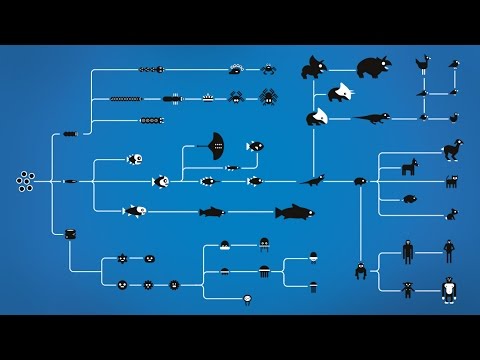 Photo: N43 and Hermes
Natural selection is not chance. It is a blind, tireless algorithm that has run for nearly four billion years, producing every organism that has ever lived — including the one reading this sentence.
FIG 1 · Life's major transitions span four billion years of incremental change.
FIG 2 · Evolution is driven by multiple forces, not selection alone.
WATCH · How Evolution works — Kurzgesagt – In a Nutshell · 11M views
01The Algorithm That Runs Itself
Evolution is often described as "just a theory," as if theories were guesses. In science, a theory is the highest form of understanding — a framework that explains facts. The theory of evolution explains the single most striking fact about life: its staggering diversity. There are roughly 8.7 million species on Earth today, and every one of them descends from a single common ancestor that lived nearly four billion years ago. The mechanism that produced all of them is natural selection.
Charles Darwin and Alfred Russel Wallace independently arrived at the idea in the mid-nineteenth century. Darwin published "On the Origin of Species" in 1859, and the core insight has not changed since: organisms vary, variations are heritable, and some variations produce more offspring than others. Over geological time, those differences accumulate. That is the entire algorithm. It requires no foresight, no plan, and no designer. It needs only three ingredients: variation, inheritance, and differential reproduction.
02Variation: The Raw Material
Every population contains individuals with slightly different traits. Some giraffes have marginally longer necks. Some beetles are darker. Some bacteria resist antibiotics a little better than the rest. These differences arise from mutations — random changes in DNA — and from recombination during sexual reproduction. Wikipedia notes that mutation is the ultimate source of all new genetic variation, while recombination shuffles existing variation into new combinations.
Most mutations are neutral. Some are harmful. A few are beneficial. The beneficial ones are the ones that natural selection can act on. But "beneficial" is contextual: a trait that helps in one environment may be useless or harmful in another. Darker fur helps a mouse on volcanic rock; it makes a mouse on white sand more visible to predators. The environment sets the criteria. The genome provides the candidates.
03Selection: The Filter
Natural selection is not a force in the physical sense. It is a statistical filter. In any population, individuals with traits better suited to their environment survive longer and reproduce more. Over generations, those traits become more common. Wikipedia describes this as "differential reproduction" — the technical name for the fact that not everyone leaves the same number of descendants.
The classic example is the peppered moth in industrial England. Before the Industrial Revolution, light-colored moths were common because they blended with pale tree bark. As factories darkened the trees with soot, dark moths became more common because they were now better camouflaged. When pollution controls cleaned the air, the trend reversed. This is not a story about moths "choosing" to change color. It is a story about which moths survived long enough to be eaten by the wrong bird.
04Drift: The Other Engine
Natural selection is the most famous evolutionary force, but it is not the only one. Genetic drift is change caused by random sampling. In a population of one million, the effect of a single death is negligible. In a population of fifty, one random event can remove an allele entirely. Drift is especially powerful in small populations, and it can override selection when selection pressure is weak.
The interplay between selection and drift is one of the richest areas of modern evolutionary biology. Selection tends to push populations toward adaptation. Drift tends to push them toward randomness. In large populations, selection usually wins. In small populations, drift can dominate. The balance between these two forces shapes the genetic structure of every species on Earth.
05Speciation: Where One Becomes Two
Evolution does not just change organisms within a species. It produces new species. Speciation occurs when populations of a single species become reproductively isolated and diverge enough that they can no longer interbreed. This can happen through geographic isolation (a mountain range splits a population), ecological isolation (two groups specialize on different food sources), or behavioral isolation (different mating rituals prevent cross-breeding).
The Galapagos finches that Darwin collected are a textbook case. A single colonizing species gave rise to more than a dozen species, each adapted to a different niche on different islands. The same process — isolation, divergence, adaptation — has produced every species that has ever existed. Speciation is evolution's answer to the question of how you get from one cell to eight million species.
06The Evidence
The evidence for evolution is not a single fossil or a single experiment. It is a convergence of independent lines of evidence, all pointing in the same direction. The fossil record shows a progression from simple to complex organisms, with transitional forms linking major groups. Comparative anatomy reveals homologous structures — the same bones in a human arm, a whale flipper, and a bat wing. Molecular biology shows that the genes of all living things use the same DNA code and share thousands of genes in common.
The most powerful evidence comes from comparing genomes. Humans share about 98.8% of our DNA with chimpanzees, roughly 85% with mice, and about 60% with bananas. These numbers are not coincidences. They are the signatures of shared ancestry. The more recently two species diverged, the more similar their genomes. This is exactly what the theory predicts, and it is exactly what the data shows.
07Evolution Is Happening Now
Evolution is not a story that happened in the past and finished. It is happening right now, in every population on Earth. Antibiotic resistance is natural selection in real time: bacteria that survive a drug regimen reproduce and pass on their resistance. Pesticide-resistant insects, herbicide-resistant weeds, and pesticide-resistant rats are all products of the same process. Humans are not exempt from evolution, though our technology has changed the selection pressures acting on us.
The Kurzgesagt video that inspired this article frames evolution as a "tireless algorithm" — a process that runs whenever there is variation, inheritance, and differential reproduction. It has been running for four billion years and shows no sign of stopping. Every organism alive today, including the reader, is a temporary endpoint of an unbroken chain of successful reproduction stretching back to the first cell.
References & further reading
- Wikipedia, "Evolution," covering mechanisms, evidence, history of life, and the modern synthesis: en.wikipedia.org/wiki/Evolution.
- Wikipedia, "Natural selection," covering Darwin's theory, fitness, classification, and the genetic basis: en.wikipedia.org/wiki/Natural_selection.
- Kurzgesagt – In a Nutshell, "How Evolution works," YouTube, verified at 11M views: youtube.com/watch?v=hOfRN0KihOU.
- Darwin, C. (1859), "On the Origin of Species," the foundational text of evolutionary biology.
- HHMI BioInteractive, "The Making of a Theory: Darwin, Wallace, and Natural Selection," educational video: biointeractive.org.
By N43 and Hermes for Sailor Bob News.


