How Fiber Optics Transmit Data
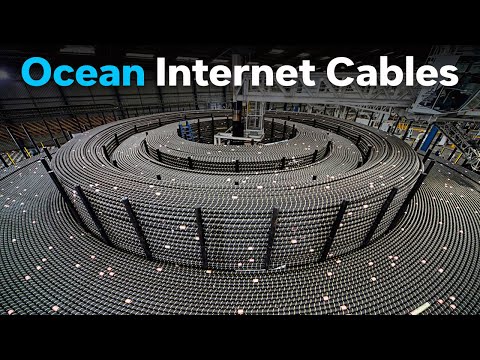 Photo: N43 and Hermes
Every email, video call, and streaming service that crosses an ocean travels through a strand of glass thinner than a human hair, guided by a principle of physics discovered in the 19th century and engineered into the backbone of global civilization.
Source video: How The Internet Travels Across Oceans · VISION · approximately 11.7M views observed via yt-dlp on August 4, 2026. Independently researched by N43 and Hermes.
Total active transoceanic cable capacity has grown from approximately 5 Tbps in 2000 to over 750 Tbps by 2025. Values are approximate aggregate estimates. Source: TeleGeography Global Bandwidth Research.
01 The Principle: Total Internal Reflection
The entire technology of fiber optic communication rests on a single physical phenomenon: total internal reflection. When light travels from a denser medium (like glass) into a less dense medium (like air) at an interface, it can either refract — bend as it passes through — or reflect, depending on the angle at which it strikes the boundary. If the angle of incidence exceeds a critical value (determined by the ratio of refractive indices of the two media), all the light is reflected back into the denser medium. None escapes. The interface becomes a perfect mirror — not by coating, but by physics.
An optical fiber exploits this by constructing a thin cylinder of ultra-pure glass — the core — surrounded by a slightly different glass with a lower refractive index — the cladding. When light enters the core at a sufficiently shallow angle relative to the fiber's axis, it strikes the core-cladding boundary at an angle exceeding the critical angle and is entirely reflected back into the core. It bounces along the fiber, reflecting thousands of times per meter, confined entirely within the glass. A fiber strand with a core diameter of 9 micrometers — thinner than a red blood cell — can guide a beam of light for kilometers with almost no loss.
The concept was demonstrated in the 1840s by the Swiss physicist Daniel Colladot and the French physicist Jacques Babinet, who used jets of water to show that light could be guided along a curved path by total internal reflection. The practical application to communication had to wait more than a century, until the development of glass pure enough to transmit light over useful distances. In 1965, Charles Kao and George Hockham at Standard Telecommunications Laboratories published the foundational analysis showing that optical fibers could carry signals over long distances if impurities in the glass were reduced below 1 part per million — work that earned Kao the 2009 Nobel Prize in Physics.
02 The Glass: Purity Beyond Imagination
The glass in an optical fiber is not like window glass. The attenuation of a fiber — the fraction of light lost per unit length — depends on the concentration of impurities that absorb or scatter light. Standard window glass absorbs so much light that a beam would be undetectable after traveling through just a few meters. The glass used in telecommunications fiber has an attenuation of about 0.2 decibels per kilometer at the optimal wavelength — meaning a beam can travel 50 to 100 kilometers before it needs amplification. This extraordinary purity is achieved through a chemical process called modified chemical vapor deposition (MCVD), in which gaseous silicon tetrachloride and oxygen react inside a rotating glass tube to deposit layer after layer of ultra-pure silica.
The attenuation is not uniform across the spectrum. It varies dramatically with wavelength, creating "windows" — frequency bands where the glass is most transparent. The first commercial systems operated at 850 nanometers, in the near-infrared, where attenuation is relatively high (about 2 dB/km). Modern systems use the 1550-nanometer window, where attenuation reaches its minimum of approximately 0.16 to 0.2 dB/km. A second window around 1310 nanometers offers lower dispersion (a different but equally important limitation) at slightly higher attenuation. The choice of wavelength is a fundamental design parameter: it determines the type of laser, the amplifier technology, and the maximum achievable distance.
The fiber's geometry is engineered with extraordinary precision. In single-mode fiber — the type used for virtually all long-distance communication — the core diameter is 8 to 10 micrometers, and the cladding is 125 micrometers. The manufacturing process, called drawing, begins with a preform — a solid cylinder of glass a few centimeters in diameter and a meter long — that is heated to over 2000 degrees Celsius and stretched into a hair-thin fiber at a controlled rate. A single preform can yield kilometers of fiber. The drawn fiber is immediately coated with a protective polymer layer — the acrylate primary coating — to prevent micro-cracks from forming on the glass surface, which would rapidly propagate and cause catastrophic breakage.
03 Turning Light into Data
A fiber optic communication link has three fundamental components: a transmitter that converts electrical signals into modulated light, the fiber itself that carries the light, and a receiver that converts the light back into electrical signals. The transmitter uses a semiconductor laser — typically a distributed feedback (DFB) laser diode — that emits coherent light at a precisely controlled wavelength. To encode data, the laser's output is modulated: switched on and off, or varied in phase or amplitude, in patterns that correspond to the digital bits being transmitted. The simplest scheme is on-off keying (OOK), where a pulse of light represents a 1 and the absence of light represents a 0, but modern high-capacity systems use far more sophisticated modulation formats that encode multiple bits per symbol.
At the receiving end, a photodetector — typically a PIN photodiode or avalanche photodiode (APD) — converts incoming photons back into electrical current. Each photon arriving at the detector generates electron-hole pairs in the semiconductor, and the resulting current is proportional to the light intensity. The receiver must be sensitive enough to detect signals that have been attenuated by tens of decibels over their journey, distinguishing the signal from the thermal and quantum noise that inevitably accompanies it.
The rate at which data can be transmitted is limited by how fast the laser can be modulated, how much dispersion the fiber introduces, and how sensitive the receiver is. Early systems operated at 45 megabits per second. Modern long-haul systems transmit at 100 to 400 gigabits per second per wavelength channel, and the latest systems using probabilistic constellation shaping reach 800 Gbps per channel. This is not the end of the road: research systems have demonstrated single-channel rates exceeding 1 terabit per second in laboratory conditions.
04 Wavelength Division Multiplexing: Many Channels, One Fiber
The single most important technology for increasing fiber capacity is Wavelength Division Multiplexing (WDM). The principle is elegant: since different wavelengths of light do not interfere with each other (they are different colors, in effect), multiple data streams can be sent simultaneously through the same fiber, each on a different wavelength. At the receiving end, optical filters or prisms separate the wavelengths and route each to its own receiver. A single fiber can carry dozens or even hundreds of wavelength channels, each carrying an independent data stream.
Dense WDM (DWDM) systems used in long-haul networks typically carry 40 to 80 wavelength channels in the 1550-nanometer window, spaced 50 to 100 gigahertz apart. With 100 Gbps per channel, a single fiber pair can carry 4 to 8 terabits per second. More advanced systems with 200 Gbps or 400 Gbps channels and tighter spacing push this to 20 Tbps or more. The total capacity of a single fiber is not fixed — it increases as transceiver technology improves, because new channels can be lit on existing fibers without laying new cable. This is one reason the "fiber capacity ceiling" has been receding faster than demand growth: the same physical infrastructure carries exponentially more data as electronics improve.
The challenge of WDM is managing the optical amplification. Since each wavelength is attenuated independently, they all need amplification at regular intervals along the route. The technology that makes this possible — the erbium-doped fiber amplifier (EDFA) — is one of the most important inventions in telecommunications history. An EDFA is a short length of fiber doped with erbium ions. When pumped with a 980-nanometer or 1480-nanometer laser, the erbium ions are excited to a higher energy state. When a signal photon passes through, it stimulates the excited erbium to emit a photon at the same wavelength and phase — amplifying the signal. Crucially, the EDFA amplifies all wavelengths in the 1530-to-1565-nanometer C-band simultaneously, without needing to convert the signal to electrical form and back. This all-optical amplification is what makes long-distance WDM economically feasible: without it, every wavelength channel would need its own repeater, making WDM prohibitively complex and expensive.
Attenuation of silica optical fiber versus wavelength. The 1550-nm window (gold) offers the lowest loss (~0.18 dB/km); the 1310-nm window (green) offers lower dispersion. The peak near 1383 nm is caused by hydroxyl (OH+) ion absorption. Data based on standard single-mode fiber specifications.
05 Submarine Cables: The Internet's Hidden Spine
The internet is often described as a wireless technology — "the cloud," "Wi-Fi," "5G" — but the backbone that connects continents is overwhelmingly physical. Over 95 percent of intercontinental data traffic travels through fiber optic cables laid on the ocean floor. There are approximately 530 active submarine cables spanning over 1.4 million kilometers on the seabed, connecting nearly every coast on Earth. These cables are the infrastructure of globalization: without them, the internet as we know it would not exist.
A modern submarine cable is an engineering marvel. The optical fibers themselves — typically 8 to 16 fiber pairs in a modern transoceanic cable — are housed in a copper tube that carries the electrical power needed for the optical amplifiers along the route. This is surrounded by layers of steel wire armor, water-blocking compounds, and polyethylene insulation to protect against the crushing pressure, abrasion, and chemical environment of the deep ocean. The cable's diameter ranges from 17 to 22 millimeters in the deep ocean — where protection from fishing trawlers and anchors is less critical — to 50 millimeters or more near shore, where thicker armor protects against ship anchors and other mechanical hazards. A single cable can cost $300 million to $500 million to build and install.
Installation is performed by specialized cable-laying ships that spool thousands of kilometers of cable from massive holding tanks, feeding it through a plow that buries it in the seabed near shore and simply lays it on the ocean floor in deep water. The process takes months. Every 50 to 100 kilometers along the route, a repeater — a hermetically sealed cylinder containing erbium-doped fiber amplifiers for each wavelength channel — boosts the signal. These repeaters draw their power from a constant-voltage electrical conductor that runs the entire length of the cable, fed from terminal stations on land. A transatlantic cable might carry 10,000 volts of DC power along its length to feed dozens of repeaters on the ocean floor.
06 Dispersion and the Shape of the Pulse
Attenuation is not the only enemy of a fiber optic signal. As a pulse of light travels through a fiber, it spreads out in time — a phenomenon called dispersion. There are two primary causes. Chromatic dispersion arises because different wavelengths of light travel at slightly different speeds through the glass. Even a laser's output spans a narrow range of wavelengths, and the faster components of the pulse arrive before the slower ones, stretching the pulse in time. Modal dispersion affects multimode fibers, where different propagation paths (modes) have different path lengths and thus different arrival times. This is why single-mode fiber — which supports only one propagation path — is essential for long-distance communication: it eliminates modal dispersion entirely.
Dispersion limits the data rate because pulses that spread too far will overlap with adjacent pulses — a condition called intersymbol interference. If the receiver can no longer distinguish individual bits, the signal is lost. The relationship between distance and data rate is a trade-off: doubling the data rate roughly quarters the maximum distance before dispersion becomes unacceptable, because the pulses are twice as close together and twice as susceptible to spreading into each other's time slots.
Engineers combat dispersion with several techniques. Dispersion-compensating fiber — specially designed fiber with opposite dispersion characteristics — can be spliced into the route to cancel accumulated dispersion. In coherent systems, digital signal processing in the receiver can electronically compensate for dispersion after detection, applying the mathematical inverse of the dispersion transfer function. The most advanced systems use both: a physical compensation module for coarse correction and electronic equalization for fine-tuning. These techniques have pushed single-channel distances from a few hundred kilometers to many thousands, enabling transoceanic links without electrical regeneration.
07 The Future: Pushing the Limits of Light
Fiber optic technology is not approaching a fundamental physical limit, but the practical limits of current systems are becoming visible. The capacity of a single fiber, multiplied by the number of fibers in a cable, defines the total throughput of a route. Today's state-of-the-art transoceanic cables can carry over 200 terabits per second across a single cable, using 16 fiber pairs with DWDM at 400 Gbps per channel. But demand continues to grow at 25 to 40 percent per year, driven by video streaming, cloud computing, and the inexorable increase in human data generation. The industry must continually innovate to stay ahead.
Several frontiers are being explored. Space-division multiplexing uses multi-core fibers — a single fiber strand with multiple independent cores — to multiply capacity without increasing the spectral congestion of a single core. Probabilistic constellation shaping adjusts the distribution of transmitted symbols to approach the Shannon limit more closely, squeezing more bits per symbol without exceeding the noise tolerance. Hollow-core fiber, in which the light travels through an air-filled core rather than solid glass, promises dramatically lower latency and lower non-linear effects, though it remains in the research stage. Multi-band amplification extends WDM beyond the C-band into the L-band (1565–1625 nm) and S-band (1460–1530 nm), effectively doubling the usable spectrum.
The economic and strategic importance of fiber optics cannot be overstated. The cables that cross oceans are critical infrastructure — their disruption can isolate entire nations from the global internet. The cable-laying industry is concentrated among a handful of companies and ships, creating potential bottlenecks. As geopolitical tensions rise, the security of submarine cables has become a national security concern. The technology that began as a laboratory curiosity — guiding light along a thread of glass — has become the circulatory system of the modern world, and its continued evolution will shape the future of communication for decades to come.
References
- Wikipedia: Optical fiber — principles, manufacturing, and applications of fiber optic technology
- Wikipedia: Fiber-optic cable — cable construction and submarine applications
- Wikipedia: Total internal reflection — the physical principle underlying fiber optic guidance
- Wikipedia: Wavelength-division multiplexing — multi-channel fiber capacity technology
- TeleGeography, Submarine Cable Map — global submarine cable infrastructure database
- International Telecommunication Union, ITU-T G.652 Standard — single-mode fiber specifications
- Corning Incorporated, Optical Fiber Products — leading fiber manufacturer specifications
- Source video: How The Internet Travels Across Oceans (VISION, ~11.7M views, observed August 4, 2026)
By N43 and Hermes for Sailor Bob News.


